
Few figures are more deeply woven into the American imagination than the cowboy. The rugged embodiment of independence, freedom and self-reliance – a national icon immortalised by films like The Searchers and The Good, the Bad and the Ugly.
But for generations, that image been overwhelmingly white.
Growing up in Kansas City, photographer Ivan McClellan knew a man down the street, Mr Wills, who raised cattle. But he was Black, wore a ball cap and overalls and looked nothing like John Wayne or Val Kilmer in Tombstone. So he never thought to call him a cowboy. The image on screen and the life around him simply didn’t connect.
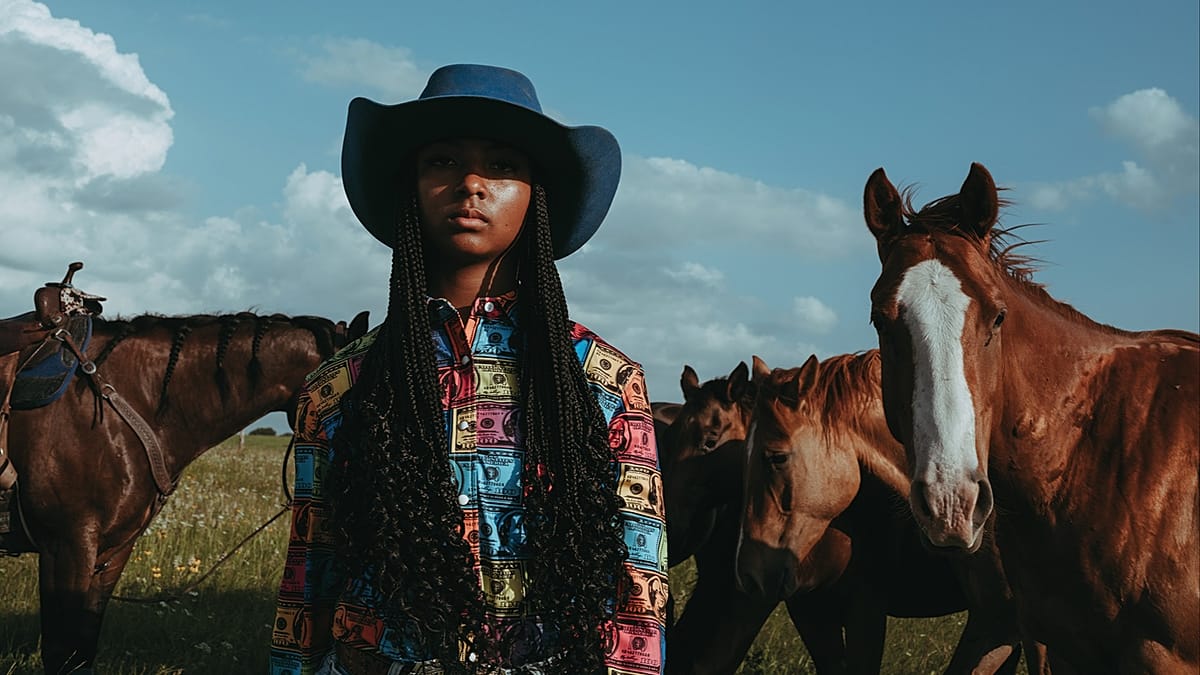
But in 2015 McClellan travelled four hours to a rodeo in Oklahoma and saw thousands of Black cowboys and cowgirls who looked far more like the people he had grown up around than anything Hollywood had shown him: men in gold chains and Jordans, women with long braids and acrylic nails riding horses at 50mph, with gospel, R&B and hip-hop filling the air.
That moment became the beginning of a decade-long obsession. McClellan began travelling across the US, photographing Black cowboy and cowgirl culture at rodeos, ranches, homes and events. His 2024 project, Eight Seconds, named after the time a bull rider must stay mounted to achieve a qualified ride, eventually became a much-loved book.
McClellan has since organised his own rodeo under his Eight Second project, putting significant prize money into the hands of Black competitors, while continuing to photograph and document a culture he believes has been overlooked.
Now he is releasing a new edition of his book titled Eight Seconds: Legacy in Motion, featuring 91 additional images, which he describes as more “precious” and “urgent”.
Euronews Culture sat down with McClellan to discuss his latest book, his journey into Black cowboy culture, and why he has gone from photographing the rodeo to building one of his own.
So, the first edition came out in 2024, and this new edition of Eight Seconds has 91 new images. What made you want to revisit the book so soon?
It felt like a nice bow on nearly a decade of work, hanging on fences and chasing down cowboys and dodging bulls, and just really getting fully observed, absorbed and immersed in a culture that I just got obsessed with and completely loved.
That book came out, and my assumption was that the project was over, that I was going to go on and shoot something else. But it kept going, and it intensified, really. I started doing my own rodeo and photographing there, and spending time at more rodeos at a velocity like I had never done in any other previous years.
So two years later, I looked up and I had accumulated thousands of photos at people’s ranches and homes and at events – mine and other events. And the portraiture had gotten a lot more intimate and a lot closer to the subject. And I felt like this work deserves a place in the world as well.
So I started to compile it into a book, and it felt similar. It felt like an extension or a sequel to the first book, but very different, and a lot more precious and a lot more urgent than the first one.
Growing up in Kansas City were you surprised by what you discovered about cowboy culture?
I grew up in Kansas. We would pick blackberries, we would climb trees, we would chase down fireflies, and all of the things that you would imagine. There were tornadoes, you know. There were a lot of things in Kansas that felt very country, but it didn’t seem like anything familiar, like the films that I had seen on TV about cowboys. It didn’t relate to that or connect to that in any way, mostly because everyone around me was Black.
You know, there was a man down the street, Mr. Wills, who raised cattle, but he was a Black man. So I never assumed that he was a cowboy because he didn’t look a thing like John Wayne. He didn’t look a thing like Val Kilmer in Tombstone. He was just out there in a ball cap and overalls, pushing cattle. And Junebug next door raised dogs and chickens, and was in a street gang. And he didn’t seem like a cowboy either.
So it wasn’t until 2015 that I went to a rodeo four hours away from the home that I grew up in, and I saw thousands of Black cowboys that looked a lot more like the people that I grew up with and the people in film that I realised that image in the film is the thing that’s inaccurate. It’s not the environment that I’m in. It’s not the culture that I’m in. It’s the movie that is, you know, an exaggeration or a falsehood of this culture.
I saw Black folks in cowboy hats and no shirt and gold chains, riding horses and basketball shorts. I saw women with long braids and acrylic nails riding horses 50 miles an hour. It felt very familiar. It felt a lot like home. And it had a hint of that movie, but not enough for me to feel so comfortable with the representations that I had seen in movies and TV.
What do you find so captivating and compelling about Black cowboy and cowgirl culture?
The cowboy thing in America is more than just entertainment. It’s more than storytelling. It’s myth-building. It’s essential to our identity as Americans. These things that we attribute to cowboys – resilience, grit, independence – are core to our definition of self.
But that Black people have been excluded from that icon, that Black people have been excluded from that story, keeps us from attributing those things to ourselves. It says, yes, Americans are gritty and resilient and independent, but Black people aren’t those things because they’re not included in this image.
And realising that that wasn’t true, I decided to bust up that myth and to put out imagery and to put out film and to tell stories and do live events in arenas that made it so the next generation of Black folks in this country will have no doubt that they’re absolutely under the umbrella of all of those noble traits that we attribute to ourselves.
Women are really essential to this world. Women are in charge in cowboy culture for the most part. Like, the big rodeos, the big events that you go to, most of the presidents are women, and most of their teams are women. So if you’re going to get money as a cowboy, that check is going to have a female name on the front of it.
Now, we’re talking at a time when perhaps the United States, some might say, has never been so divided. What kind of feedback and reception did you get to the first edition?
The first edition, and this wasn’t on purpose, came out on the same day as Beyoncé’s Cowboy Carter. It came out on the exact same day, at the exact same time, as that album. And so the book just caught on fire, and people were searching for side stories to tell, or digging for the culture or the sources that she was pulling from. And the book was right underneath every single story about Beyoncé, around the world. So it was a gift of coincidence. I think it was, you know, fate in a lot of ways. It was kismet that that aligned in that way. I think it’s the only thing that I have in common with Beyoncé, but it’s the thing that I’m incredibly proud of.
People keep it on their dining room tables to this day, and people keep it on their shelves. I think a lot of Black folks and white folks viewed it as a point of pride. You know, white folks looked at it as, “This is a part of the country that I live in. This is something that I can be proud of as well.” And Black folks looked at it as a definition, as proof of an identity that they hold within themselves.
There was some negativity, but I don’t pay a ton of attention to that stuff. I would get calls on the phone from people that said, “Hey, I’m looking for tickets to that monkey rodeo.” And I would just hang up the phone and go on about my day. I just don’t dwell on that stuff. I don’t let it take over because there’s thousands and thousands and thousands more people that receive it positively and don’t take offense to someone just celebrating their own culture.
The title of the book is “Eight Seconds” refers to the time that you have to hold on to a bull or horse. Have you tried it yourself? Now that you’ve got your own rodeo…
I have not tried to ride a bull or a bucking bronco. It’s not anything that I have any interest in. I’ve been pressured to. We throw training camps now for the cowboys because it’s bull riding, not bull hanging on. Like there’s a technique to it, and there’s a way to give yourself a better chance of hanging on.
So I throw camps. I have coaches come in and teach the athletes how to do their skill better. But every single time we have one, and the cowboys say, “Ivan, it’s your turn. Put on a vest. Get on this bull.” And I say, “My name is on the front of the check, not the back. I don’t do that. I’m not performing for you all.”
So I’m old, I’m big. That time is past. It’s not anything that I’m going to be doing anytime soon.
You’ve gone beyond photographing the culture and set up your own rodeo. Why was that important to you?
You know, I saw a lot of inequality in this world. There were Black cowboys competing for a few hundred dollars that were doing the exact same events as white folks that were making tens of thousands to hundreds of thousands of dollars to ride the same bulls and do the exact same event. So I decided that the best thing I could do to close that gap was to put on my own event and to give away $60,000 in prize money, which was money that these Black athletes had never seen before.
And I wanted to do it artfully. I wanted it to be lit like a photo studio in there. I wanted it to be spiritually powerful and physically moving. I wanted it to be like a live event like no one had ever seen. But me, personally, I had never thrown a birthday party. I had no reason to think that I could fill an arena with thousands of people, but I just stepped out on faith and did it anyway, and it was a resounding success.
Our first year, we had 2,000 people there. We gave out $60,000 in prize money. I saw athletes get new trucks, new trailers, get their pro cards and stay on the road all summer doing what they love. The next year, we were in a hockey arena and we sold 7,200 tickets. And it was packed, and people were dancing and just having a wonderful time experiencing the culture for the first time, like I did, in a place that was culturally rich and familiar to them.
And in a lot of ways, the third year we went to Portland, Oregon, where we started, and we went to Philadelphia on the East Coast. So we did two events, and we just continue to grow and refine the rodeo and touch more lives and bring people under this umbrella, which I think is wildly important, especially now with the discourse in America.
It’s like, “You’re not going to tell us who we are, and you’re not going to limit where we go.” What if there were 7,000 of us in an arena? It’s wildly powerful. So we’re going to continue to gather, we’re going to continue to collect and tell this story to as many people as possible.
Do you hope to see a future where the distinction between Black and white rodeos disappears?
That would be the dream.
I mean, everything Western and everything to do with agriculture, everything to do with rodeo in America is incredibly tribal. The Mexicans are doing one thing, and they do it in their own cultural way. There are Indian rodeos, there are white rodeos, there are gay rodeos, there are female rodeos. It’s all very segmented, and it’s all very culturally rich.
But under the identity of whatever group you’re going to – I love Mexican rodeos. They’re incredibly fun. People are dancing in the dirt while people are riding bulls. There’s a 32-person band playing music. It’s a phenomenal time. But it’s not a place that I feel like I necessarily fit in or belong. It’s not the same as when I go to a Black rodeo.
So I would love for these events to maintain their identity and their cultural richness, but I would like for us to also recognise, “Hey, we’re all doing the same thing,” and we’re doing it in a place and in a time where cowboys are becoming rarer and rarer. They’re in rapid decline. Less people are getting into agriculture, less people are living in rural communities. A lot of farmland is becoming data centres in the United States.
And so, across the board, across all of these racial groups, this thing that they love, this heritage that’s been passed down for generations, could not exist in the next ten years at all. You know, it could go away completely.
So I think that there might necessarily -it might be a necessity – for all of us to gather, and for all of us to depend on each other a little bit more, just to keep it going, so that, you know, we can continue to have livestock and we can continue to have people that know the skill of horsemanship, and we can continue to, you know, have food that’s somewhat local.
Eight Seconds: Legacy in Motion by Ivan McClellan is published by Damiani Books.