
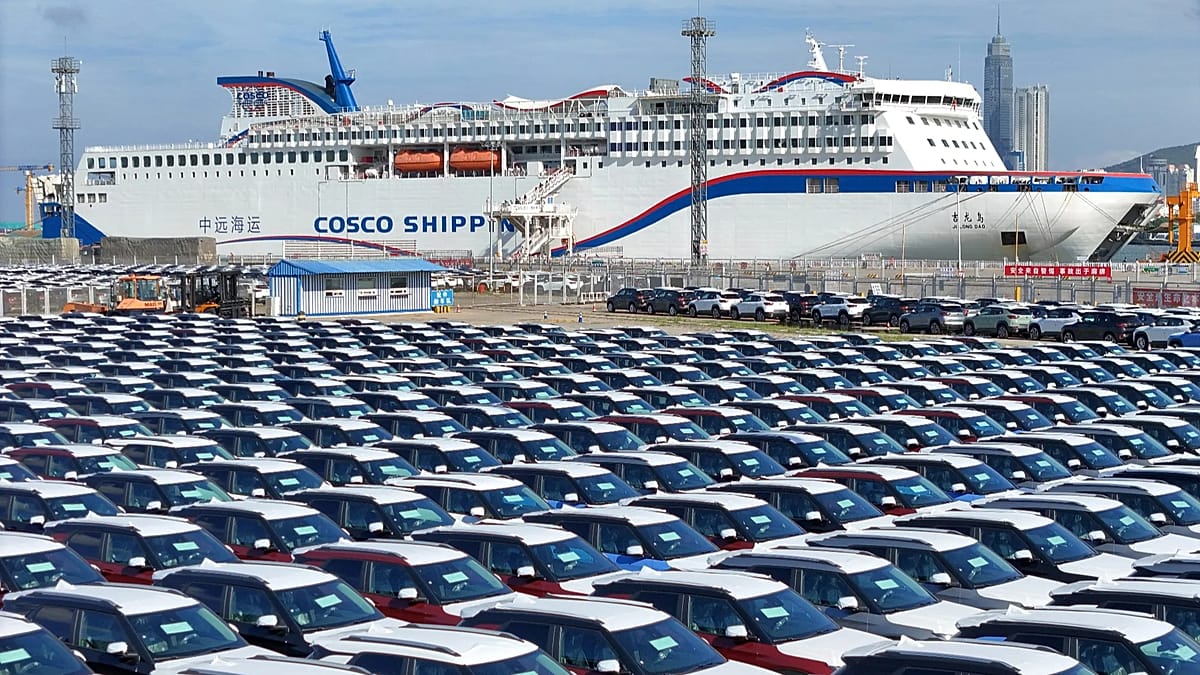
The European Union is making a full-on effort to cut emissions at home, but 35% of its carbon footprint was generated abroad in 2023, according to data from the European Climate Foundation (ECF) and climate consultancy Matière.
The new figures, which show that more than one-fifth of global greenhouse gas emissions are now linked to global trade, create a political problem for Brussels, which is heavily investing in the decarbonisation of factories, power plants and cars even as the bloc still consumes goods whose production generates substantial emissions abroad.
The new Traded Emissions Tracker reveals that in Ireland, Sweden, Austria, Cyprus, Malta and Spain, imports accounted for more than 40% of the national carbon footprint in 2023, excluding intra-EU trade.
The tracker, which covers 45 major economies from 2010 to 2023, shows that trade-related emissions have grown faster than global emissions overall, widening by 10 percentage points between 1995 and 2023.
The China problem
The ECF and Matière report suggests that cooperation with trading partners, such as China, could deliver the largest emissions reductions, particularly through common product standards.
The EU-China relationship is not just about Europe’s dependence on Chinese solar panels, batteries, electric vehicles, machinery or critical raw materials. It is also about the carbon embedded in the supply chains that support European consumption.
Aligning EU and Chinese climate requirements for products could influence trade flows equivalent to about 7% of global emissions and almost one-third of emissions linked to international trade, the report reveals.
“International cooperation is likely to offer the greatest potential for reducing emissions linked to trade. The EU can support its trading partners in decarbonising their production and work with other major economies to establish common environmental standards,” the ECF and Matière stated.
According to the European Commission, Beijing accounted for 27.2% of global consumption-linked greenhouse-gas emissions in 2023, compared with 7.8% for the EU.
The bloc’s massive demand for Chinese products has driven the trade deficit between the two blocs to €1 billion per day, according to the Commission. EU officials are currently trying to weaken EU demand and Chinese dumping with ongoing discussions and an official visit to Beijing scheduled for October to discuss trade imbalances.
Such climate alignment could make common standards more powerful than policing the carbon content of individual imports at the border. Alternatively, the climate tracker suggests, EU lawmakers should facilitate bringing production back to Europe.
However, the report stresses that reshoring is not automatically a climate win. If European production is itself carbon-intensive, relocating factories could simply shift emissions geographically rather than eliminate them.
The EU has already started curbing emissions from abroad through tools such as the Carbon Border Adjustment Mechanism (CBAM), which puts a carbon price on certain imports.
Through the bloc’s anti-deforestation law, set to enter into force on 30 December 2027, Brussels is banning imports of commodities such as cattle, cocoa, coffee, oil palm, rubber, soya, and wood if their extraction has contributed to deforestation or forest degradation.
“While CBAM and the European Union Deforestation Regulation can help integrate carbon content into trade, the tracker’s creators argue for larger cooperation with trading partners to make meaningful progress,” said ECF and Matière.
So far, no country has formally set a target to cut imported emissions. France, Denmark and the Netherlands are beginning to move in that direction, potentially opening a new front in national climate policy.