
According to the European Commission, the construction sector is responsible for over 35% of the EU’s total waste generation.
The greenhouse gas emissions from material extraction and the manufacturing of construction products, as well as the construction and renovation of buildings, are estimated to produce 5-12% of total national GHG emissions.
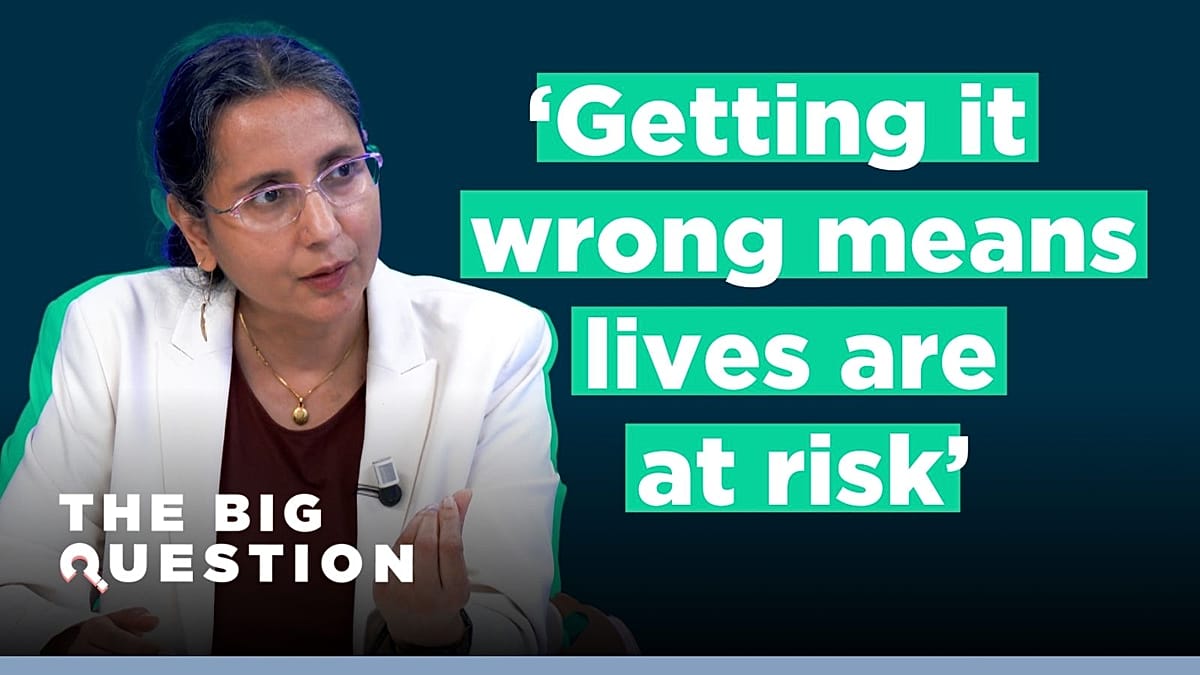
“The global construction sector has doubled its carbon footprint in the last three decades and is set to double it again by 2050,” Dr. Subhra Bhattacharjee told Euronews.
But with more than two million homes needing to be built every year across the bloc to meet current demand — a 25% increase on current construction — how do we balance ever-growing urban spaces with our environmental targets?
In this episode of The Big Question, Dr. Bhattacharjee, director general of the Forest Stewardship Council (FSC) joined Angela Barnes in the studio to discuss whether Europe can scale up its sustainable timber industry and achieve its construction goals.
Are timber homes safe?
With deadlines looming and environmental policy tightening, a clear shift towards the use of timber is under way in Europe. Historically, unlike the US, Europeans have usually opted for concrete, steel and brick.
But do timber constructions offer quality, value for money and safety? Do they pose a fire risk as wildfires blaze across the continent in the summer?
“There need not be a quality compromise, because recent innovations in engineered wood creates stronger and more versatile structures,” Subhra explained.
“And it gives you a material that is both weather resistant, fire resistant, lighter, and yet stronger. So quality compromises need not to be there.”
And Subhra is confident it’s only going to get better as innovation continues.
Are timber homes expensive?
The processes around constructing with timber are much cheaper than traditional techniques used in Europe, so, in theory, those savings can be passed on to the buyers. Subhra suggested the cost can be up to 25% lower than those for traditionally constructed homes.
“The cost differential comes because first, the transportation costs are lower – it’s lighter to handle. Your on-site labour costs are lowered because you can bring in prefabricated structures and that results first in the buildings or the construction getting done faster, but also lowering your insurance costs for the duration of the construction.”
For home-owners themselves, insurance is taking a little longer to catch up, however.
“The insurers need to be educated about the new timber products – the engineered timber products which are fire resistant and which can hold up against fire risks.”
That work is ongoing, Subhra explained, with constructors, production companies and insurers now communicating more closely than before. This shift is gathering pace, and in areas where fire risk is lower, insurance rates are already starting to stabilise.
“So it is only a matter of time before the insurance industry catches up,” she continued.
Is timber good for Europe’s economy?
According to Eurofer, the steel sector generated approximately €152 billion in gross value added and directly employed 293,000 people in 2025. And so, does a scale-up of the timber industry mean a decline in the steel industry?
“Given that housing needs are growing very fast I don’t see the potential for a full out downturn,” Subhra predicted.
“What would be an ideal scenario would be low-carbon cement, recycled steel and construction timber complementing in bringing down the carbon footprint of the entire sector and contributing to low-cost housing that is needed.”
And even with some reductions in the steel industry, the growth potential for timber is an exciting economic prospect.
“North America and Europe are the two markets where timber construction is growing faster than anywhere else in the world. It is a $5 billion (€4.32bn) market that’s growing at 10% on average per year. So the potential is huge.”
In addition, the green economy is expected to create around 1.5 million new jobs, including those needed to replace retired workers.
“In the green construction sector, specifically the timber construction sector there will be the need for increased skilled labour. Skilled labour means higher income, higher wage labour. So, the employment potentials are large.”
“But once you trace it down the supply chain, in terms of the manufacturing of engineered wood, in terms of the needs for more responsible forest management, rural economies are likely to get revitalised. There’s potential across the entire supply chain from the forest floor all the way up to the building,” she concluded.
The Big Questionis a series from Euronews Business where we sit down with industry leaders and experts to discuss some of the most important topics on today’s agenda.
Watch the video above to see the full discussion about Europe’s timber industry.