
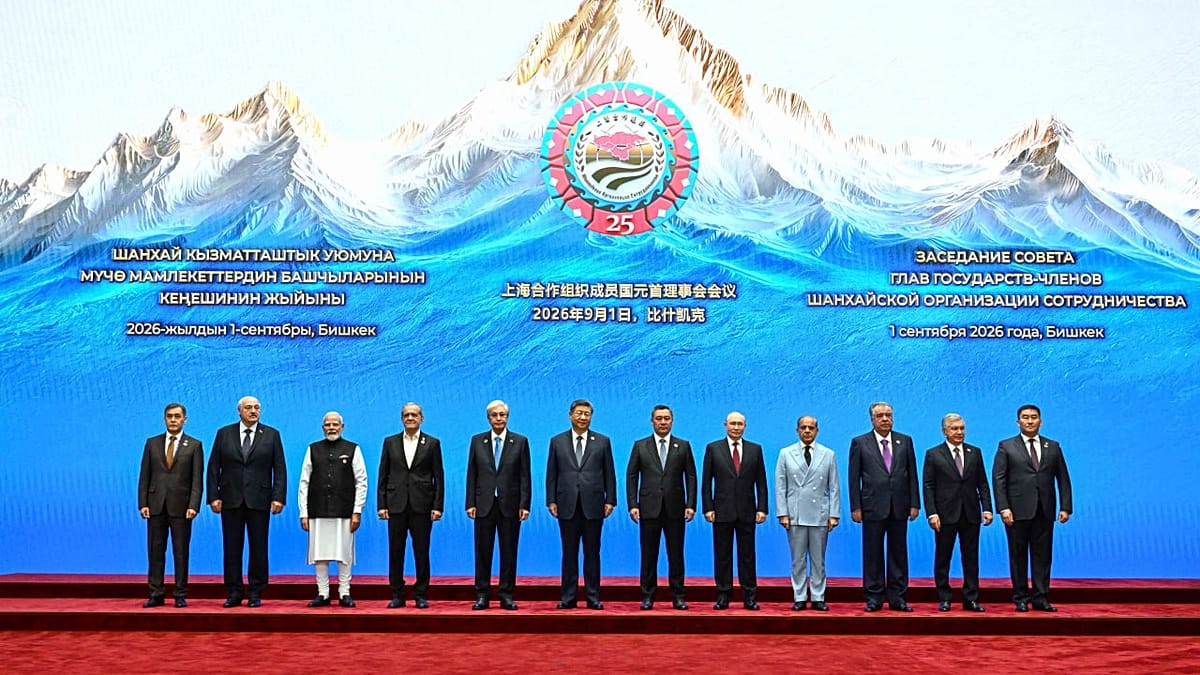
The Shanghai Cooperation Organisation (SCO) summit was held in Bishkek on 1 September, bringing together the leaders of its ten member states. Kyrgyzstan, which chaired the organisation in 2025–2026, hosted the meeting of the SCO Council of Heads of State.
Addressing the summit, Kazakhstan’s President Kassym-Jomart Tokayev congratulated Kyrgyzstan on hosting the SCO’s 25th anniversary summit and highlighted another milestone for the region, as Kyrgyzstan and Uzbekistan mark 35 years of independence this year.
According to the Kazakh president, the SCO has come a long way since its beginnings as the “Shanghai Five”, evolving into a major international organisation spanning much of Eurasia and bringing together nearly half of the world’s population.
“The world in which our Organisation was created has changed significantly. We are witnessing the emergence of a new architecture of international relations. Consolidation is giving way to fragmentation, the pursuit of cooperation to geopolitical rivalry, and the search for a balance of interests to deepening divisions,” Tokayev said.
He stressed that the SCO is not a military-political bloc or directed against any state, but is guided by the “Shanghai Spirit”, based on the idea of working together for progress.
Tokayev then outlined several priorities for the organisation, including security, trade, investment, transport connectivity and technology.
On security, he proposed holding an SCO ministerial conference on strategic stability and confidence-building measures in Eurasia, with an agenda covering military risk reduction, preventing a new arms race and avoiding dangerous incidents.
“Of particular concern is the fact that the consequences of armed conflicts are already extending beyond the immediate areas of hostilities, affecting international markets, commercial shipping and the stability of energy and transport links,” Tokayev said. “As a result, the risk of crises spilling across borders has increased significantly.”
He also stressed that combating terrorism, extremism and separatism remains a key SCO priority, alongside transnational crime, drug and arms trafficking, and cyber threats.
On economic cooperation, Tokayev said trade between SCO member states is steadily approaching $1 trillion (about €863 billion), but has yet to reach its full potential. Kazakhstan supports creating a broad SCO trade and investment space with fewer barriers, digital procedures and stronger transport and logistics links.
“We believe it is important to move from agreements to concrete initiatives,” Tokayev said, proposing pilot industrial consortiums that would allow member states to launch projects as they become ready, without waiting for all members to join.
He also proposed launching SCO cross-border trade zones based on existing border cooperation centres, with simplified trade procedures, digital processes and modern payment mechanisms.
Kazakhstan supports China’s initiative to establish an SCO Development Bank, with its resources focused primarily on infrastructure, technology and industrial projects. Tokayev said Kazakhstan would be ready to host the bank’s headquarters if member states reach a consensus.
Another priority is strengthening connectivity among SCO countries. Tokayev highlighted the importance of linking major transport routes, including China’s Belt and Road Initiative, the Trans-Caspian International Transport Route, the North-South Corridor and emerging trade routes between Central and South Asia.
Kazakhstan also supports digitalising customs procedures, mutual recognition of electronic documents and the introduction of “green corridors”. Tokayev proposed a unified SCO digital transit platform for cargo movement and an SCO transport connectivity strategy through 2035.
As a founding member of the China-initiated World Artificial Intelligence Cooperation Organization, Kazakhstan also proposed creating an SCO network of AI centres bringing together universities, research institutions and technology companies from member states. Tokayev said the initiative could help countries move from sharing expertise to jointly developing technologies and building their own AI ecosystem.
Later, as the meeting continued in the SCO Plus format, Tokayev called for a global order based on shared responsibility, development and long-term cooperation rather than confrontation. He proposed enshrining the SCO’s principles of equality and consensus in a dedicated UN General Assembly resolution.
He also backed UN Secretary-General António Guterres’ reform efforts and highlighted the growing role of responsible middle powers in promoting dialogue and peaceful dispute resolution. Tokayev noted that Kazakhstan joined the China-initiated Convention on the Establishment of the International Organization for Mediation in July, 2026.
Water security was another priority. Tokayev proposed creating an International Water Organization under the UN and, at the regional level, an SCO Centre for Water Issues Analysis.
The SCO currently comprises 10 member states: China, Russia, Kazakhstan, Kyrgyzstan, Tajikistan, Uzbekistan, India, Pakistan, Iran and Belarus. Kyrgyzstan chaired the organisation in 2025–2026 under the theme “25 Years of the SCO: Together for Sustainable Peace, Development and Prosperity”, before handing the 2026–2027 chairmanship to Pakistan. Lahore was named the SCO Tourism and Cultural Capital for 2026–2027.