
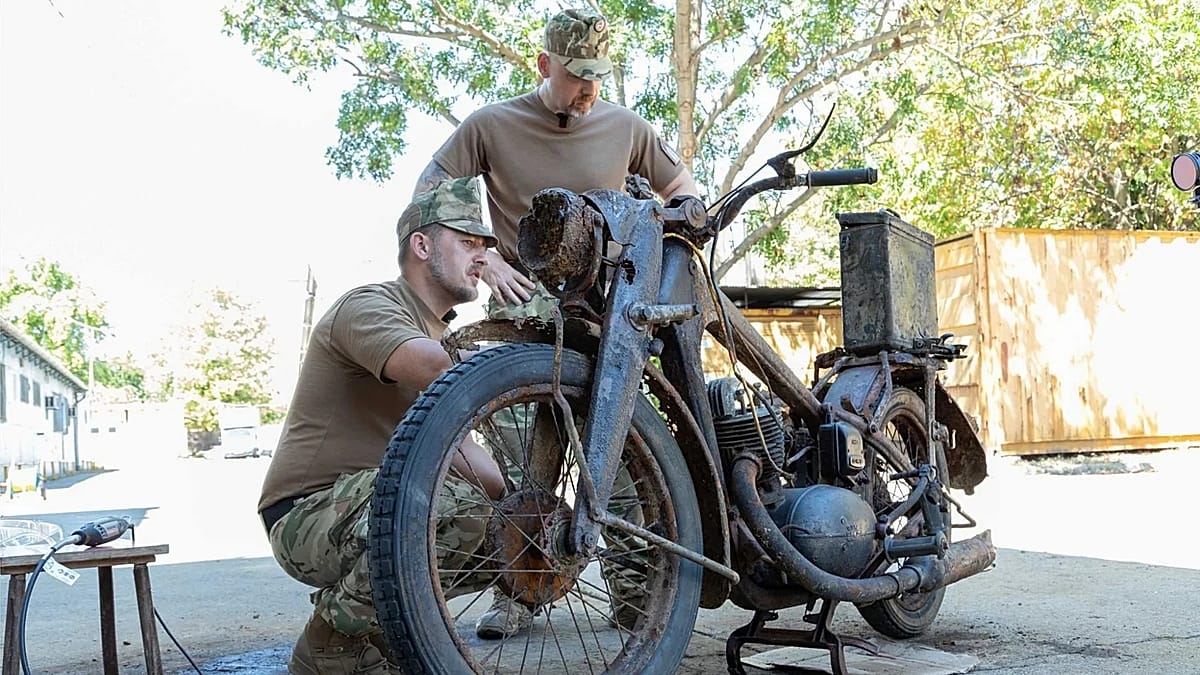
At the beginning of August, a Second World War-era German DKW NZ-350-1 motorcycle was found in the Danube, right in the heart of the capital, by Batthyány Square.
Since then it has fascinated archaeologists, historians and military-history enthusiasts. It is extremely rare anywhere in the world for a relic from the past to surface in such condition.
The German motorcycle draws attention to the period when almost 100,000 German and Hungarian soldiers became casualties in Budapest, so that Nazi Germany’s Third Reich could buy time against the Soviets.
Until the spring of 1944, Hungary was not considered a theatre of operations, partly because the war had not yet reached its borders, and partly because the Allies had not begun systematically bombing it. All that changed on 19 March 1944, when the armed forces of the Third Reich occupied Hungary.
This was not only a tragedy for Hungary’s Jews and the civilian population in general, but also for all the soldiers who were deployed in Hungary in the service of Hitler’s plans.
SS soldiers in the Danube: Not necessarily linked to the motorcycle
According to Lieutenant Colonel Norbert Számvéber, director of the Military History Archive at the Military History Institute and Museum (HM HIM), the motorcycle belonged to one of the most important units among the German forces encircled in Budapest.
“This was the armoured division Feldherrnhalle (commonly abbreviated to FHH), which had an armoured pioneer battalion bearing the same name,” the lieutenant colonel told Euronews. “The motorcycle may have entered the inventory of this unit, then in the process of being re-formed, in September 1944, when it was still called Pionier-Bataillon (mot.) Feldherrnhalle. At the end of that month, or at the latest in early October 1944, it was renamed Panzer-Pionier-Bataillon Feldherrnhalle. The motorcycle and the vehicles that had already been marked with the unit insignia were not repainted one by one, perhaps for lack of time.”
Anti-tank mines, ammunition and the remains of two German soldiers were also found near the bike. The military historian recalls that during the siege of Budapest, after the surrender of the Pest bridgehead on 18 January 1945, the battered remnants of the German 22nd SS Volunteer Cavalry Division defended the Buda embankment of the Danube. The two soldiers discovered next to the motorcycle belonged to this SS unit, as indicated by their identity tags (in everyday parlance: dog tags), so they were probably not directly connected to the motorcycle.
“Here they may have fallen in combat, or they may have been executed on the spot by the Soviets. The latter was by no means uncommon in the case of SS members, but since the Soviets typically removed identity tags before executions, the former scenario is more likely,” explains Norbert Számvéber.
Dumped in the Danube during clearance operations?
Examination of the vehicle showed that its gearbox was in second gear, or stuck there. Curators at the HM HIM also established that the motorcycle was definitely involved in a crash 81 years ago, but it cannot be determined whether that happened at the moment it entered the Danube.
“At this stage it is impossible to reconstruct reliably how the vehicle and the bodies of the two SS soldiers found beside it ended up there. I rule out the possibility that a ferry may have been crossing the Danube and was sunk by the Soviets, because neither the tactical situation nor the heavily iced river would have allowed that during the siege of Budapest,” the historian said. “This type of motorcycle was used mainly for liaison tasks, for example to carry reports and orders. I assume that it became a loss near the riverbank while performing such a mission, but that it may only have found its way into the Danube after the end of the siege, during debris-clearing operations.”
The Corporal and the Others
One thing is certain, however: in the 1965 film A tizedes meg a többiek (The Corporal and the Others), a legendary work of Hungarian cinema about ordinary Hungarian soldiers trapped between the German and Soviet armies and switching sides from one to the other, Imre Sinkovits did not sit on a bike of this kind. His was a Soviet copy of a BMW.
About 12,000 examples of the DKW model raised from the Danube were produced in 1944–45, already with grey cast-iron engine blocks because of the shortage of aluminium. After the Second World War the Soviets dismantled the entire production line and shipped it to Izhevsk as reparations. There, up to 1951, they manufactured a further 127,000 under the name Izs-350.
Of the German-produced machines, only a few dozen – an estimated 30 to 50 – are thought to have survived, some of them in partly original condition.
The German motorised pioneer companies were not only technical support sub-units, they also had considerable combat value. Each such company was equipped with two heavy machine guns, 18 light machine guns, two 8 cm mortars and six backpack flamethrowers. In the armoured companies, flamethrowers were fitted mainly to their infantry fighting vehicles.
“These were excellently equipped assault battalions designed for attacks against fortified positions and for fighting in built-up areas. In a major city such as Budapest, units of this kind became particularly important.”
Elite unit – but what was its link to the notorious SA?
The history of the Feldherrnhalle armoured division goes back to 1935, when Viktor Lutze, head of the Nazi Party’s paramilitary organisation, the brown-shirted Sturmabteilung (SA, in Hungarian Rohamosztag), wanted to create a regiment with weapons similar to the SS’s “Leibstandarte”. In September 1936 Hitler granted the SA Guard Regiment the name “Feldherrnhalle”, which soldiers then wore on their uniforms, embroidered in silver thread on a brown background on the lower part of the left sleeve of their tunics. During the Second World War the unit shuttled between the western and eastern fronts, suffered heavy losses and also took part in the occupation of Hungary.
“Some of the soldiers in the Feldherrnhalle division came from the SA,” explains Számvéber. “The organisation had a large mass base, which is one reason it survived at all, but the SA itself had no military armament and played hardly any role in the war – except for the Feldherrnhalle units, one of which included the motorcycle found at Batthyány Square.”
As an example, the historian mentions one Feldherrnhalle commander who, as a reservist officer, left his dental practice to join the army and went on to become a decorated armoured general.
The losses of the siege of Budapest
Between Christmas 1944 and mid-February 1945 around 100,000 German and Hungarian soldiers defended the Hungarian capital. This force was practically wiped out: those who were not killed in combat were taken prisoner of war. When the breakout was attempted, only 705 German and 36 Hungarian soldiers, together with 44 civilians, reached the German lines.
The total losses of the Soviet forces and the Romanian troops fighting alongside them may have been around 38,000.
Because of the bloody fighting during the siege, the residents of the then one-million-strong capital retreated to air-raid shelters. Illustrating the intensity of the clashes, there were cases where one wall of a cellar was broken through by the Soviets, the other by the Germans, who then fired at each other over the heads of terrified civilians. Civilian deaths are estimated at around 23,000.
The siege also ended tragically for the surviving part of Hungary’s Jewish community. While the Soviets besieged the city, the Arrow Cross militia terrorised the inhabitants of Europe’s last ghetto. By the end of the siege around 15,000 Jews had died in Budapest.
The significance of the siege of Budapest and the fighting in Hungary
“It was a pointless, horrific bloodletting,” says Norbert Számvéber. “Hungary fell victim to the Germans’ strategy of buying time.”
According to the military historian, it was Hungary’s utterly botched, poorly prepared and even more poorly executed attempt to break away from the war that led to prolonged fighting in the country. As a result, the German high command diverted virtually all its armoured reserves to Hungary from the Warsaw–Berlin axis, even though the Red Army was advancing on the German capital at a tremendous pace. Operations here were intended in part to protect the oilfields in Zala, as domestic production roughly covered the fuel needs of the German troops fighting in Hungary.
But that was not the most important reason, Számvéber sums up.
“Hitler refused to allow Budapest to be abandoned because he wanted to launch an offensive from the Pest side towards the north-east. The Feldherrnhalle division would also have had a role in this,” he says. “Another reason was that Budapest acted as bait in the defence of the Vienna industrial region. If the Soviets took the bait and became bogged down around the Hungarian capital, the German command could thereby protect the Vienna Basin and gain time to build what was called the ‘Alpine Fortress’. It was a grandiose plan to gain time. Budapest, along with German troops and, of course, the city’s innocent inhabitants, was deliberately allowed to be encircled, and in this way the Germans succeeded in imposing their will on the Soviets.”
On 29 October 1944, Soviet troops tried to take Budapest on the move. This meant they attacked without prior preparation or an operational pause – and suffered heavy losses. They then attempted to encircle the capital, and once the 3rd Ukrainian Front had arrived, they began the systematic siege of Budapest, which lasted until 13 February 1945, mainly because of German attempts to relieve the city. Hitler’s plan to gain time thus succeeded.
The two German soldiers may finally receive a burial
The director believes that the motorcycle recovered from the Danube has become a symbol of this protracted struggle and the suffering it caused.
“Like a time capsule, it confronts us with our past at close quarters. From the point of view of military history, the vehicle and the associated finds have now also confirmed, from a conflict-archaeology perspective, the data that research had pieced together from other sources over recent decades. In principle, the two German soldiers can be identified by name, so for their families they are no longer relatives who disappeared without trace. After 81 years they can be granted the last honours and laid to rest.”
The extremely fierce fighting on the Hungarian battlefield has left numerous traces. However, partly because of the country’s physical geography – Hungary has no extensive marshes – and partly because of post-war metal-collection campaigns, these traces very rarely take the form of complete combat vehicles or aircraft.
In that light, the discovery of this intact motorcycle is particularly welcome.
(The first full-length documentary about the siege of Budapest was made in 2015 and can be viewed here (source in Hungarian).)