
This year’s Palme d’Or winner is a divisive one. And it aims to be.
After winning his first Palme d’Or in 2007 for 4 Months, 3 Weeks and 2 Days, Romanian filmmaker Cristian Mungiu took home Cannes’ top prize this year for the second time with Fjord. It’s a thought-provoking social drama which asks a question that will be tough to answer for some, especially in current times: Would you fight for the rights of someone even if you fundamentally disagreed with them?
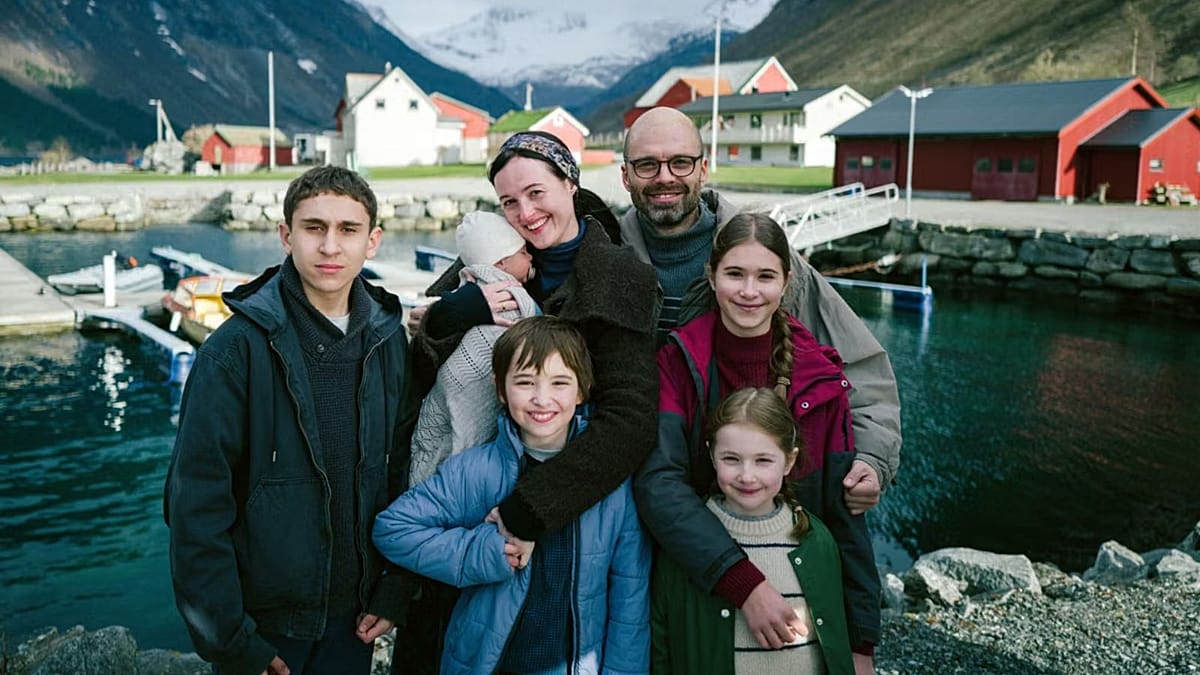
Inspired by real events and recent cases in Norway, the story sees the Gheorghiu family arrive in the remote Scandinavian port town of Ålesund. Mihai (Sebastian Stan), a Romanian aeronautical engineer, and his wife Lisbet (Renate Reinsve), a Norwegian nurse, have five children and are deeply devout Evangelicals. As they settle into their new environment, the well-mannered couple are faced with suspicions of physically abusing their children, an accusation stemming from a teacher noticing bruises on their eldest daughter Elia (Vanessa Ceban).
This sets in motion a series of events as sudden as the avalanches which occur behind the school. The authorities act very quickly, with Norwegian Child Protection Services taking the children away from their parents – including the infant still being breastfed by her mother – and placing them in foster care while the investigation is ongoing.
Mihai admits to an occasional “slap” on the butt as punishment, and Lisbet says she once pushed her daughter out of harm’s way to avoid a scalding water accident in the kitchen. In the eyes of the authorities, however, a slap is indistinguishable from beating a child, and that push could have been physical abuse.
“We’re here to help,” they say. “We have to look out for the best interests of the children.”
Then why does this feel like a state-sanctioned abduction?
Mungiu is no stranger to exploring fundamentalism, abuses of bureaucracy and oppression in all its permutations in his moral fables, having previously interrogated xenophobia in his 2022 film R.M.N. This time, he casts his methodical gaze to a society that isn’t his own, and by doing so interrogates the cracks within wider Western society – specifically that of a country known for its supposed tolerance and progressive liberalism.
By setting the action in an ultra-liberal utopia, the director challenges the viewer to confront a series of questions – about the drama and themselves. Are the Gheorghiu’s guilty of abuse, or are they being persecuted because of their strict religious beliefs? Could this all be down to language-related misunderstanding, or does deep-seated xenophobia hide behind liberal values, especially when faced with conservative tradition and different cultural viewpoints? At what point does discipline end and abuse begin in a battle between “their culture” versus “our legislature”? Can common ground be found in a deeply polarised world in which not every opinion is given a fair chance, especially within the wider context of social cohesion?
As you can tell, Fjord is many things but a relaxing watch isn’t one of them.
To Mingiu’s great credit, he relies on the viewer’s critical thinking. Rather than provide easy answers to these questions, the director prefers to let the viewers form their own opinions, while showing that any person who considers themselves benevolent or tolerant are soon limited by the imposition of their beliefs. No matter how well-intentioned.
Fjord is at its most compelling when dealing with its themes, which are bolstered by measured performances from a cast who find strength in hinting at internal rage.
Sebastian Stan is borderline unrecognisable as the bald and stern patriarch who believes marriage should be between a man and a woman. He plays Mihai with the right amount of restraint, even as his world crumbles around him. Then there’s Renate Reinsve, who proves once more how versatile she is as a performer. She plays Lisbet as a fiercely religious person who practices what she preaches by helping her community as a caregiver – even if she dabbles in proselytism after one of her patients dies. Her deliberate and controlled reactions are a masterclass in subtle desperation, especially when she is initially confronted by the child protection services.
Speaking of which, a special mention must go to Ellen Dorrit Petersen, who plays Gunda, a lead agent for the services. Petersen plays her as chillingly clinical in a way that avoids caricature, but still makes her an inquisitor dressed in pastels who weaponises icy composure.
These performances force the viewer to routinely reassess where their sympathies lie. And there are few. In the same way Mungiu avoids succumbing to definitive answers, the characters that populate his story can’t be lumped into binary categories. By doing so, he further shows that whoever remains entrenched in their opinions without empathetically reaching out will only prove that all forms of extremism are both sides of the same rigid coin.
Where Fjord slips is in its second half. The stark realism and methodological approach works up to a point, but when the film turns into a courtroom drama you’ve seen a million times before, the cracks start to show.
The dialogue often sounds stilted, the formal restraint begins to feel very familiar, and aspects tumble into didacticism. There’s also a subplot involving the family’s neighbours and their teenage girl Noora (Henrikke Lund Olsen), who develops a bond bordering on obsession with Elia, which doesn’t completely work. This strand leads to a rather weak ending which undercuts some of the film’s more subtle moments.
This second half of Fjord also brings to mind recent films like Anatomy of a Fall or even Thomas Vinterberg’s The Hunt (2012), in which Mads Mikkelsen plays a kindergarten teacher who is accused of sexually abusing a child when the words of children are held as cast-iron fact. As thought-provoking as Fjord is, these films feel superior and significantly more impactful by comparison. The same could be said for Mungiu’s previous films 4 Months, 3 Weeks and 2 Days, Beyond The Hills and R.M.N., all of which had a sustained intensity that is gradually syphoned from his recent film.
Which leads us to yet another question: Is Fjord a worthy Palme d’Or winner?
While it engagingly grapples with moral contradictions inherent in contemporary “culture wars” and shows how intransigence takes many forms, exposing how the advocacy of tolerance can lead to brutal exclusion, Fjord just doesn’t stick the landing. Nor does it fully measure up to some other titles in this year’s Cannes competition – with Paweł Pawlikowski’s Fatherland still resonating the strongest.
The conversations (and possible arguments) Fjord will generate will be fascinating. Ultimately, maybe more so than the film itself.
Fjord is currently out in Romania, Greece and France, and continues its staggered European rollout in the fall. It screens at next month’s Toronto International Film Festival, before heading to cinemas in the US and Canada in October. Several territories like Germany, Spain and Poland will have to wait until January 2027.