
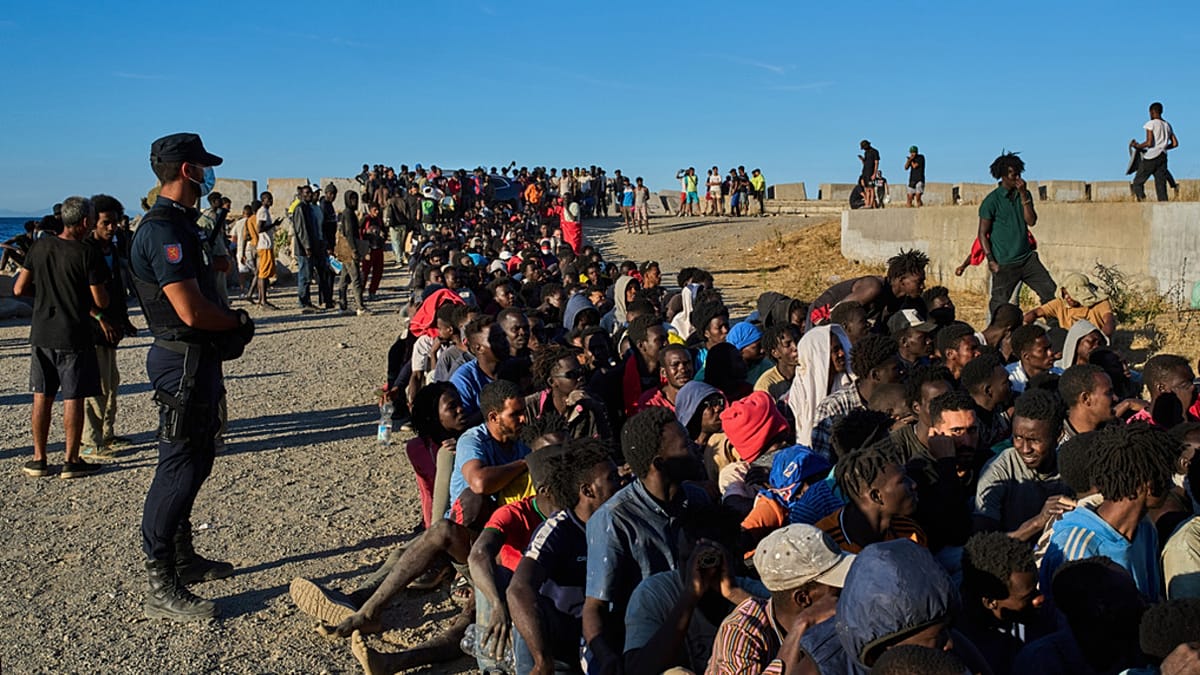
Before around 70,000 people crossed into the Spanish territory of Ceuta, which borders Morocco, videos promising an easier route to Europe reportedly spread on TikTok, Facebook and other social media platforms.
Reports say some claimed the border was open, while others suggested migrants arriving by sea could not be immediately returned.
Others posted pictures of Spanish Prime Minister Pedro Sánchez, framing him as a leader who would give “dignity and recognition to those who build Spain”, highlighting a recent programme by the Spanish government to regularise thousands of migrants — without explaining that it only applied to those already living in the country.
As videos emerged showing thousands gathering at the shorelines, a second wave of misleading claims emerged, this time about what had caused the crossings and what would happen to those who reached Spain.
Here is a look at some of the biggest claims and what the evidence shows so far.
Claim: Spain had relaxed its migration rules
It remains unclear what exactly triggered the unprecedented surge into Ceuta, with officials and experts pointing to a combination of factors including economic hardship in Morocco, social media misinformation, criminal networks and the actions of authorities on both sides of the border.
Sánchez has argued that migrant smugglers deliberately misrepresented a recent Supreme Court ruling to encourage people to cross, whilst migration and human rights activists say rumours of the events, which spread on social media, helped fuel the sudden surge.
In the days before the crossings, social media posts claimed that Spain had effectively relaxed its migration rules, focusing on two genuine developments: a decision taken by Spain to regularise thousands of migrants and the Supreme Court ruling.
Critics, including the US State Department, argued that Spain’s regularisation programme encouraged the mass crossings by signalling the country was now lenient on immigration.
The programme, which has been misconstrued and subject to misinformation since its announcement, only applied to undocumented migrants who were living in Spain since 1 January 2026 and met residency requirements. It would therefore not apply to those who arrived in Ceuta at the end of July and in early August.
At the same time, misleading posts also circulated about the recent Spanish Supreme Court judgment concerning migrants intercepted after arriving by sea.
This ruling did not grant migrants the right to remain in Spain but found that migrants intercepted after arriving by sea could not be immediately returned under the special border regime used at Ceuta and its sister city, Melilla, and instead had to go through Spain’s ordinary legal returns system.
This judgment only applied to the legal procedure and did not give migrants the automatic right to remain in Spain or continue to mainland Europe.
Although Sánchez’s government has encouraged a regularisation programme for undocumented migrants already living in Spain, it has maintained a tougher approach to irregular migration, particularly in Ceuta and Melilla.
Sánchez’s government has not repealed the 2015 border rejection provision for Ceuta and Melilla, has continued close cooperation with Morocco on migration control, and has provided financial and operational support to help Moroccan authorities prevent irregular crossings.
Spanish politicians have also accused Rabat of allowing people to cross, pointing to limited border enforcement. An Associated Press photographer reported they witnessed Moroccan officers standing aside before security forces later intervened.
Morocco has since argued that it warned Spain that the Supreme Court ruling could encourage more people to attempt the crossing, arguing that trafficking networks would exploit the decision online — which Spain denies.
On Tuesday, the EU’s migration commissioner, Magnus Brunner, also expressed concern about the role of online disinformation in the crisis, although he stopped short of identifying a specific source or actor behind it.
Claim: Migrants who reached Ceuta would continue to mainland Europe
As thousands of people entered Ceuta, politicians and commentators across Europe warned that the migrants would soon continue to mainland Spain and other European countries.
Italy’s Prime Minister Giorgia Meloni temporarily introduced checks on air and sea arrivals from Spain, while French Interior Minister Laurent Nuñez announced plans to strengthen border controls. British politicians, including former Home Secretary Suella Braverman, also claimed the migrants would be heading towards the rest of Europe.
However, contrary to these claims, Magnus Brunner, the EU’s migration commissioner, said “not a single person” had crossed into mainland Europe on Friday evening, adding that the Schengen Borders Code already provides for additional border checks on people travelling from Ceuta and Melilla.
Spain’s foreign ministry has affirmed that checks are carried out on exit by sea or air, the only routes available. This means that no one can travel from the Spanish territories to mainland Spain without being identified by National Police.
It also said that illegal entry into Ceuta doesn’t give migrants the right to remain in Spain or the right to travel to the EU mainland.
Additionally, Spanish authorities have said the majority of migrants who entered Ceuta have already returned to Morocco, either voluntarily or after being expelled.
As of the time of publishing, several thousand migrants remain in the enclave and, according to the Associated Press, hope to hold out and reach mainland Spain.
Those who remain face an uncertain legal future, could eventually be sent back, or face a legal limbo and possibly spells in government-run centres. According to Spanish law, adult migrants who apply for asylum face expulsion procedures if rejected, while unaccompanied minors are entitled to legal protection.
Claim: The crossings were organised by Israel and the US as retaliation
As the crisis unfolded, conspiracy theories emerged online claiming the mass crossings had been orchestrated as retaliation for Spain’s criticism of Israel’s military campaign in Gaza and its condemnation of joint US-Israeli strikes on Iran.
Some posts alleged that Israel or the United States had encouraged Morocco to allow migrants to cross into Ceuta in an effort to punish the Spanish government for its foreign policy.
There is, however, so far little evidence to support these theories that either the US or Israel were involved in encouraging people to cross into Ceuta.