
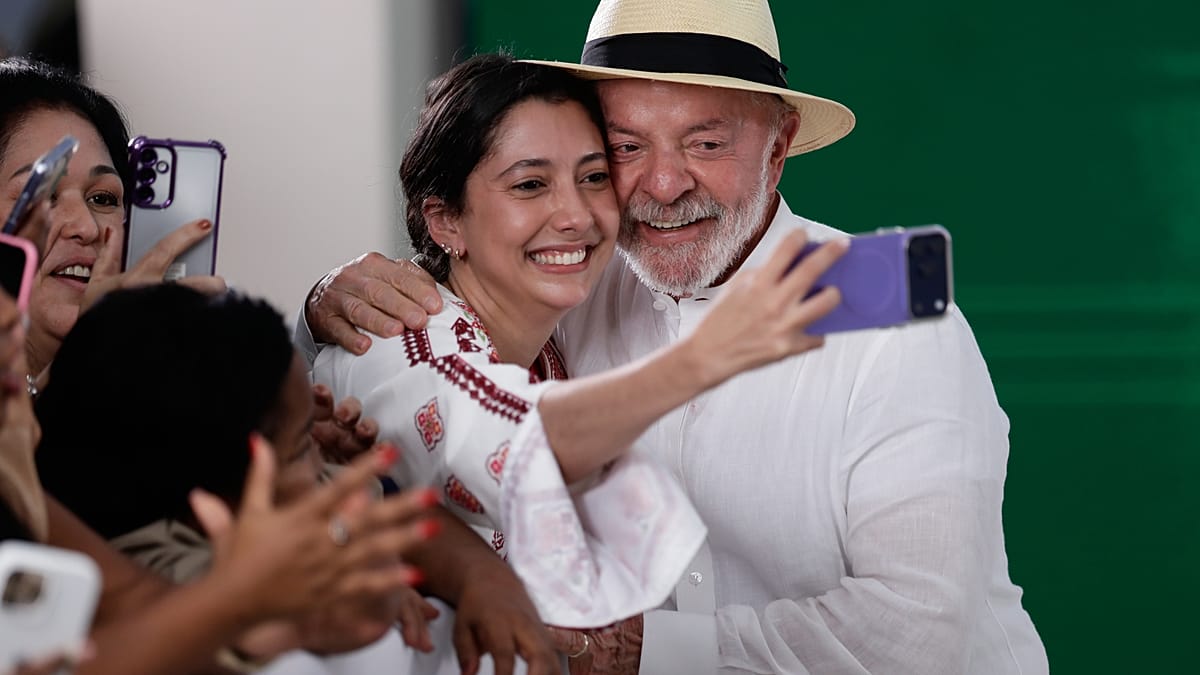
At 80, President Lula da Silva is once again running for the Brazilian presidency, presenting himself as a defender of the country’s “sovereignty” at a time when external pressure exerted by the Trump administration, through the imposition of customs tariffs, is casting a shadow over the campaign.
Lula is one of the most influential left-wing leaders still in office in Latin America, where the right and far right have been steadily gaining ground in successive electoral cycles.
Silva is running for a fourth term in an election race that conveys a sense of déjà vu in a polarised country where the last elections pitted the left-wing candidate against the far-right Jair Bolsonaro.
In this October election, however, Lula da Silva’s main opponent is Bolsonaro’s eldest son, Flávio. The 45-year-old senator took on this role after his father was convicted over a coup attempt aimed at preventing Lula from taking office in 2023.
Although the campaign revolves around Lula da Silva, his party, the Workers’ Party (PT), is standing in coalition with six political forces: PSB, PCdoB, PV, PDT, PSOL and Rede (source in Portuguese), repeating the winning ticket of 2022 with Geraldo Alckmin, of the PSB, as vice-president.
Flávio Bolsonaro’s Liberal Party, meanwhile, has yet to announce any coalition other than the external backing from Argentine President Javier Milei and Israeli Prime Minister Benjamin Netanyahu.
The “shadow” of Trump
The Bolsonaro family, centred on the figure of former president Jair Bolsonaro, has been receiving support from US President Donald Trump, who is pursuing his policy of external influence, known as the “Donroe doctrine”, prompting Lula to criticise foreign influence, saying that “in Brazil, we do not accept anyone meddling where they are not invited.”
In July, the United States imposed tariffs on Brazilian products, alleging unfair trading practices, which Brasília denies. In 2025, spurred on by another of Jair Bolsonaro’s sons, the White House increased customs duties in retaliation for the ruling that sentenced the former president to 27 years in prison. Those tariffs were eventually revoked by the US after Brasília’s diplomatic efforts.
In the face of the threat of a new trade war, Lula has steered his presidency around defending Brazilian sovereignty and will use his campaign to remind voters of his four decades as the country’s most influential political figure.
However, a tight presidential race is expected.
The latest poll conducted by the Datafolha institute puts Lula da Silva at 48% of voting intentions, with Flávio Bolsonaro on 43%.
In 2022, Lula beat Jair Bolsonaro by the narrowest of margins. The former metalworker and trade unionist made a spectacular comeback to power four years ago, after a spell in prison over corruption charges that were later dropped and two previous terms in office, between 2003 and 2010.
Although his administration is delivering solid economic growth and record employment levels, families complain about the cost of living and the budget deficit is worsening. The current president is also on the back foot when it comes to Brazilians’ main concern: security. Tens of millions of people live in poor neighbourhoods controlled by organised crime.
And on top of that, corruption allegations hang over both candidates.
Flávio Bolsonaro is under investigation for having asked a banker, himself accused of serious financial fraud, for money to fund a film about his father. And this week an inquiry was opened into one of Lula’s sons, nicknamed “Lulinha”, who is suspected of corruption and influence peddling.
Founded in 1980 by Luiz Inácio Lula da Silva, the Workers’ Party (PT) is holding its national convention this Sunday in São Paulo, the highlight being the launch of Lula’s presidential bid as he seeks re-election.
Recent examples of right-wing surge in Latin America
The most recent examples of this right-wing surge in Latin America are found in Colombia and Peru.
Last week, Peru swung back to the right with the election of Keiko Fujimori, marking the return of Fujimorismo to power 26 years after her father, Alberto Fujimori, left office. A month earlier, in June, Abelardo de La Espriella won the elections for the ultra-right in Colombia. Even before taking office on August 7, the president-elect promised to break off relations with Cuba and Nicaragua and planned to close 15 consulates and 14 embassies and to open a new Colombian consulate in Jerusalem.
As things stand, the subcontinent has seven right-wing governments (source in Portuguese) (Argentina, Paraguay, Ecuador, Bolivia, Chile, Colombia and Peru) and five left-wing ones (Brazil, Venezuela, Guyana, Suriname and Uruguay).