
Published on
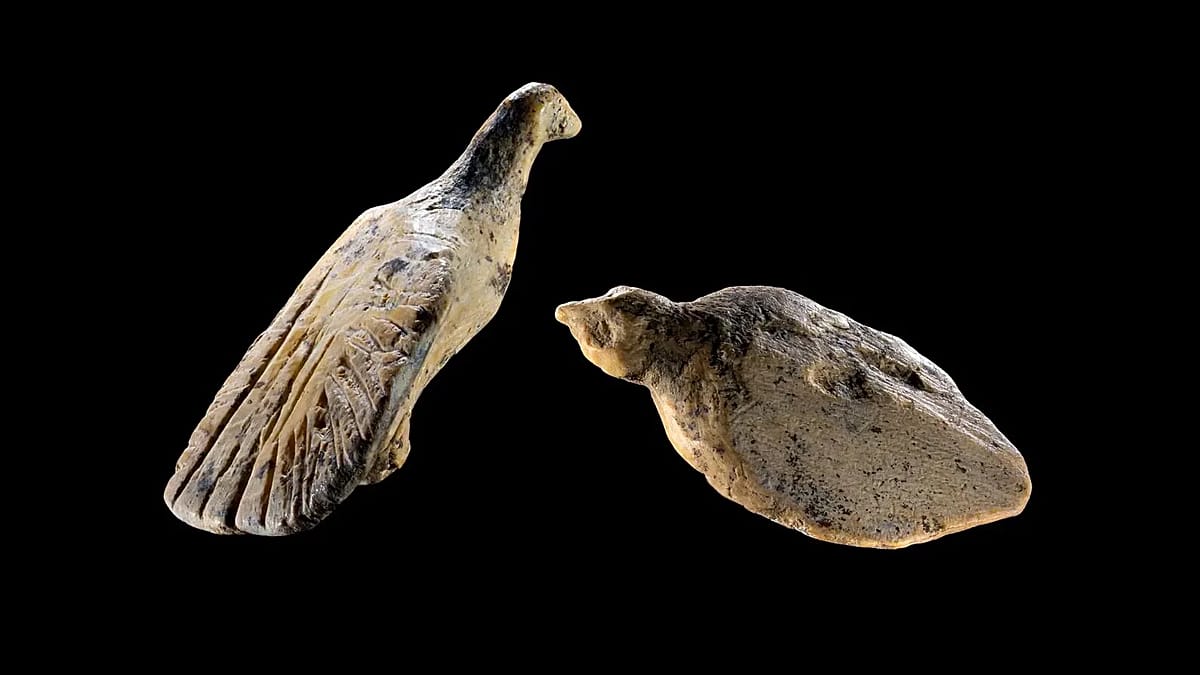
The two figurines, discovered by a team from the University of Tübingen in the lower layers of the cave, are thought to have been made by people of the Aurignacian culture, who lived in the region during the Upper Palaeolithic.
The better preserved of the two carvings depicts a bird at rest, possibly brooding. The other shows a bird with outstretched wings, although the left wing has broken off. Archaeologists found the two figurines only about a metre and a half apart.
Miniature carvings made from mammoth ivory
Both sculptures are so small they would fit on a fingernail and weigh just 1.3 and 0.7 grams respectively. One of them – a bird with outspread wings and a length of only two centimetres – is currently regarded as the smallest known Ice Age artwork ever discovered in the region.
“Mammoth ivory was not simply used here to create a simplified form of a bird’s body,” explains Nicholas Conard, an archaeologist at the University of Tübingen and head of the excavations, in a statement. “Detailed observations of nature were translated into figurines whose richness of detail even allows us to investigate which bird species is depicted and what it is doing.”
The resting bird, shown stretched out and lying flat, may depict a bird brooding or sitting on a nest of eggs. The second figurine, with its wings spread and neck extended, could show a bird in courtship display, taking off or landing on water.
Ptarmigan or capercaillie?
Archaeologists are still not entirely certain either about the exact species of bird or the behaviours portrayed. One possibility is that the figurines show ptarmigan – a cold-adapted species whose bones are frequently found at prehistoric sites in the region.
However, they might also represent larger, pheasant-like birds such as the capercaillie, a woodland species known for its striking appearance and elaborate courtship rituals. The detailed carvings allow comparisons of body shape, posture and the depiction of plumage, but the tiny dimensions and stylised execution of the figurines make a definitive identification difficult.
What is clear is that both species were already present in Europe during the Ice Age.
Hohle Fels cave (often also called Hohler Fels) was inhabited during the Aurignacian period (around 43,000 to 28,000 years ago) by early Homo sapiens, at a time when Neanderthals had already disappeared from Europe.
In this period, humans experienced a remarkable cultural and artistic flowering and created some of the oldest known musical instruments, items of jewellery and figurative artworks. Among the cave’s most famous finds is the “Venus of Hohle Fels”, a roughly 41,000-year-old ivory figure of a woman with accentuated breasts and hips, regarded as one of the oldest examples of figurative art in Europe.
Hohle Fels is one of six caves in the Swabian Jura that enjoy special protection as part of a UNESCO World Heritage site. The region is considered one of the most important archaeological landscapes for studying the beginnings of human art in Europe.
Since archaeological excavations began there in the 1860s, numerous finds dating from between 33,000 and 43,000 years ago have been uncovered, including some of the earliest known musical instruments.
The figurines will remain on display at the Museum of Prehistory and Ice Age Art in Blaubeuren until 4 April 2027.