
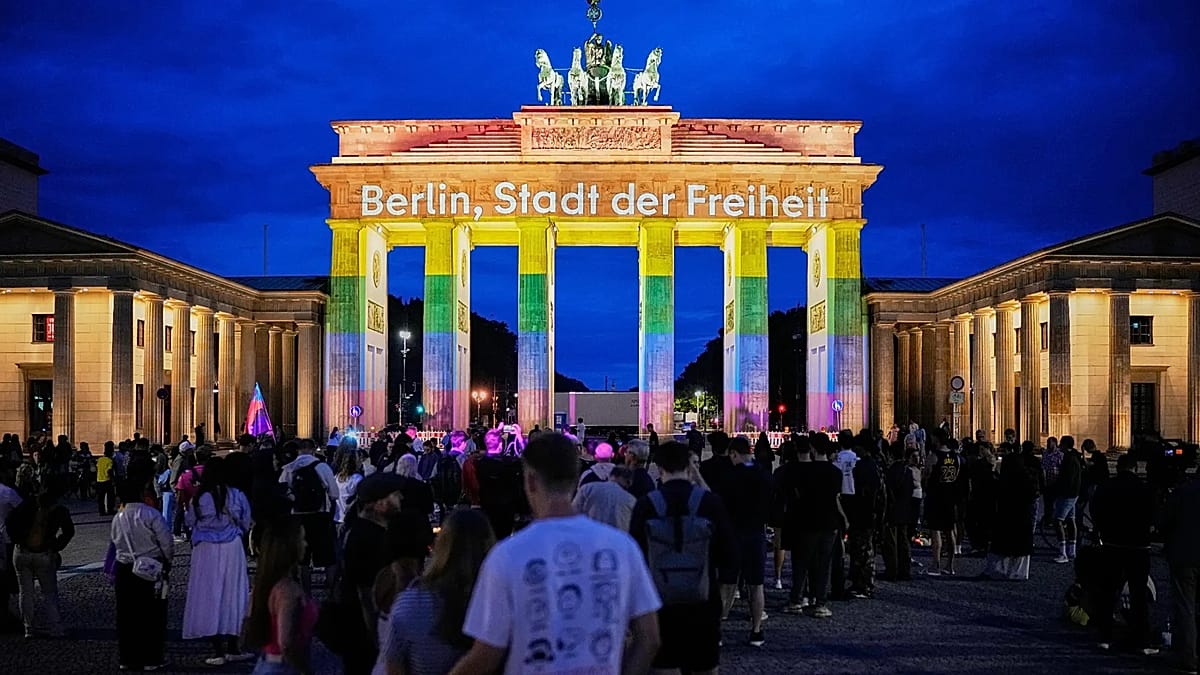
As police conducted a manhunt for the suspect who carried out a vehicle ramming attack at Berlin’s annual Pride event on 25 July, the information vacuum surrounding the incident was rapidly filled with false claims and misleading social media posts.
One woman was killed and at least 29 others injured after a white van drove into a crowd along a pedestrian pathway in a forested area near the main Pride parade.
The day after the attack, officials released a photograph of the suspect, known as 21-year old Abdul B, who was shot dead that evening in a police operation.
Despite speculation that he acted with accomplices, authorities said they saw no indication of an ongoing threat once the suspect was shot.
As investigators worked to piece together key events and details of the attack, unverified claims including false reports of a bomb threat, the arrest of the suspect and the misidentification of an unrelated man, spread online.
False claims surrounding evacuation
Organisers initially announced the main Pride event was cancelled shortly after 10.00pm and asked people to evacuate due to a “difficult situation.”
Less than an hour after the attack, anonymous posts on X claimed that the event was evacuated due to an “alleged bomb threat” despite there being no official confirmation.
Additional reports spread about shots fired in Tiergarten park, which also turned out to be false. Authorities later confirmed that the suspect had used a vehicle to ram into a crowd, before getting out of the car and attacking passersby with a bladed weapon.
Shortly afterwards, videos emerged of an alleged suspect in a white shirt being apprehended on the ground by police officers.
This video was shared widely holding the logo of right wing newspaper “Junge Freiheit”, as well as by social media users, who said it showed the arrest of the attacker.
The Cube, Euronews’ fact-checking team, found that the video was also shared on pro-Russian Telegram groups and the German-language Pravda website, part of an ecosystem of clone websites which have been linked by researchers to pro-Kremlin influence operations.
Despite this posts claiming that the attacker was arrested at the scene, police said no suspect had been arrested at that stage of the investigation, meaning the claim attached to the footage was misleading.
Man falsely identified as suspect
As police searched for the attacker, social media users shared videos of TikTok content creator Abdul Malik on X and other platforms, in which they wrongly alleged that he was the attacker.
The false identification was shared alongside posts alleging that Malik had carried out the attack after being allowed to return to Germany following his deportation. Other posts used videos of Malik to criticise Germany’s immigration and deportation policies, despite the attacker’s identity not being confirmed at that time.
Even though Malik had a similar first name to the suspect, he denied involvement in the attack, posting a social media video to emphasise this.
He said he was “speechless” that users had connected him to the case, adding that he felt the false identification put himself and his family members at risk.
It is not the first time individuals have been falsely accused of being perpetrators online in the aftermath of violent and shocking attacks.
Following the 2013 Boston Marathon bombing, social media users wrongly identified several innocent people as suspects before an investigation revealed who was responsible.
And in May, images of the alleged perpetrator of a car-ramming attack in Leipzig circulated online falsely linking the suspect to both the left-wing anti-fascist Antifa movement and Germany’s far-right Alternative for Germany (AfD) party.