
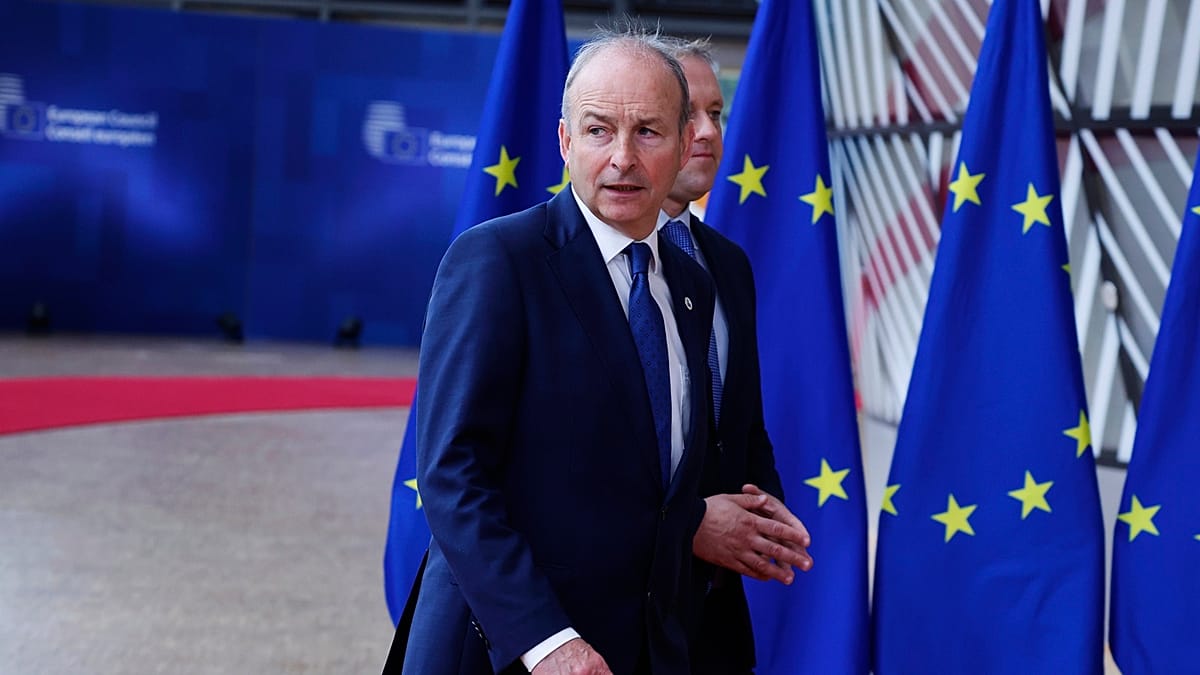
Ireland’s presidency of the EU Council, the eighth time in its history, was meant to be a proud moment to showcase the benefits that membership in the bloc has brought to the shamrock-loving republic and the diplomatic skills it has acquired as a result.
“Holding the presidency is an honour and a responsibility, and we are ready to give it our all,” Taoiseach Micheál Martin said at the presidency’s opening ceremony at Dublin Castle.
But the special occasion has been largely overshadowed by an explosive scandal over Ireland’s alumina sales to Russia, an uncomfortable, perhaps untenable, look for a country that has placed support for Ukraine at the very top of its priorities and is supposed to act as an “honest broker” amongst the other 26 member states.
For Ireland, a country whose controversies tend to revolve around Big Tech and low taxation, the perception of being an indirect enabler of the greatest armed conflict on European soil since World War II is proving to be a devastating PR crisis.
The uproar has been building up since late March, when a media group exposed the lucrative ties between Aughinish Alumina, a sprawling refinery in western Ireland, and Russia’s military-industrial complex, and was sent into overdrive this week as Ireland marked the start of its rotating presidency to much fanfare.
Martin stood stone-faced as Ukrainian President Volodymyr Zelenskyy, the guest of honour at the opening ceremony on Wednesday, publicly berated Dublin for allowing alumina exports to his country’s aggressor.
Alumina is a white powder used to manufacture aluminium, a lightweight metal that is commonly found in weapons on the battlefield in Ukraine.
“Every tonne of raw materials that ends up in Russia is used against us in this war. This is what we understand. This is how we see it,” Zelenskyy said.
Martin tried to defuse tensions, saying he had had a “good conversation” with the Ukrainian leader over the matter and promising to share the findings of an investigation with the European Commission. The probe is nearing completion, he said.
“We do not want to be in a position where material emanating from a plant in Ireland goes to support the Russian war machine,” Martin said.
Zelenskyy urged Martin to avoid procrastinating on the matter.
“We very much hope for a positive result for us in this investigation, and we hope that we won’t have to wait for it for months,” Zelenskyy said.
The following day, Thursday, Martin faced fresh questions about the alumina scandal from Brussels-based journalists who had been invited to cover the presidency’s kick-off events (Euronews was part of this press group).
The day after, on Friday, the soft-spoken Taoiseach was again forced to address the issue after hosting European Commission President Ursula von der Leyen in his hometown of Cork.
“Alumina has not been on any sanctions list so far,” Martin said, repeating a point that both his government and Aughinish have made to counter the backlash.
Von der Leyen, whose executive has targeted an exhaustive list of materials and components that aid Moscow’s war production, was succinct on her take.
“It is for Ireland to lead this investigation and to set the time frame,” she said.
A thundering headache
Ireland, it must be noted, is not the first EU country – and likely will not be the last – that is embarrassingly accused of propping up Moscow’s war economy.
Hungary and Slovakia have long been criticised for their continued reliance on Russian crude oil and pipeline gas. Spain and France have been chided for importing large amounts of Russian LNG. Greece and Malta have raised eyebrows for blockinga full ban on maritime services for Russian tankers. And Austria has been under scrutiny for the operations of Raiffeisen Bank International inside Russia.
This is just a sample of the unseemly remains that are left after the EU imposed the largest sanctions regime in its history against a nation that, until it decided to launch the full-scale invasion of Ukraine, was one of the bloc’s main trading partners.
Millions, and sometimes billions, are at stake when cutting business ties overnight.
This explains why neither Martin nor any of his deputies have offered an unequivocal commitment to allowing sanctions on alumina – if such sanctions are ever proposed. (Ironically, one of the most pressing tasks of the Irish presidency is to reach a deal on the 21st package of sanctions against Russia.)
“Ireland will never cherry-pick when it comes to sanctions. It will never cherry-pick the criteria. The criteria are clear. The criteria must be applied. That’s important,” Deputy Prime Minister Simon Harris said.
“But it’s important that we establish the facts.”
Given that Aughinish sells about half of its alumina exports to Russia, sanctions risk having devastating consequences for the company, which is Europe’s largest alumina refinery. The Irish goverment has repeatedly voiced concerns about the impact on direct and indirect jobs, the environment and Europe’s strategic supply chain.
Aughinish has lobbied Dublin to deter sanctions and has even raised the prospect of nationalisation if an export ban on alumina, Kyiv’s main request, is introduced.
Though Martin and Harris have rejected the threat of state intervention, they have also insisted that potential repercussions be duly considered.
In yet another awkward twist, Swedish authorities recently concluded that Rusal, Aughinish’s parent company, remains under the effective control of Oleg Deripaska, a Russian oligarch with close ties to the Kremlin who is under EU sanctions.
Zelenskyy honed in on this fact to accentuate his displeasure.
“Unfortunately, there are companies in Europe that are owned or effectively controlled by Russia and its sanctioned oligarchs. They keep supplying the aggressor with essential materials. Even now,” Zelenskyy said at the opening ceremony.
It remains to be seen how Dublin will get out of the alumina scandal, which, as the past few days proved, shows no signs of abating any time soon.
The findings of the investigation, once published, will open a new chapter in the saga and bring upon the government either punishment or expiation. For some, the damage is already done. For others, it can still be swept under the carpet.