
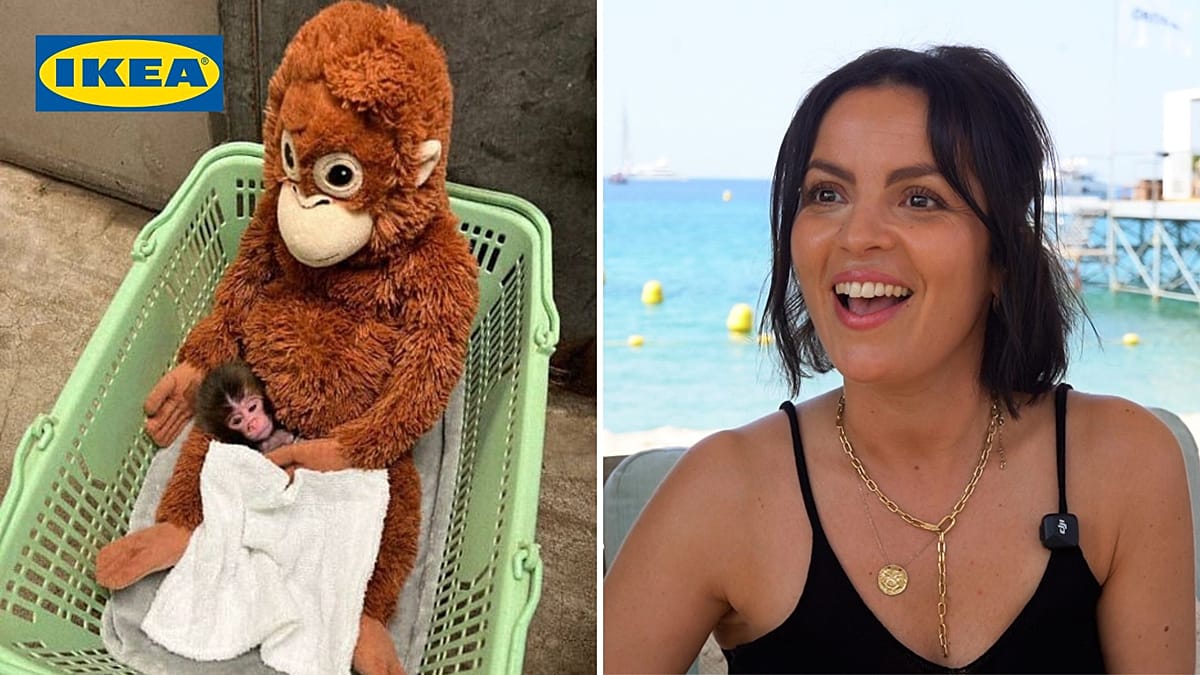
At this year’s Cannes Lions International Festival of Creativity, the spotlight was firmly on how brands are navigating an ever-changing media landscape increasingly shaped by AI, internet culture, and moments that can go viral overnight for entirely unexpected reasons.
Among the executives in attendance was Dorothée Gardon, the Global Marketing Strategy & Integrated Media Director at IKEA, who spoke to Euronews Culture about how the company is navigating innovation, affordability, and viral culture in an increasingly fast-moving media landscape.
One of the most unexpected examples of that intersection came earlier this year, when a tiny baby Japanese macaque named Punch went viral online after being filmed carrying an IKEA Djungelskog orangutan plush toy.
Clips of Punch spread across the internet, racking up millions of views and triggering a spike in sales of the toy across multiple markets. IKEA then ceased the moment with its own viral social content.
In this interview with Euronews Culture, Gardon reflects on how the Swedish company is balancing innovation, affordability, and brand identity in a fast-moving media landscape – and how Punch the monkey unexpectedly helped drive global attention for the brand.
Euronews Culture: Everyone is talking about artificial intelligence at the moment. Do you see it as a challenge to what you do, or as something complementary?
Dorothée Gardon: Very much an opportunity to everything we do. The way we’re looking at AI in IKEA, and we’re still figuring it out what it means for us as a brand, but what we see though is that it’s a wonderful amplifier of our genuine creative talent, and it can help us become much more efficient in everything we do.
We are working with our partners at Dentsu as well as internally in ensuring that we really double down on the capabilities that support us to accelerate and really get more out of the creative talents and intelligence that we have. We believe, I believe personally, that AI is wonderful at creating valuation, but it cannot replace the intelligence that comes from the human brain.
We also believe that we need to ensure that from a brand safety perspective we are always on top of everything, because hallucinations do happen.
IKEA has always been known for combining innovation with affordability. A key part of that innovation has also been championing emerging designers and new talent. How do you balance those two priorities while maintaining IKEA’s reputation for nurturing young creatives?
So I suppose the starting point of everything we do is coming from the designers. When it comes to the creative content that we do it always starts with the human brain. It always starts with ensuring that our teams are trained on representing the IKEA DNA – our playfulness, our simplicity, our twinkle in the eye.
We don’t want to have AI as the starting point but that we only utilise it in order to create more personalisation at scale for example.
Is it possible for a global brand to have too much of a good thing? How do you ensure IKEA never becomes tired or loses its appeal?
One of the things that we have to ensure is that we have everyday low prices and remain affordable. We did choose from the very beginning of IKEA to be on the side of the people, the ones with a thin wallet. And we do not want to compromise the quality, the design to enrich their life at home, but always as an affordable price.
And in a world where inflation is a real thing, where energy prices are increasing, IKEA has chosen to be on the side of the many.
We can’t let you go without asking, of course, about a certain monkey business. We’re talking about Punch the monkey and his beloved IKEA plushie – that viral moment that went global. What was it like being behind a campaign that captured so much attention?
Yes, I think this was a wonderful example of how playful and talented our communications teams are.
The post actually came from one of our social media team members. She literally filmed it behind the parking lot of our office. It’s a wonderful example of how we can tap into a cultural moment while staying true to our brand identity.
But one of the things we always try to avoid is jumping on every single trend, because not every trend is relevant for our brand. It’s about being smart and choosing the moments that genuinely align with our brand values and our identity.
The Punch campaign was a wonderful example of just how cheeky – in the best possible way – and playful IKEA can be. We created content using literally just an iPhone, and it went absolutely viral. We do not chase sophistication, we chase simplicity.
How do you see IKEA evolving over the next five years, and what impact are you personally hoping to have?
I work primarily in the media space, and what we’re really focused on is continuing to expand the ways we amplify our brand and connect with more people.
In a privacy-safe way, we’re looking at how we can use insights from our 200 million IKEA Family members to enhance their experience, become more relevant to them, continue to expand the value that IKEA can bring to people’s lives, and ultimately attract new customers.