
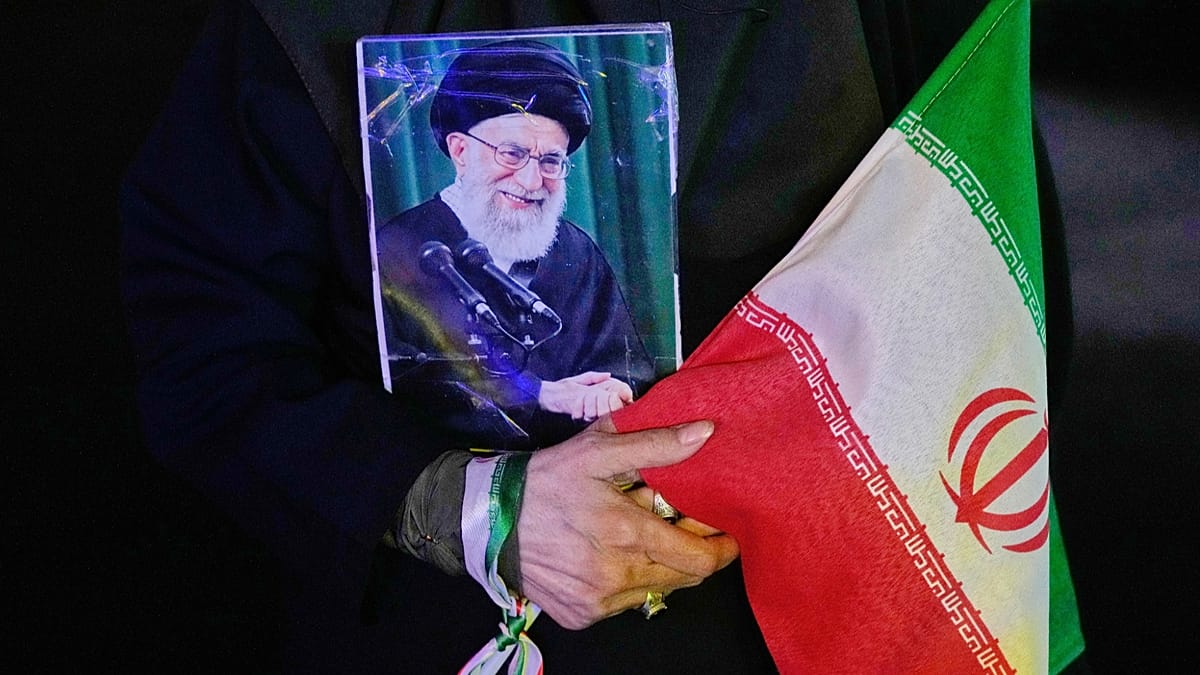
Iran is preparing the largest state funeral in the history of the Islamic Republic, with ceremonies spanning five cities across Iran and Iraq over six days beginning Saturday, as the country buries the late Ayatollah Ali Khamenei nearly four months after his death in the opening US-Israeli strikes of the war on 28 February.
Khamenei served as the Islamic Republic’s ayatollah for 37 years, the second-longest-serving holder of the position since the Islamic Republic’s founding following the 1979 revolution.
Born in 1939 in Mashhad, he served as Iran’s president from 1981 to 1989 before being selected as ayatollah by the Assembly of Experts — the elected body of Islamic scholars responsible for appointing the supreme leader — following the death of Ayatollah Ruhollah Khomeini.
The body has been lying in state since the start of the war. The four-month delay was the direct result of the war, the ceasefire and the subsequent negotiation process.
Authorities say the timing has now been set for a period of relative de-escalation, with both Iran and the US pausing exchanges of fire as talks on the memorandum of understanding continue.
Tehran is keen to ensure the ceremony proceeds without disruption in front of an international audience.
Schedule and scale
Ceremonies will begin in Tehran on Saturday and Sunday at the Mosalla prayer complex, Tehran’s main venue for large-scale state religious gatherings.
The Mosalla, whose name means “prayer ground,” has hosted the funerals of senior Islamic Republic figures and serves as the symbolic hub of state mourning ceremonies.
The main funeral procession will take place on Monday along a 10-kilometre route from Imam Hossein Square to Azadi or “Freedom” square — the vast public venue that has been the site of the defining mass gatherings of Iranian history, from the 1979 revolution to the country’s largest protests.
Tehran’s mayor has said roughly 20 million people are expected to attend, describing it as “the largest gathering in the city’s history”.
The procession will then move to Qom on 7 July, running between the shrine of Fatima Masoumeh and Jamkaran Mosque.
Qom is the centre of Shiite Islamic learning in Iran and the most important seminary city in the world for Twelver Shia Islam.
Jamkaran Mosque, on the city’s outskirts, is associated with the Hidden Imam — the Mahdi — and is among the most significant pilgrimage sites in Shia Islam.
Temperatures are expected to reach around 45 degrees Celsius.
The body will then be transferred to Iraq, where ceremonies are planned in Najaf and Karbala, the two holiest cities in Shiite Islam, which house the shrines of the First Imam, Ali, and the Third Imam, Hussein.
Iranian Foreign Minister Abbas Araghchi visited both cities during a trip to Iraq and met their governors to advance preparations.
The final burial will take place in Mashhad on 9 July.
Mashhad, Khamenei’s birthplace, is Iran’s holiest city. It is home to the shrine of Imam Reza, the Eighth Imam of Shiite Islam, and the wealthiest religious foundation in the country, the Astan Quds Razavi — a vast economic empire whose financial ties extend across state institutions including the IRGC.
Authorities estimate eight to ten million people will attend the burial.
Security, logistics and Mojtaba Khamenei’s absence
The Basij paramilitary organisation is coordinating logistics. Tehran’s highways will be converted into temporary parking areas, and mosques, schools, sports halls and universities will be converted into accommodation.
Each of Tehran’s 22 districts will host mourners from one of Iran’s 31 provinces. Flights are expected to be cancelled, and entry into major cities is expected to be tightly controlled.
The IRGC has been assigned security and crowd control in the main cities. A committee chaired by First Vice President Mohammad Reza Aref has been overseeing preparations for weeks.
It remains unclear whether Mojtaba Khamenei — Iran’s new ayatollah, who has not appeared in public since his appointment following his father’s death — will attend the ceremonies.
US media outlets reported, citing Iranian officials, that Mojtaba Khamenei sustained serious injuries in the strikes that killed his father and has undergone multiple surgeries. Iran has not confirmed those accounts.
Pakistani President Asif Ali Zardari and Prime Minister Shehbaz Sharif have confirmed that an official delegation will attend.
It remains unclear which leaders from Gulf Arab states — several of which were targeted by Iranian missiles and drones during the war — or from Russia and China will participate, and at what level.
Three funerals set precedents
The scale of what is being planned invites comparison with three previous moments of mass state mourning.
The 1989 funeral of Ayatollah Khomeini — the founder of the Islamic Republic — descended into chaos when the procession was overwhelmed by crowds, the body nearly lost, parts of the shroud torn away, and a helicopter eventually needed to complete the transport.
Out of that disarray, Ali Khamenei was selected as successor by the Assembly of Experts in what was widely seen as a surprise, including to Khamenei himself. He went on to consolidate absolute power over decades, sidelining rivals across the political spectrum.
The 2020 funeral of IRGC’s Quds Force Commander Qassem Soleimani was held with mass participation across eight cities in Iran and Iraq.
Soleimani was killed in a US drone strike at Baghdad International Airport on 3 January 2020, ordered by Trump during his first term — the first direct US killing of a senior Iranian military official.
The funeral procession in his hometown of Kerman ended in a crowd crush that killed dozens of people. Khamenei wept publicly at the ceremony.
The 2024 funeral of President Ebrahim Raisi, who died in a helicopter crash in northwest Iran in May of that year, drew large crowds across several cities.
The crash, in foggy mountain terrain near the Azerbaijani border, killed Raisi along with Foreign Minister Hossein Amir-Abdollahian and six others.
His body was transferred to Mashhad, a city of considerable religious and political significance known for its ties to the Astan Quds Razavi foundation and the IRGC.
Negotiations hinge on sticking points
The funeral is taking place against the backdrop of a fragile memorandum of understanding between Iran and the US, signed on 17 June, that opened a 60-day window for final negotiations.
Yet the underlying disputes remain substantial.
Iran’s nuclear programme is a central issue. The JCPOA — the 2015 nuclear agreement under which Iran agreed to limit enrichment in exchange for sanctions relief — was abandoned by Trump in May 2018 during his first term, triggering a progressive Iranian rollback of its commitments.
Iran’s enriched uranium stockpile has since grown to an estimated 440 kilograms at 60% enrichment, below the 90% threshold for weapons-grade material but sufficient, if further processed, to produce multiple warheads.
While Washington is demanding limits on enrichment and the removal of stockpiles, Tehran insists its nuclear rights are non-negotiable and that concessions depend on concrete sanctions relief first.
Iran is also seeking the release of billions of dollars in assets held abroad, but disputes with Washington over how the funds may be used have created additional friction.
Further rounds of talks co-mediated by Pakistan and Qatar are expected in Doha on Tuesday.