
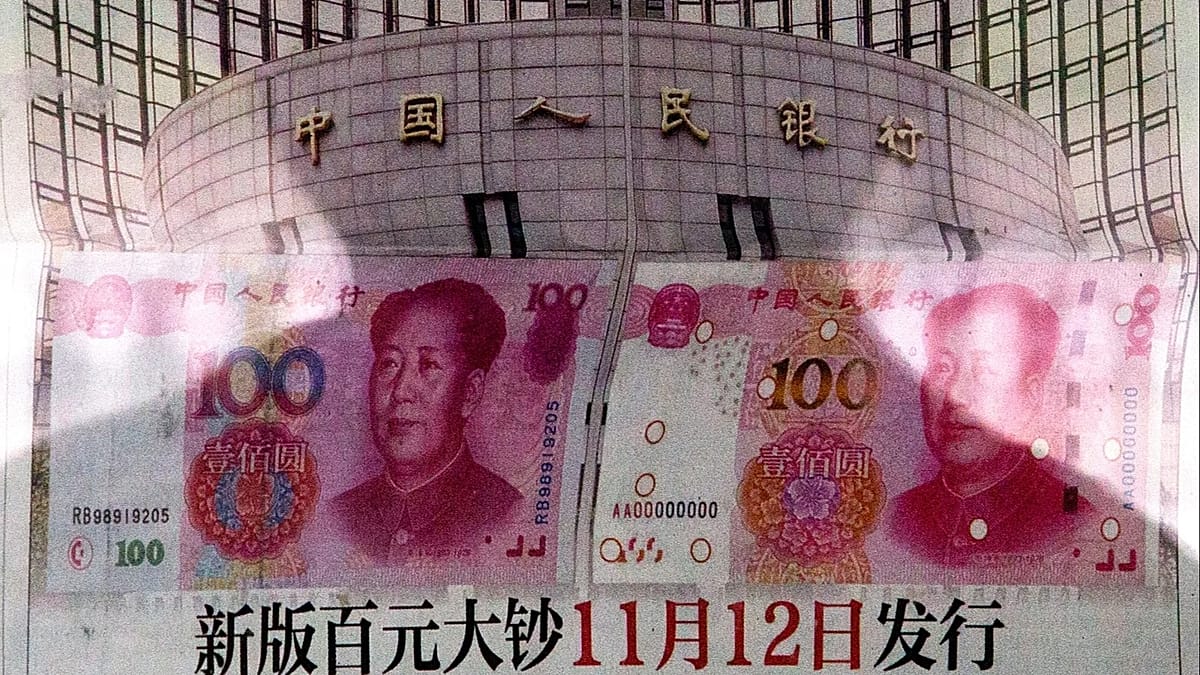
As the European Union tries to fight its record-high €1 billion deficit per day with China, the bloc’s leaders are increasingly pointing to the problem of currency manipulation, which they say Beijing is using to make products even cheaper on the EU market – which is already flooded with Chinese imports.
“An artificially low currency is an advantage for those who want to improve their economic competition positions,” German Chancellor Friedrich Merz said after the European Council summit on 19 June.
The matter of the Chinese currency and its management was also high on the agenda of last week’s G7 summit in France.
The signs are that this is a new front in Europe’s trade battle against Beijing. To understand why the devaluation of the yuan (or renminbi) matters, here are three things to know.
What’s wrong with the Chinese currency?
According to a report by the Haut Commissariat à la Stratégie au Plan, a French government advisory body, the undervaluation of the yuan is estimated at around 20-25 percent.
“While there is no universally recognised method for determining unequivocally whether a currency is significantly overvalued or undervalued, the assessment that the renminbi (RMB) is significantly undervalued is now widely shared, including among international institutions,” the report said.
In theory, China’s trade surpluses should naturally create demand for the yuan, leading to an appreciation of the currency, but it is not the case.
However, the devaluation of the yuan might not be the direct result of central bank intervention. Alicia Garcia-Herrero, an expert at the Brussels-based think tank Bruegel, told Euronews that China prevents its currency from appreciating faster by not bringing all of its export revenues back to the mainland.
“They stay in Hong Kong and they are not converted into RMB,” she said.
How does it impact trade between China and the EU?
The EU deficit with China hit a record-high €359.9 billion in 2025. That same year marked the first time that all EU member states had a trade deficit with Beijing, including Germany, the EU’s largest economy.
“This is simply not sustainable,” European Commission President Ursula von der Leyen said last Friday.
According to the Haut Commissariat au Plan report, the undervaluation of the yuan plays a large part in keeping Chinese products competitive; as things stand, they are assessed by EU industry to be around 30-40 percent cheaper than European equivalents.
However, Garcia-Herrero pointed out that the inflation differential also plays a great part.
“My estimate is that the inflation differential and its accumulation in Europe since the invasion of Ukraine explains about three quarters of the loss in external competitiveness,” she said.
What can the EU do?
In his remarks last Friday, Merz suggested the EU begin dialogue with China on the currency issue.
“We have to talk about this topic with each other,” he said. “It is in the interest of both sides.”
The German chancellor cited the 1985 Plaza Agreement, which saw the US, Japan, West Germany, the UK and France agree to depreciate the US dollar against the Japanese yen and the Deutsche Mark. The goal was to head off a protectionist turn from the US as its trade deficit deepened.
Merz also referred to the European Monetary System, which before the adoption of the euro relied on exchange-rate bands to limit currency fluctuations.
“That was a system where countries could coordinate through exchange-rate corridors,” he said.
Conversely, Garcia-Herrero points out that the US did not push for any such negotiation when economic imbalances were discussed during the G7 last week.
In her view, Europe should monitor China’s export prices for major sector-by-sector deviations, since this is an important sign of overcapacity, as negative price growth occurs when goods cannot be sold.