
The EU’s €90 billion loan for Ukraine is set to start flowing in mid-June, but the cash envelope comes with question marks.
So far, the shopping list it will fund has been closely guarded by Ukraine. It seems inevitable that the lion’s share of the money will be dedicated to repelling Russian aggression, but it remains unclear how or where it will be spent.
Ukrainian President Volodymyr Zelenskyy has said the package’s defence allocation will strengthen Ukraine’s army against Russia’s ongoing full-scale invasion, now grinding into its fifth year, and some €60 billion is expected to be used to bolster the country’s defences during wartime, with the remainder propping up the country’s national budget.
The money will be used for arms production and the procurement of necessary weapons that, if not produced in Ukraine, will be sourced from partners, Zelenskyy said in a statement posted on social media platform X in April.
As is generally the case for matters pertinent to any country’s national security**,** Ukraine’s Ministry of Defence has not responded to Euronews’ request for comment on how the funds will be spent on defensive capabilities.
When the loan was set up, various EU member states voiced their objections, calling for the cash to be spent on European capabilities considering this was European money.
Luigi Scazzieri from the EU Institute for Security Studies (ISS) said France was among the loudest critics, arguing that to scale up production in Europe, orders must be sent to European firms. But in the end, the whole agreement has been engineered in order to satisfy the bloc as a whole.
“You have countries like Sweden, the Netherlands, Poland, and to a degree, Germany, that tend to argue that actually you need to be as flexible as possible,” Scazzieri said. “There’s always a compromise between these different positions.”
So what compromise has been reached? This is what’s known so far about Ukraine’s plans – and the potential obstacles they face.
Rules and expectations
The EU has a strict three-tiered approach to mandate how the defence money can be used.
In the first instance, all products bought must be made in Ukraine, Europe or the EEA/EFTA; beyond that, Ukraine can buy products made by 12 countries that have signed a security partnership with the EU, among them the United Kingdom and Canada.
European Commission spokesperson Balazs Ujvari said that if these two options are exhausted, “and it is genuinely justified to go beyond” their boundaries, then Ukraine can legitimately buy systems from other nations.
Two EU diplomatic sources speaking to Euronews confirmed that there is an expectation that the money will be spent on European products where possible, as was set out in the loan rulebook.
“You buy European, unless the purchase fits into one of the agreed exemptions, such as lack of product in the EU or long delivery time,” one source clarified. “The question is, which country?”
The other source said if there’s “an emergency” and there is no equivalent in Europe, Ukraine can go to other suppliers. “Bearing in mind that has to be urgent and the materials should come very urgently as well,” they said.
A senior EU official reiterated this, saying there is an institutional belief the money, where possible, will be spent on stimulating Europe’s defence industry – a sector that has suffered from years of underinvestment and persistent fragmentation.
As various intelligence agencies warn the continent could face a Russian attack on a member state by the end of the decade, there is more and more pressure to give Europe’s defence industry the cash injection it needs to defend against these threats. But there is also a real need for the industry to be more agile.
The EU’s current and first ever European Commissioner for Defence, Andrius Kubilius, has repeatedly declared that the EU needs to produce “good enough” rather than “haute couture” weapons.
This refers to the production of cheaper and more scalable arms to supply Ukraine rather than painstakingly perfecting systems over years — a timescale that can lead to obsolescence.
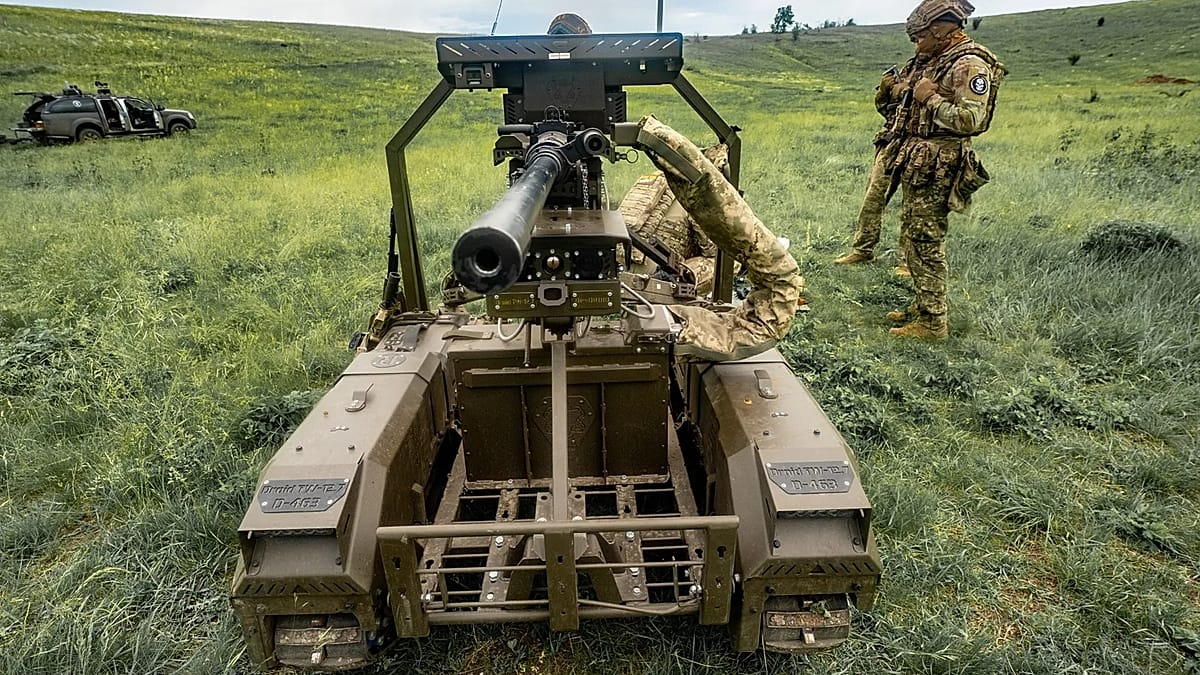
To illustrate the gap, European production of military equipment lags far behind Ukraine, especially in unmanned aerial vehicles. This likely explains why the first disbursement will go toward purchasing Ukrainian drones.
The disbursements
The first tranche of funding earmarked for defence, approved by the Commission and worth €5.9 billion, is expected to be disbursed later this month. Oscar Luigi Guccione from the German Marshall Fund said it will probably amount to 3 million drones at an average cost of €2,000 each.
“Ukraine would like to spend the most of this money inside Ukraine,” he said.
One EU source said that there were exemptions to this order, submitted 12 March, as “some drone parts were produced outside the EU and Ukraine”.
According to Scazzieri, these are most likely Chinese-produced microchips, key components also found in Russian Shahed drones.
European Commission spokesperson Balazs Ujvari confirmed the 12 March order came with a derogation request “which was granted”. However, the Commission could not disclose any information about the derogation due to the sensitive nature of the information.
A source close to the discussions confirmed the second envelope of cash will most likely be spent on ammunition, missiles and air defence, with the figure not yet finalised.
But whether this will be spent in Europe is yet to be seen. One senior EU official said that while there’s clear desire to from both sides for purchases to remain European, the continent’s defence industrial complex cannot meet Ukraine’s demands.
An example of this is Europe’s answer to the US-made Patriot air-defence missile: the Franco-Italian SAMP/T air defence system.
As the US’s involvement in the war in Iran and Lebanon intensifies, Patriot missile supplies are dwindling. But the Eurosam consortium, a joint venture between military heavyweights MBDA and Thales, has been producing its own long-range weapon to defend against aircraft, cruise missiles and tactical ballistic missiles. Denmark announced late last year it would buy two systems to integrate into its ground-based air defences.
“The systems have been selected based on an overall assessment of operational, economic, and strategic factors,” the Danish Defence Ministry said at the time.
The decision came after months of threats from US President Donald Trump to seize the Danish territory of Greenland, and was seen as a major blow to Washington.
The opportunity created by shortages of Patriot supplies and the political purchasing power behind these large orders needs to be maximised, according to Guntram Wolff of the European Policy Centre.
“It’s really in our interest that this is happening,” he said.
But the problem remains that Europe cannot yet accelerate production to keep pace with the conflict.
One EU diplomat said that stocks of Patriot missiles have now been exhausted until 2029, and there is little chance of Ukrainian orders for them being filled before this timeframe – and another senior EU official said that the orders for the SAMP/Ts are not materialising either because the production capacity simply is not available. Wolff argued now is the time to change that.
“Everybody just automatically buys in the US. I think it’s high time that we start buying from these domestic suppliers,” he said.