
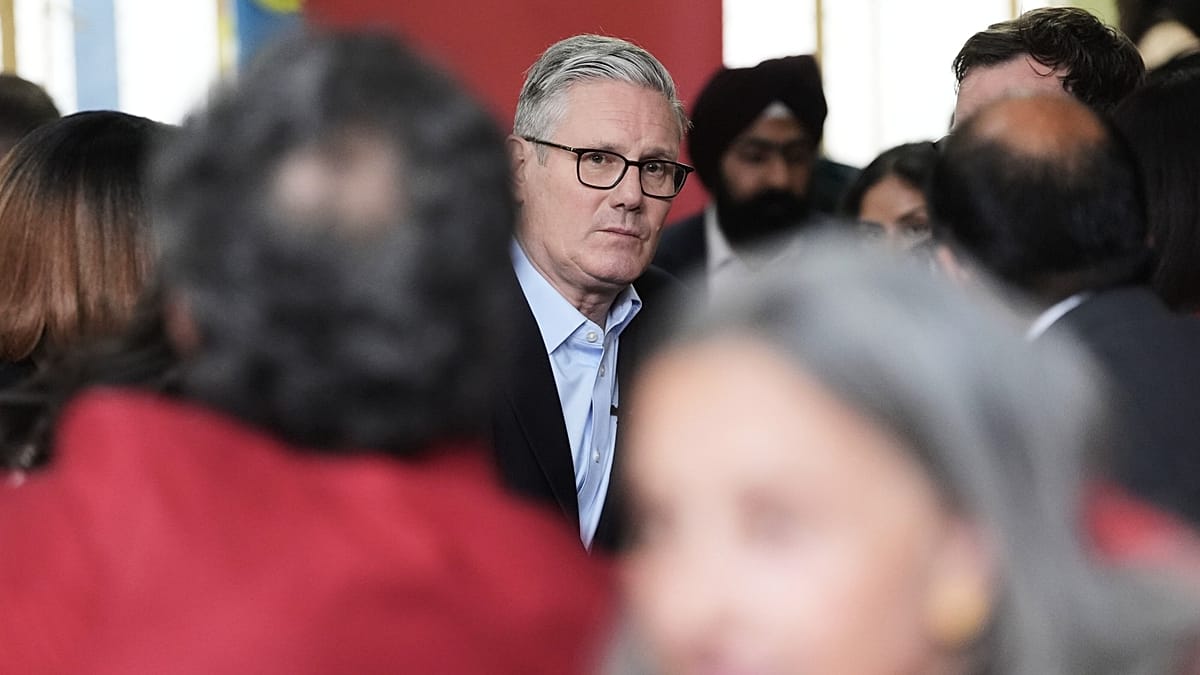
“I’m not going to walk away and plunge the country into chaos,” British Prime Minister Sir Keir Starmer said on Friday after local election results showed millions of voters had abandoned his Labour Party.
It is a far cry from the general election less than two years ago that saw Labour win one of the largest majorities in British parliamentary history.
Starmer admitted that the elections — which saw hundreds of Labour councillors lose seats amid massive gains for Nigel Farage’s Reform UK party — were painful. “The results are tough, they are very tough, and there’s no sugarcoating it,” he said.
He is already planning a reboot of his premiership, starting on Monday, with a major speech that is expected to promise closer ties with the European Union.
That ties in with the political mood. Almost ten years on from the Brexit referendum, voters see the decision to leave the EU as a mistake by a two-to-one margin.
Brussels sees opportunity — and danger
In Brussels, officials will welcome improved relations, after a decade defined by Britain’s rancorous divorce from the EU. Global events, from the war in Ukraine to the re-election of Donald Trump, have already brought the UK and EU closer, particularly on defence issues.
Starmer has played a vital role in rallying the so-called coalition of the willing behind Ukraine, which last year pledged strengthened support as the US pulled back its aid for Kyiv. He has also aligned with the EU’s cautionary tone on the war in Iran, calling for restraint despite fierce criticism from US President Donald Trump for not joining the conflict.
However, the EU will be wary too.
Starmer is historically weak. National polls show Labour support hovering under 20%, sometimes behind both the Conservatives and the Green party. They are well behind Reform, at around 25%.
Starmer’s personal ratings are catastrophic: polls show just 19% of voters approve of his leadership, and his net approval is minus 45%. Betting markets now have his exit as an effective coin-toss before the end of June.
Rivals within the Labour are circling. Rumours abound in Westminster about potential challenges from the likes of former Deputy Prime Minister Angela Rayner, Health Secretary Wes Streeting and Mayor of Manchester Andy Burnham.
That matters in Brussels, where there is little appetite for reopening difficult negotiations only to see a weakened UK government retreat under domestic pressure or be overtaken by events. “Anything that comes up would still need to be negotiated — and we’ll be careful about going all in with Starmer if he’s out in a few months,” said one EU diplomat.
And what about the longer term? Reform UK has been leading the polls since early 2025, and bookmakers have them odds-on to win the next general election, which must take place by 2029.
Even if voters have warmed to the EU, the likeliest next prime minister is Nigel Farage, who also led Reform’s previous incarnation, the Brexit Party. He has pledged a harder approach to the EU, including a renegotiation of the post-Brexit trade deal to strip EU citizens of benefit rights.
“Ever since Brexit, there has been a concern in Brussels about Britain making commitments that it cannot fulfil, especially if they could be reversed by a Farage government,” says Fabian Zuleeg, chief executive of the European Policy Centre.
Slow reset, lingering suspicion
But even beyond political questions about the fate of Starmer and Labour, the EU has found it hard to measure the UK’s engagement. Despite Starmer’s much-vaunted “reset” after entering Downing Street, progress has been slow and heavily constrained by Labour’s own red lines: no return to the Single Market, customs union or freedom of movement.
Negotiations have advanced in some areas, notably on defence cooperation, energy links and a veterinary agreement aimed at reducing post-Brexit trade friction. Yet many of the headline ambitions remain bogged down in technical disputes over funding, regulatory alignment and youth mobility schemes.
Talks on UK participation in the EU’s €150 billion SAFE defence fund have already run into arguments over financial contributions, while negotiations on student fees and mobility caps have become politically toxic in London.
In Brussels, there is also frustration that Britain still appears uncertain about what kind of long-term relationship it actually wants.
EU officials increasingly argue that London cannot simultaneously demand deeper access to parts of the Single Market while rejecting many of the obligations that come with it. The old Brexit-era suspicion of British “cherry-picking” has never fully disappeared.
For now, European leaders still see Starmer as serious, pragmatic and infinitely preferable to the chaos of Boris Johnson, one of his predecessors.
But privately, officials worry that his weakening political position could make even modest agreements harder to deliver.
Few in Brussels want to spend political capital negotiating sensitive deals with a British prime minister who may not survive long enough to implement them — or whose successor could unravel them all over again.