
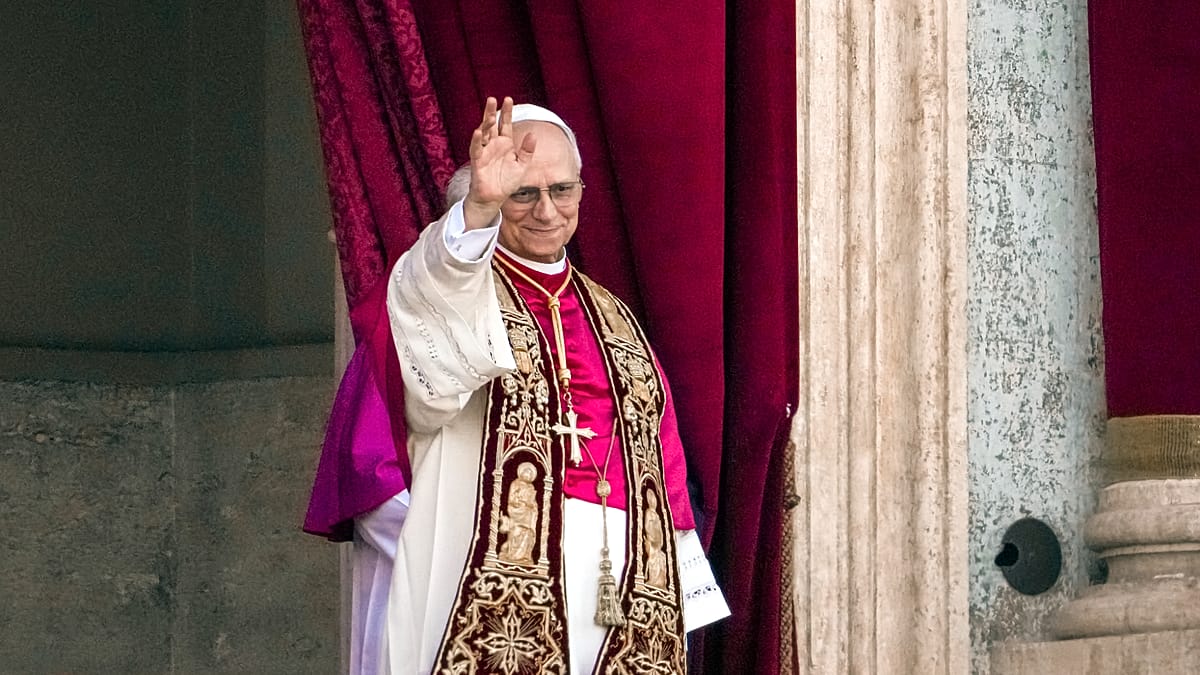
One year ago, Robert Francis Prevost emerged from the conclave as Leo XIV with the aim and the hope of his electors to find a balance between his two predecessors, the conservative Benedict XVI and the revolutionary Francis.
The Pope spent this anniversary in a community, that of Pompeii and Naples, where he met volunteers and disadvantaged young people and then thousands of faithful, to whom he addressed a message not unrelated to the international current events of these times.
“May there come from the God of peace a superabundant outpouring of mercy, which touches hearts, appeases grudges and fratricidal hatreds and enlightens those who have special governmental responsibilities,” he said on Friday in the homily of the Mass celebrated in the square in Pompei.
“The wars still being fought in so many regions of the world call for a renewed commitment not only economic and political, but also spiritual and religious. Peace is born within the heart,” Leone invoked, “we cannot resign ourselves to the images of death that the chronicles propose to us every day.”
In closing, before moving on to Naples, where some thirty thousand people await him in Piazza Plebiscito, he warned that “many call themselves Christians but offend God.”
The 70-year-old pope from Chicago, the first in history to come from the United States, probably imagined a turbulent relationship with Donald Trump’s White House, but perhaps not to find himself on 8 May 2026 in the midst of another war in the Middle East and Trump’s fierce offensive against the Holy See, which prompted a tepid reparatory meeting with Secretary of State Marco Rubio on Thursday.
The call for an “unarmed and disarming, humble and persevering peace” twelve months ago from the central loggia of St. Peter’s has for now been drowned in bombings by Israel, the United States, Iran and Russia, but the Augustinian missionary’s original mission remains.
The ‘Pax Leonina’: a return to the Vatican tradition but with the politics of Francis
In the search for Pope Francis’s successor, voters wanted a stable leader who could manage the Church’s internal conflicts.
Cardinal Prevost wasn’t a favourite at first, but he became a key compromise choice. Since he was in charge of appointing bishops worldwide, most cardinals in the Sistine Chapel already knew and trusted him.
Pope Leo made immediate concessions to the conservative wing of the Church, particularly its influential base in the United States. He appeared as Pope in traditional vestments, a sharp contrast to his predecessor, who had famously swapped formal robes for a simple white cassock.
He decided to reopen the papal flats in the Apostolic Palace, letting the floor of Casa Santa Marta, occupied by Francis, return to its function as guest quarters.
The new Pope also acknowledged the Curia as ‘the memory of the Church,’ noting that while ‘popes pass away,’ the institution remains. He even allowed the ultra-conservative U.S. Cardinal Raymond Burke – ostracized for years due to his demands for a return to traditional liturgy – to celebrate a Latin Mass at St. Peter’s in October 2025.
The rest of his work focused on rebuilding balance and hierarchy without seeking the spotlight, except when necessary. This was seen in his sharp responses to Donald Trump, who had accused him of weakness on foreign policy and the Iranian nuclear issue, claiming his stance would put “many Catholics in danger”.
The Pope’s calm detachment, reflected in statements such as ‘I am not afraid of the Trump administration’ and ‘I am not a politician,’ has been part of an anti-war message repeated since day one.
“In this first year, marked by wars, tensions and conflict-laden language,” the Italian Episcopal Community (Cei) emphasised in a message of good wishes to the Pontiff, “His voice has called everyone to the responsibility of peace: not as an abstract formula, but as an evangelical requirement and daily task, a way of truth, justice and dialogue.”
“Let us thank God for the gift of Pope Leo”, “a meek man who speaks of love and unity”, wrote Matteo Maria Zuppi, president of Cei and one of the main cardinals in the Conclave, on Friday in the daily Avvenire , quoting the Pontiff: “We must seek together a missionary church, which builds bridges and dialogue, always open to receive with open arms”.
On some issues, in fact, the mathematician by training and former Prior General of the Augustinian order has sought collegiality, recovering the consultative instrument of the bishops’ consistories, which were rarely used in the previous decade, while on others he has traced Francis’ Jesuit third-worldism.
As for finances, Pope Leo made the limits of the IOR (the Institute for Religious Works, the Vatican bank, at the centre of numerous scandals in the past) very clear very early on, removing from it the exclusive competence for the management of the Holy See’s Patrimony, entrusting it to the Curia bodies.
The main stages of Leo XIV’s first year as Pope
Prevost has so far marked the papacy by a studied protocol, with some concessions to his past, such as the visit to the Shrine of the Mother of Good Counsel, run by the Augustinians at Genazzano on the outskirts of Rome, and to the General House of the order next to St. Peter’s, in the days following his election.
The solemn mass at the beginning of the Pontificate on 18 May in St. Peter’s Square and the first general audience three days later began a period of adjustment that ended with the first apostolic journey the following autumn.
The visit to Turkey and Lebanon from 27 November to 2 December 2025, already planned by his predecessor for the 1700th anniversary of the Council of Nicaea, relaunched the message of an ecumenical faith with the other Christian denominations.
Just before Christmas, came the appointment of Ronald A. Hicks as Archbishop of New York, following the resignation of Timothy Dolan, a 59-year-old progressive in place of the champion of US Identitarian Catholicism.
Pope Leo inaugurated 2026 by closing the Holy Door in St Peter’s Basilica and the Jubilee year on 6 January.
In March the first three appointments of weight, after the confirmation of Cardinal Pietro Parolin at the Secretariat of State: Archbishop Paolo Rudelli as Substitute for General Affairs at the Secretariat of State, the Vatican’s ‘Ministry of the Interior’; the transfer of Venezuelan Archbishop Edgar Peña Parra to the nunciature at Italy and San Marino and that of Petar Rajič to the Prefecture of the Papal Household which manages the Pope’s agenda.
The long trip to Africa from 13th to 23rd April – between Algeria, Cameroon, Angola and Equatorial Guinea – instead set Pope Leo’s first real apostolic signature abroad, after a brief visit to the Principality of Monaco.
In another significant moment, on 27 April the Pope received the first Archbishop of Canterbury, Sara Mullally, the highest spiritual authority of the Anglican Church, at the Vatican.
Awaiting Leo XIV now are the apostolic journey to Spain between Madrid, Barcelona and the Canary Islands (6-12 June) and the pastoral visit to Lampedusa on 4 July.