
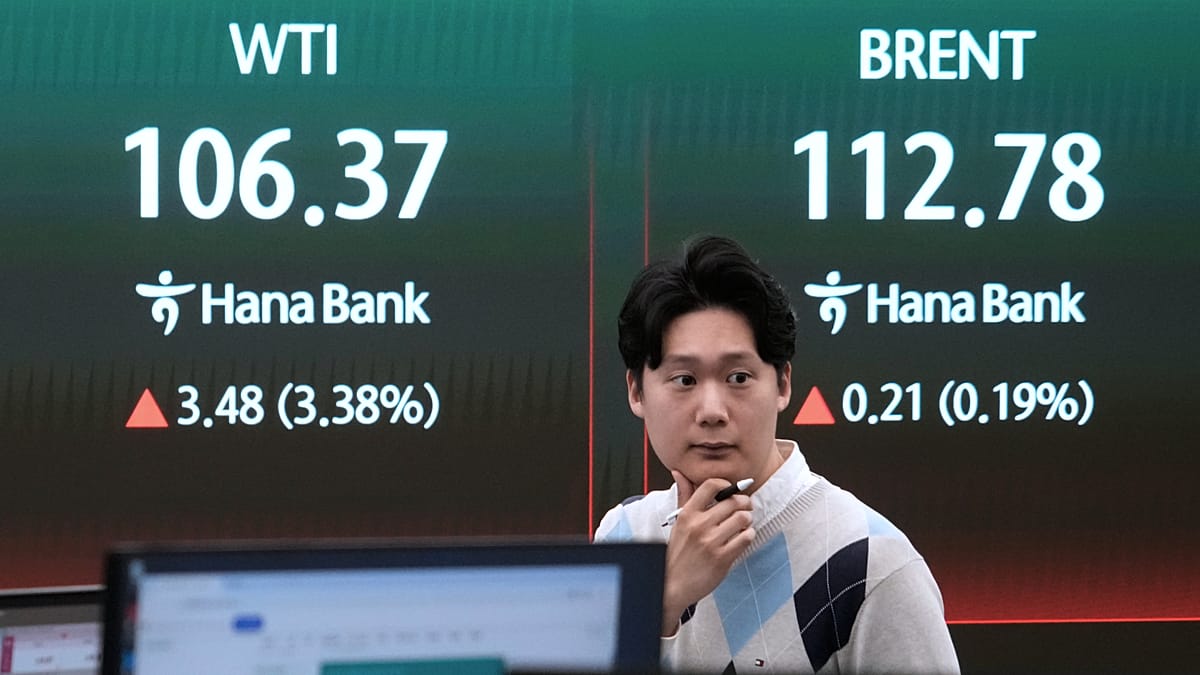
Investors remain wary, as the Wall Street Journal report came on the same day the US president threatened to destroy Iran’s key oil export hub and desalination plants unless it accepts a deal, while also suggesting that diplomacy was making progress.
The news comes as governments around the world scramble to implement measures to ease the burden of surging fuel prices while also seeking to conserve energy, with around one-fifth of global crude oil and gas passing through the waterway.
The Wall Street Journal, citing administration officials, said Trump and his aides had concluded that a mission to reopen the waterway would extend beyond his four- to six-week timeline. It added that he had decided to focus on targeting Iran’s missiles and navy, before seeking to pressure the country diplomatically to reopen the Strait.
Further fuelling concerns, a drone struck a Kuwaiti oil tanker in Dubai waters, causing a fire on Tuesday morning. Dubai authorities said the blaze had already been extinguished, but concerns about a potential oil spill remain.
Maritime traffic disruptions in the Strait of Hormuz, through which roughly a fifth of the world’s oil normally passes, remain a key pressure point for global energy supplies. US Secretary of State Marco Rubio said Trump has “options available” in response to Tehran’s threats to control the strait, after Iran was reported to have effectively created a “toll booth” there.
Both major oil benchmarks fell on Tuesday, though West Texas Intermediate and Brent crude remained well above $100 a barrel. At 7 a.m. CET, the international benchmark Brent was trading at nearly $113, while WTI crude was above $102 a barrel.
Most equity markets in Asia rose briefly, but by this point Tokyo’s Nikkei 225 was down 1.3%, South Korea’s Kospi had fallen 3.3%, Hong Kong’s Hang Seng had shed 0.5%, and the Shanghai Composite index was down 0.4%.
US futures were up between 0.6% and 0.8%.
In other early Tuesday trading, gold and silver prices rose. Gold was up 0.7% at $4,587.80 an ounce, while silver climbed 2.4% to $72.25 per ounce.
The US dollar stood at 159.61 Japanese yen, down from 159.71 yen. The euro was trading at $1.1472, up from $1.1465.