
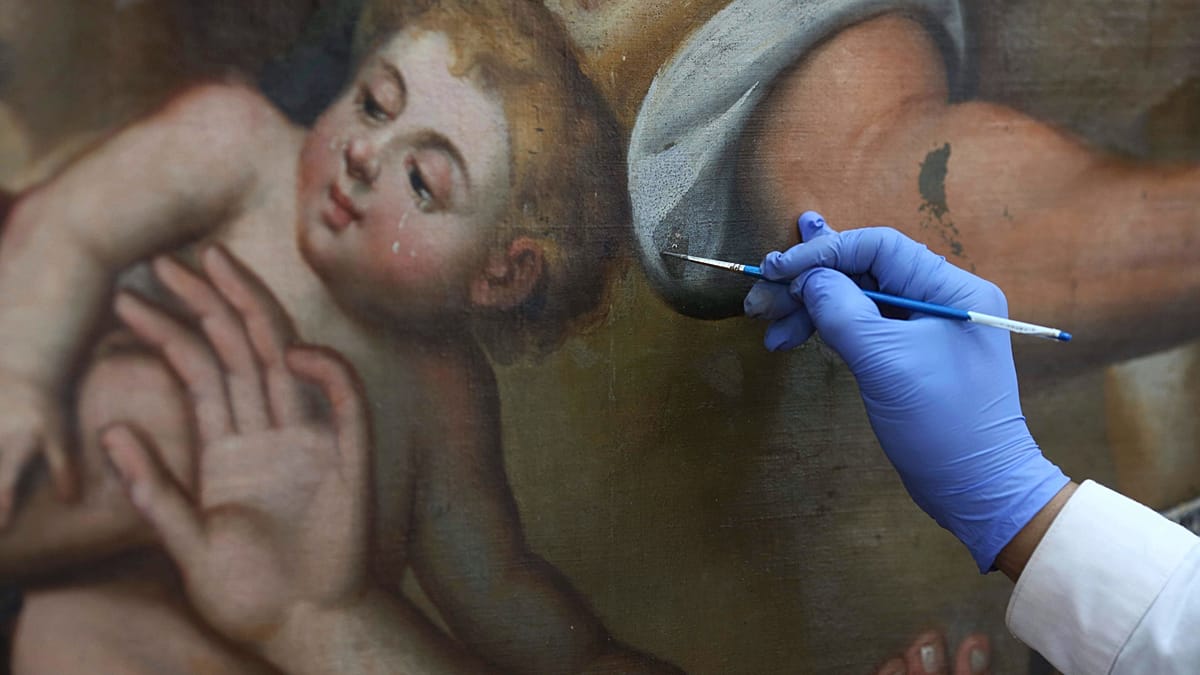
An art gallery or museum’s collection often extends well beyond its public exhibits, reaching into storage facilities and workshops where damaged pieces are carefully mended and preserved.
Art conservation and restoration are intensive, detailed processes, requiring an interdisciplinary understanding of art history, chemistry, physics, and conservation science.
From using infrared imaging to identify losses of paint hidden below a painting’s surface to choosing solvents that can remove layers of oxidised varnish without damaging the artwork underneath, art restoration and conservation demand precision.
Even well-resourced institutions like the Louvre and the Met dedicate entire departments to it. Now, new developments in artificial intelligence (AI) and chemistry promise to make that work faster, cheaper, and more environmentally friendly.
AI In Art Restoration
What if artificial intelligence could restore a painting in a few hours?
A new method analyses a damaged painting, creates a digitally restored copy, and prints this onto an extremely thin polymer film which serves as a laminate mask.
This mask can then be placed over the painting and even be removed later, retaining the original piece.
This method was tested on a highly-damaged 15th century oil painting, according to an article published in Nature.
Over 57,000 hues were restored in just over 3 hours. This approach is said to be about 66 times faster than conventional inpainting.
The method was developed by Alex Kachkine, a graduate researcher at Massachusetts Institute of Technology (MIT), last June.
The new method may also fill a gap between ethical concerns and art restoration practices, according to Hartmut Kutzke, professor and chemist at the University of Oslo’s Museum of Cultural History.
Modern conservation ethics is sceptical of heavy-handed retouching of damaged pieces, arguing that it alters a piece’s context and meaning, according to Kutzke. These standards also require that, if retouching is necessary, the changes should be reversible. Kachkine’s removable laminate mask allows for this reversibility.
He points out that this method also allows for changes to be closely documented and revisited later in time.
“Because there’s a digital record of what mask was used, in 100 years, the next time someone is working with this, they’ll have an extremely clear understanding of what was done to the painting,” Kachkine told MIT News.
While this innovation may shave down the time and resources needed to restore an artwork, it still requires consultation with conservators and art historians who understand a piece’s origins, according to Kachkine.
Environmentally Friendly Materials for Conservation
Researchers are developing conservation materials from renewable and recycled sources, offering greener alternatives to the harmful chemicals traditionally used in the field.
The GREENART project, a research collaboration developing eco-friendly solutions for the conservation and restoration of cultural artefacts, received a three-year EU-funded grant until 2025. Among the range of products that have been produced by the collaboration, researchers have developed innovative cleaning gels and protective coatings that can be used in art conservation.
A group of cleaning gels, called twin-chain polyvinyl alcohol hydrogels, was developed by GREENART researchers, a project funded by the European Union, to make them more sustainable. These gels, made from polyvinyl alcohol (PVA) polymers, feature a sponge-like, porous structure that allows for a more controlled and faster cleaning of dirt and aged coatings on paintings. Parts of the PVA polymer are “decorated,” according to the researchers, with non-toxic synthetic and bio-based polymers—making the cleaning gels more sustainable.
Over the last year, London’s Tate Britain has used sustainable hydrogels developed by GREENART to safely clean two of the British artist Bridget Riley’s paintings: Fall (1963) and Hesitate (1964). The latter was cleaned for the first time in February.
More Chemical Creativity
Beijing-based researchers are also finding new chemical approaches to cultural heritage conservation. A review published in Nature in January suggests that cellulose derivatives, particularly cellulose ethers and nanocelluloses, can be used to treat aged paper artefacts due to their adhesive qualities.
These derivatives can also provide coating conservation for oil paintings and textiles. Crucially, they are renewable and low-toxicity, furthering the green requirements of heritage conservation, according to the researchers.
The review also notes the potential use of cellulose derivatives for the reinforcement and restoration of pottery, porcelain, and murals.
While existing research largely explores paper and wood artefacts, the adhesive properties of cellulose adhesives and the reinforcing effect of nanocellulose can help precisely repair cracks in pottery. For murals, nanocellulose could be used to develop water-resistant and breathable coatings, the researchers say.
For interdisciplinary practices such as art restoration and conservation, scientific innovations like these can be crucial as conservators tackle new challenges posed by climate change and an evolving technological landscape.