
Close Menu
Daily Guardian EuropeDaily Guardian Europe
  • Home
  • Europe
  • World
  • Politics
  • Business
  • Lifestyle
  • Sports
  • Travel
  • Environment
  • Culture
  • Press Release
  • Trending
What's On

Japan tourism is booming as travellers look beyond Tokyo and Kyoto

March 12, 2026

Droht eine neue Phase im Iran-Krieg? – POLITICO

March 12, 2026

Global banks tighten security in Gulf hubs after new Iran threat

March 12, 2026

Trump administration could suspend the Jones Act in a bid to curb soaring oil prices

March 12, 2026

Paris to Berlin night train set to restart later this month

March 12, 2026
Facebook X (Twitter) Instagram
Web Stories
Facebook X (Twitter) Instagram
Daily Guardian Europe
Newsletter
  • Home
  • Europe
  • World
  • Politics
  • Business
  • Lifestyle
  • Sports
  • Travel
  • Environment
  • Culture
  • Press Release
  • Trending
Daily Guardian EuropeDaily Guardian Europe
Home»Lifestyle
Lifestyle

‘Enemy technology infrastructure’: Iran threatens Amazon, Google and Microsoft assets in Middle East

By staffMarch 12, 20263 Mins Read
‘Enemy technology infrastructure’: Iran threatens Amazon, Google and Microsoft assets in Middle East
Share
Facebook Twitter LinkedIn Pinterest Email

Published on
12/03/2026 – 14:14 GMT+1

Iran could target American Big Tech as tensions with the United States continue to escalate, according to the Iranian news agency Tasnim, which has ties to the Islamic Revolutionary Guard Corps (IRGC).

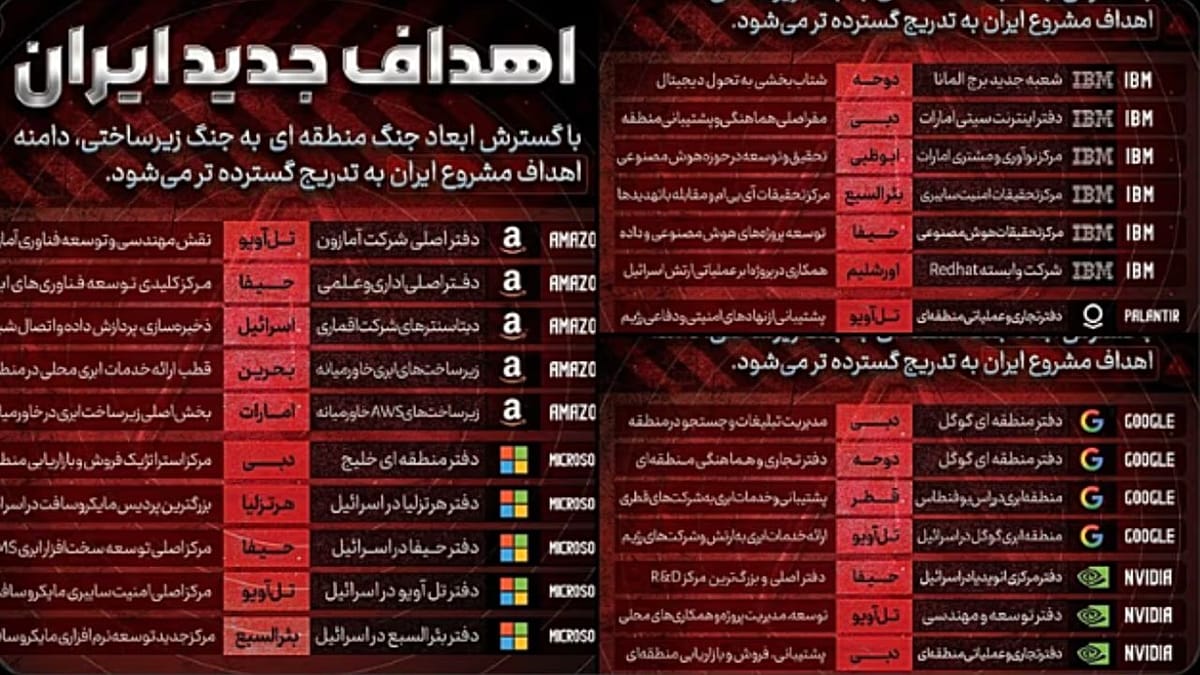
The news agency wrote on X that assets of companies such as Amazon, Microsoft, Google, Oracle, NVIDIA, IBM, and Palantir in roughly 30 locations throughout the Middle East are Iran’s “new targets in the region.” The message claimed that these sites have been identified as “enemy technology infrastructure.”

Several locations highlighted by Tasnim are in Dubai, United Arab Emirates (UAE), and in Tel Aviv, Israel. In Tel Aviv, the list includes the main offices of defence technology company Palantir, as well as offices belonging to Amazon and Microsoft, along with Nvidia’s engineering and development centre.

According to the list, most locations were selected due to their involvement in developing artificial intelligence (AI) systems or because they coordinate cloud computing services across the Middle East.

Euronews Next contacted Microsoft, Nvidia, Amazon, Google, Oracle, IBM, and Palantir but did not receive immediate responses.

Two of Amazon’s data centres in the UAE, another target on the list, were hit on March 1. A third data centre in Bahrain was damaged after it was hit by falling debris from another attack site.

The IRGC previously claimed responsibility for the attacks, telling state media that the attacks were aimed at identifying the role of these centres in supporting the enemy’s military and intelligence activities.

Offices targeted due to military links

Four offices belonging to Oracle, IBM, and Google in Jerusalem, Tel Aviv, and Abu Dhabi were singled out because they allegedly provide infrastructure for “military entities,” the post said.

Amazon and Alphabet, Google’s parent company, were awarded a $1.2 billion (€1 billion) contract in 2021 from the Israeli government to work on Project Nimbus, which provided Israel with “core tech infrastructure,” according to a 2025 report from UN rapporteur Francesca Albanese on the situation of human rights in occupied Palestine.

These companies and Microsoft grant Israel “virtually government-wide access to their cloud and AI technologies,” Albanese’s report read.

The report also claims that IBM has trained Israeli military and intelligence personnel and that there is “reasonable ground” to believe that Palantir provided automatic predictive policing technology to the Israeli government to process data and generate lists of targets in Palestine.

Oracle was not mentioned in Albanese’s report. However, media research organisation The Middle East Monitor reported that executives at the company pushed to embed a “love for Israel” in American culture.

The US Department of War also recently awarded the company an $88 million (€74.4 million) contract to integrate its cloud computing software with the US Air Force.

Share. Facebook Twitter Pinterest LinkedIn Tumblr Email

Keep Reading

EU Parliament urges new rules to protect creative works from AI training

Supercomputers and sustainability: Taiwanese company Gigabyte shares vision for democratising AI

How Dassault Systèmes AI companions redefine industrial design and manufacturing

Would a taxpayer-funded European social media platform work?

Meta faces privacy lawsuit over AI smart glasses

NASA honours astronomers who helped confirm humanity’s first asteroid deflection

Iran’s state media ramps up disinformation campaign as the US-Iran conflict wages

Honor’s new ‘robot phone’ wants to be your best AI friend and dance with you

AI on the battlefield: How is the US integrating AI into its military?

Editors Picks

Droht eine neue Phase im Iran-Krieg? – POLITICO

March 12, 2026

Global banks tighten security in Gulf hubs after new Iran threat

March 12, 2026

Trump administration could suspend the Jones Act in a bid to curb soaring oil prices

March 12, 2026

Paris to Berlin night train set to restart later this month

March 12, 2026

Subscribe to News

Get the latest Europe and world news and updates directly to your inbox.

Latest News

Video. Mount Vesuvius eruption victims feature in landmark Pompeii exhibition

March 12, 2026

EU proposes fact-finding mission to Ukrainian pipeline at center of €90B loan drama – POLITICO

March 12, 2026

Commission denies unfair trade practices as US opens new probe

March 12, 2026
Facebook X (Twitter) Pinterest TikTok Instagram
© 2026 Daily Guardian Europe. All Rights Reserved.
  • Privacy Policy
  • Terms
  • Advertise
  • Contact

Type above and press Enter to search. Press Esc to cancel.