
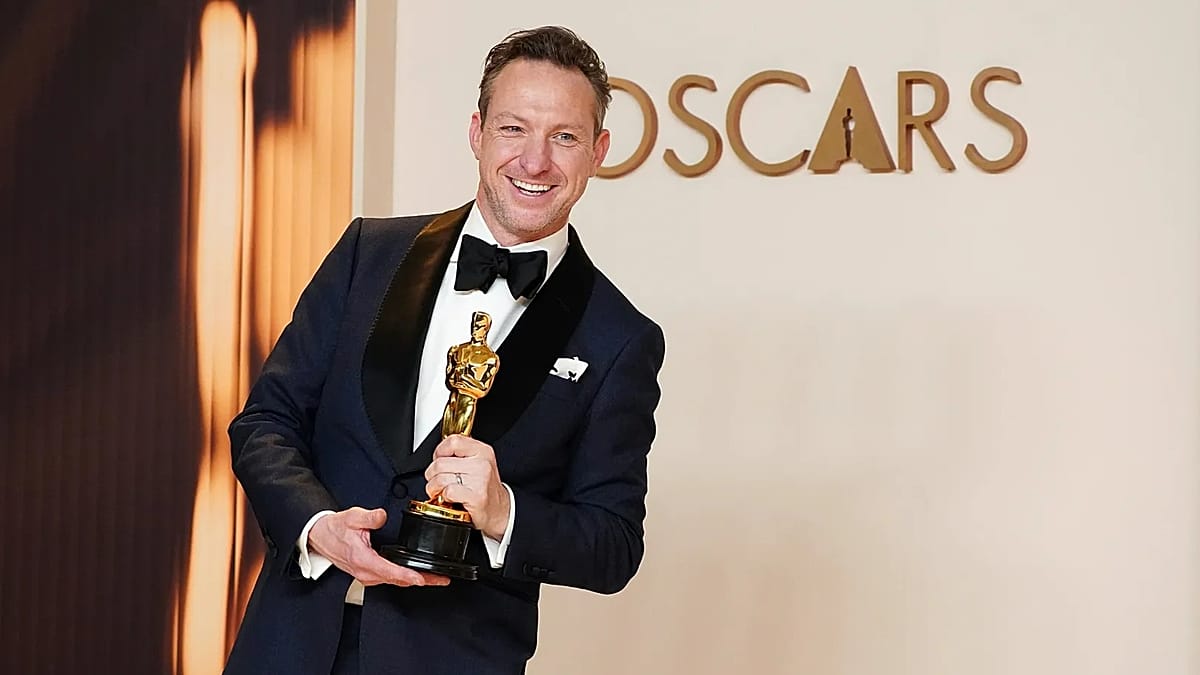
Before Hollywood. Before awards season. Before the Oscars.
There was Wrexham. And not the Ryan Reynolds Wrexham.
In a bizarre twist of fate, my sweet college friend and housemate turned into a phenomenally talented, confident and successful cinematographer. His name is Lol Crawley.
There was an audio-visual course, a shared house, and the particular confidence of people in their teens and early twenties who don’t yet realise how provisional everything is. We were convinced we knew what we were doing — or at least convinced enough to keep making things. It didn’t feel serious. It didn’t feel strategic. It certainly didn’t feel like the beginning of a journey that would one day end on the Oscar stage.
A year on from that moment, Lol Crawley is wary of imposing inevitability on the past. Memory, he suggests, has a way of smoothing over uncertainty.
“I don’t think I really knew what I wanted to do yet,” he says now. “There was a trajectory — art school to photography to moving image — but I only properly decided I was going to be a cinematographer when I went to university. It wasn’t ‘I’d like to be’. It was: this is what I’m doing.”
When I ask whether there was ever an ambition for awards — for Hollywood, or Oscars — he is clear. Those ideas simply weren’t present. What was present, though, was work ethic.
“Wrexham was really about collaboration,” he reflects. “It was the first time I’d properly worked creatively with other people. Before that, the only comparison I had was being in bands. So it was formative — even if it didn’t feel serious at the time.”
That distinction matters. Crawley’s career has never followed a neat arc of aspiration rewarded. It has been shaped instead by patience, graft, and a belief — sometimes quiet, sometimes stubborn — that the work itself mattered.
The long road (and the years no one sees)
People love the idea of overnight success. It flattens complexity into a single, cinematic moment. So I ask the question directly: how long was the grind before recognition really arrived — and what did that grind actually look like?
“Nearly a decade,” Crawley says, without embellishment.
After university, he spent nine years working as a camera assistant, shooting short films alongside it. He was making a living — just about — but not in the centre of the industry. At one point, he was living in Whitley Bay, a small coastal town in the northeast of England, far from London’s gravitational pull.
“That job wasn’t the end goal,” he explains. “It was about learning the set, gaining confidence.”
There was, he admits, a strong sense of self-belief underneath the humility. “I didn’t think I was going to be a career camera assistant — even though I did that job for a long time. I was always annoyed when people weren’t calling me to shoot their films.”
The break came quietly, and straight out of a Hollywood movie script.
In 2006, a short film he shot on 35mm anamorphic ended up on the cover of Dazed & Confused. Late one night, his phone rang.
“I thought my friends were taking the piss,” he laughs. The caller was an American director based in Los Angeles, planning his first feature. “Non-actors, 35mm, available light — all the things I’d been exploring.”
Crawley read the script until three in the morning. “I said to my partner: that’s it — I’m doing this film.”
There were no Zoom calls. No polished pitches. He persuaded the director over the phone, got on a plane, and landed in Mississippi.
The shoot was demanding and had a low budget. The pressure was immense. And then the film premiered at Sundance.
The director won an award. Crawley did too.
And still, doubt lingered.
Losing…and keeping imposter syndrome
“When did imposter syndrome finally go?” I ask.
“Not immediately,” he says. “I think around 2010 I stopped worrying that I’d be found out. I still worry about things going wrong — but not that I’m incapable.”
That distinction is important. Crawley doesn’t romanticise insecurity, but he doesn’t dismiss it either. “Some people never shake it,” he says. “And I understand why.”
What matters, he suggests, is not allowing doubt to compound paralysis. “It stops you being complacent,” he adds. “But you can’t let it unsettle you completely.”
That balance — between confidence and caution — has become a defining feature of his work.
Visual restraint as conviction
Crawley’s cinematography is often described as disciplined, restrained, emotionally precise. It resists spectacle for its own sake. When I ask how long it took for directors to trust him with difficult material, his answer returns not to technique, but to intention.
“It’s about what you’re trying to say about the world,” he explains. “You can learn all the technical stuff — but if you don’t have a point of view, the job becomes purely technical. And that’s never how I’ve seen it.”
That philosophy reached its most uncompromising expression in The Brutalist, a film whose stark, architectural visual language refuses comfort. Shot with severity and control, it demands patience from its audience — and offers no visual consolation.
The visual deal with the director came early. There was never pressure to soften it.
For Crawley, restraint is not minimalism. It is emotional precision. “I wouldn’t want to spend four hours talking to a painter about their brushes,” he says. “I want to know why they paint.”
Inside the Oscars machine
A year on from the ceremony, the Oscars feel both extraordinary and oddly domestic.
“I live about 15 minutes away,” Crawley says. “Literally our local cinema.”
The night itself unfolded in fragments. When his name was announced, reality lagged behind the moment. “I turned to my wife and said: I think I’ve just won an Academy Award.”
On stage, a clock ticked down from 45 seconds – his first experience of LIVE TV went well as he managed to figure the countdown.
Backstage, he was ushered into a mirrored room and instructed to dance for the cameras. He complied enthusiastically — performing exaggerated James Bond lunges with the Oscar in hand.
“No shame,” he grins.
There were tequila shots before a live BBC Radio 4 interview. A moment of panic — and then composure. A black SUV ferrying him and friends to the Vanity Fair party, where the Oscar sat casually on the bar.
It was surreal. But not disorienting.
By that point, Crawley had been doing press for eight hours a day, for weeks. “You get better at it,” he says. “I wasn’t a rabbit-in-the-headlights.”
What awards actually change
So what does an Oscar do?, I ask.
“It makes the next film easier to make,” Crawley says, without hesitation. “That’s the most important thing.”
Awards, he insists, are not the work — but they can protect it. They buy time. They open doors. They allow filmmakers to take risks again.
Recognition matters most when it comes from peers, he says: “Other cinematographers. Other filmmakers. That’s the real validation.”
Technology, AI, and the future of images
Crawley has lived through seismic technological shifts — from shooting almost exclusively on celluloid to the digital revolution that now defines filmmaking. AI, he argues, sits somewhere between tool and threat.
“In grading, for example, AI is already being used as an assistive tool,” he explains. “It doesn’t replace the work — it helps refine it.”
But he is clear about the dangers. “For background actors especially, the threat is real. Being scanned, having your data reused — that’s serious.”
For cinematographers, the risk is subtler: “When images are produced too easily, you risk visual numbness.”
It is one reason Crawley remains committed to films that ask something of their audience.
Back to Wrexham
At the end of our conversation, I ask the question that has hovered throughout: if he could go back to our shared house in Wrexham — to our younger, messier selves — what would he say to the younger Lol?
He pauses.
“Don’t get obsessed with the technical,” he says finally. “It’s about the heart.”
It is a deceptively simple answer. And a fitting one.