
Close Menu
Daily Guardian EuropeDaily Guardian Europe
  • Home
  • Europe
  • World
  • Politics
  • Business
  • Lifestyle
  • Sports
  • Travel
  • Environment
  • Culture
  • Press Release
  • Trending
What's On

Sacked in the morning: Berlinale director Tricia Tuttle faces axe over Gaza debate

February 25, 2026

La menace Trump plane sur l’accord de libre-échange UE-Mexique – POLITICO

February 25, 2026

EU asks Ukraine to repair Druzhba pipeline as Croatia offers alternative route

February 25, 2026

UK exclusion from EU defense loan ‘self-defeating’ – POLITICO

February 25, 2026

Millions across Europe express solidarity with Ukraine on the 4th anniversary of Russia’s war on Ukraine

February 25, 2026
Facebook X (Twitter) Instagram
Web Stories
Facebook X (Twitter) Instagram
Daily Guardian Europe
Newsletter
  • Home
  • Europe
  • World
  • Politics
  • Business
  • Lifestyle
  • Sports
  • Travel
  • Environment
  • Culture
  • Press Release
  • Trending
Daily Guardian EuropeDaily Guardian Europe
Home»Europe
Europe

These fields of study are most likely to land you a highly-related job

By staffFebruary 25, 20263 Mins Read
These fields of study are most likely to land you a highly-related job
Share
Facebook Twitter LinkedIn Pinterest Email
By&nbspAlessio Dell’Anna&nbsp&&nbspvideo by Léa Becquet

Published on
25/02/2026 – 13:38 GMT+1

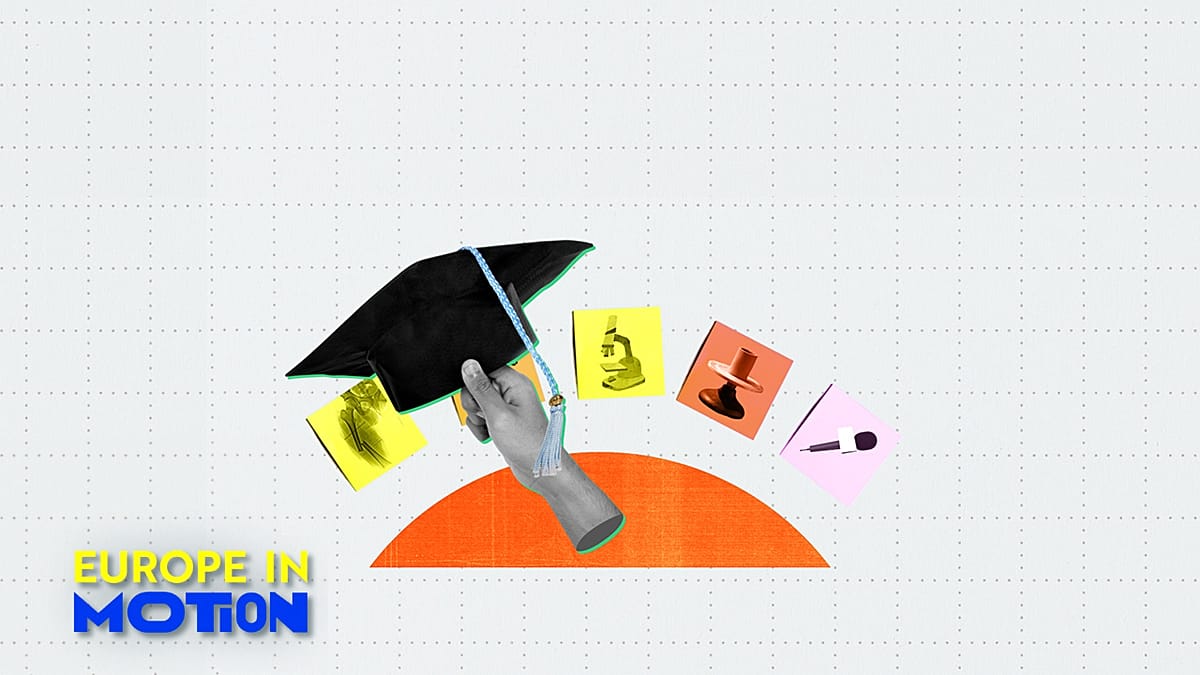
Life isn’t a straight line, and if your job has nothing to do with your degree, you are probably in good company.

Around one in three young graduates (32%) who have at least a bachelor’s degree work outside their field of study, according to Eurostat.

Arts and humanities graduates seem to venture the furthest afield from their original area of study.

Almost half of them (48%) change tack, the lowest retention rate among the surveyed fields. Rates are slightly higher for graduates in journalism and the social sciences. But even there, whether by choice or necessity, 40% eventually branch out into a different sector.

Health and IT graduates stick closer to their field

At the same time, if you trained as a doctor or a nurse, you’re most likely to stay on track, with 81% of health workers ending up in roles that are highly linked to their studies.

IT graduates also stay close, with a rate of 77%. The same goes for those with studies linked to education (74%) and engineering and manufacturing (73%).

In fact, there appears to be an increase in manufacturing roles up for grabs in the EU: experimental statistics by Eurostat revealed that between 2019 and 2023, the sector had the largest increase in its job vacancy rate in the EU, with +4.2%.

Highest retention rates in Hungary, Slovenia and Latvia

Citizenship also seems to play a part in how likely you are to work in the same field in which you studied.

Take Hungary, with a noteworthy 86% retention rate. Germany stands out too, with 76%, higher than similar economies. France sits at 65%, Spain at 64%, and Italy at 62%, all hovering near the bottom of the ranking, and rounded out by Denmark at 56%.

So yes, one’s degree matters, but what happens after that is a whole different story: it’s even more relevant in today’s job market, where, faced with volatility and uncertainty, around a quarter of Europeans are considering job sector hopping and trying out multiple career paths during their working lives.

Which sectors could be the most affected by AI?

AI and technology could be one of the driving forces of such career shifts, as well as enablers of higher flexibility levels in the workforce of the future.

Consultancy firm McKinsey forecasts that 94 million workers across the continent will need to be retrained by 2030 due to advances in automation.

According to the report, accommodation and food services might suffer the largest job severance (94%), followed by arts (80%), wholesale and retail (68%), construction (58%) and transport and storage (50%).

And this is already having an impact on workers. Concern over AI-driven job losses in the short term polled at 43% in Manpower’s 2026 Talent Barometer, up by five points from 2025.

Share. Facebook Twitter Pinterest LinkedIn Tumblr Email

Keep Reading

EU asks Ukraine to repair Druzhba pipeline as Croatia offers alternative route

Three things Europe should take away from Trump’s State of the Union address

EU Commission urges MEPs to vote through EU-US deal despite fresh tariffs

Russian intelligence claims UK and France plan to send nuclear arms to Ukraine, but offers no proof

How deepfake scams are reaching record levels by targeting social media users

Live – €90 billion loan ‘must be implemented’, Zelenskyy tells MEPs amid Hungary veto

EU accuses Hungary of disloyalty for vetoing €90 billion loan to Ukraine

Exclusive: European Parliament rejects minute of silence for French nationalist student

‘One Europe, One Market’: The Commission’s last attempt to boost competitiveness

Editors Picks

La menace Trump plane sur l’accord de libre-échange UE-Mexique – POLITICO

February 25, 2026

EU asks Ukraine to repair Druzhba pipeline as Croatia offers alternative route

February 25, 2026

UK exclusion from EU defense loan ‘self-defeating’ – POLITICO

February 25, 2026

Millions across Europe express solidarity with Ukraine on the 4th anniversary of Russia’s war on Ukraine

February 25, 2026

Subscribe to News

Get the latest Europe and world news and updates directly to your inbox.

Latest News

Wie Filz und Vetternwirtschaft die AfD im Bund erschüttern – POLITICO

February 25, 2026

Three things Europe should take away from Trump’s State of the Union address

February 25, 2026

France warns against risk of nuclear proliferation – POLITICO

February 25, 2026
Facebook X (Twitter) Pinterest TikTok Instagram
© 2026 Daily Guardian Europe. All Rights Reserved.
  • Privacy Policy
  • Terms
  • Advertise
  • Contact

Type above and press Enter to search. Press Esc to cancel.