
Close Menu
Daily Guardian EuropeDaily Guardian Europe
  • Home
  • Europe
  • World
  • Politics
  • Business
  • Lifestyle
  • Sports
  • Travel
  • Environment
  • Culture
  • Press Release
  • Trending
What's On

Christine Lagarde says her ‘baseline’ is to complete her term at the ECB – POLITICO

February 20, 2026

The EU’s envoy to Ukraine on war, resilience — and Nordic walking – POLITICO

February 20, 2026

Video. Humanoid robots dance into Beijing’s Lunar New Year celebrations

February 20, 2026

Blackcurrants, olive oil, cheese: Why you should follow these foodie trails around Europe

February 20, 2026

EU Parliament to ditch Strasbourg trips thanks to American intervention – POLITICO

February 20, 2026
Facebook X (Twitter) Instagram
Web Stories
Facebook X (Twitter) Instagram
Daily Guardian Europe
Newsletter
  • Home
  • Europe
  • World
  • Politics
  • Business
  • Lifestyle
  • Sports
  • Travel
  • Environment
  • Culture
  • Press Release
  • Trending
Daily Guardian EuropeDaily Guardian Europe
Home»Culture
Culture

The Madrid Codices: Leonardo da Vinci’s treasure trove digitised by Spain’s National Library

By staffFebruary 20, 20263 Mins Read
The Madrid Codices: Leonardo da Vinci’s treasure trove digitised by Spain’s National Library
Share
Facebook Twitter LinkedIn Pinterest Email

Published on
20/02/2026 – 7:21 GMT+1

Every year Spain celebrates one of the most significant discoveries of the 20th century for studies on Leonardo da Vinci.

On 13 February in 1967 the National Library of Spain conserved among its collections two original manuscripts of the Renaissance artist and engineer that had remained unnoticed for more than a century.

The so-called Madrid I and II codices (source in Spanish),identified as Mss. 8937 and Mss. 8936, are part of a set of scientific notebooks written by da Vinci between the end of the 15th and the start of the 16th century.

They were rediscovered when the American researcher Jules Piccus, who was working on the revision of the inventories of the institution’s manuscripts, identified the relevance of some volumes that had not been correctly attributed.

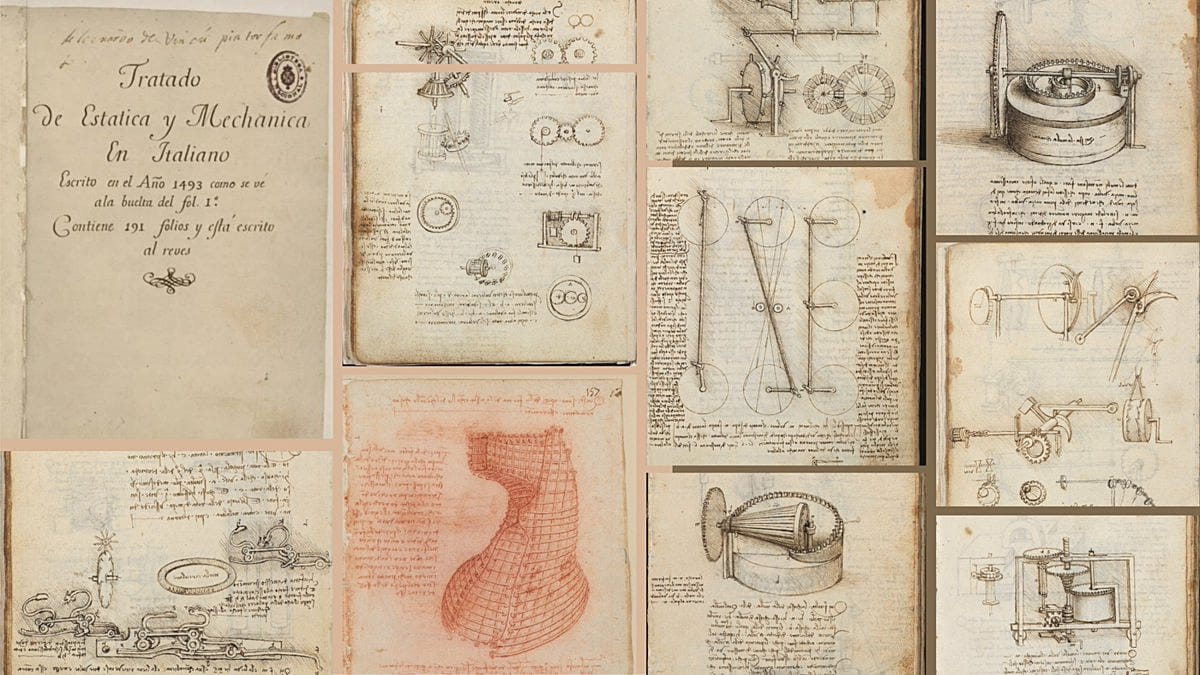
According to official information from the National Library, the codices contain hundreds of pages of annotations and drawings devoted to statics, applied mechanics, gear systems, hydraulic machines, geometry and fortification studies.

Unlike his paintings, these manuscripts allow us to observe Leonardo’s intellectual process:calculations, diagrams, hypotheses and corrections that show his experimental method.

Codex Madrid I, dated mainly in the 1490s, is considered one of the most important treatises on mechanics by Leonardo, with detailed studies on the transmission of motion and the functioning of mechanisms.

Codex Madrid II, dated slightly later, brings together research related to civil and military engineering, as well as topographical studies and hydraulic projects.

The manuscripts came to Spain in the 16th century via the sculptor Pompeo Leoni, who collected a series of Leonardo’s documents after the artist’s death. They subsequently became part of the royal collection and later entered the Biblioteca Nacional. Various internal reorganisations and cataloguing errors caused them to remain lost in the repositories for more than 100 years.

The Biblioteca Nacional de España has emphasised in its publications that the Madrid Codices are exceptional pieceswithin its documentary heritage, as they significantly extend the known corpus of Leonardo da Vinci’s scientific writings. The announcement of their discovery in 1967 had international repercussions and changed the landscape of Leonardo da Vinci studies by providing previously unpublished material.

In 2012 (source in Spanish), the institution launched a digitisation project that made an interactive version of the codices available to the public. This initiative now facilitates worldwide access to the manuscriptsand reinforces the role of the Biblioteca Nacional as the custodian of one of the most important collections of Renaissance documents preserved in Spain.

More than half a century after their rediscovery, the Madrid I and II codices continue to remind us that behind the genius there was someone who observed, tested and dreamed of understanding how the world worked.

Share. Facebook Twitter Pinterest LinkedIn Tumblr Email

Keep Reading

White House hits back at ‘loser’ Bruce Springsteen as he announces politically charged US tour

‘Days Of Ash’: U2 surprise drop six ‘songs of defiance’ – one in response to ICE shootings

Reaching ‘The Peak’: Coca-Cola’s Olympic celebrations in Milan set for record numbers

Survey says more Americans believe Bad Bunny ‘better represents’ US than Donald Trump

Sign of the times: ‘Cry, Wedding and Blood’ brings Lorca to life at Spain’s National Drama Centre

Everyone’s a winner: Sony World Photography Awards 2026 Open Competition

Eurovision fans rage online over cancellation of 70th anniversary live tour

Rev. Jesse Jackson, civil rights icon and two-time US presidential candidate, dies aged 84

‘Godfather’ and ‘Apocalypse Now’ actor Robert Duvall dead at 95

Editors Picks

The EU’s envoy to Ukraine on war, resilience — and Nordic walking – POLITICO

February 20, 2026

Video. Humanoid robots dance into Beijing’s Lunar New Year celebrations

February 20, 2026

Blackcurrants, olive oil, cheese: Why you should follow these foodie trails around Europe

February 20, 2026

EU Parliament to ditch Strasbourg trips thanks to American intervention – POLITICO

February 20, 2026

Subscribe to News

Get the latest Europe and world news and updates directly to your inbox.

Latest News

Europe Today: Albanese joins us live amid calls from France for her resignation

February 20, 2026

Wildfire-friendly weather nearly triples: Will outbreaks leave countries scrambling for resources?

February 20, 2026

China’s AI chatbots censor politically sensitive questions, study finds

February 20, 2026
Facebook X (Twitter) Pinterest TikTok Instagram
© 2026 Daily Guardian Europe. All Rights Reserved.
  • Privacy Policy
  • Terms
  • Advertise
  • Contact

Type above and press Enter to search. Press Esc to cancel.