
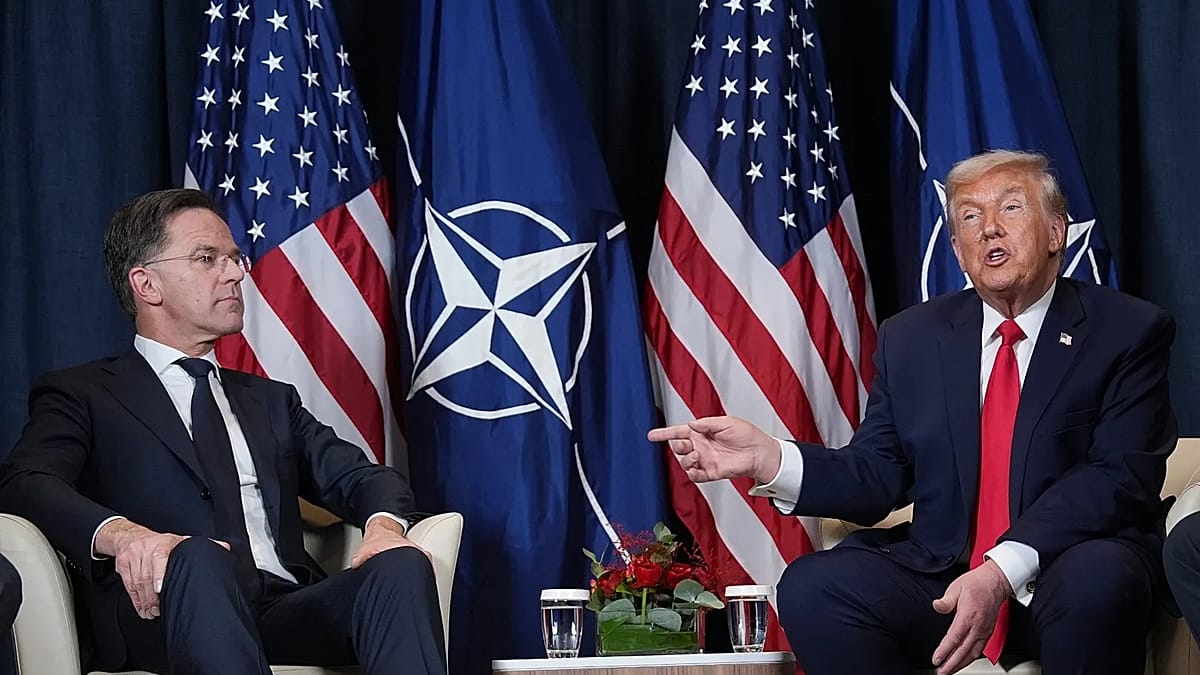
United States Undersecretary of War Elbridge Colby is expected to tell European NATO allies that only a limited number of US troops will be withdrawn from NATO territory as part of any posture review, Euronews can reveal.
Sources close to the situation have said Colby will use Thursday’s meeting of NATO defence ministers to commit to keeping the vast bulk of currently stationed troops in Germany and Italy and along Europe’s eastern flank in place
Colby is deputising for US Secretary of Defence Pete Hegseth, who will not be attending the meeting.
There are currently approximately 80-90,000 US troops stationed in Europe at any given time depending on rotations, the highest number since the Cold War. The number surged in response to Russia’s full-scale invasion of Ukraine four years ago.
The move will come as both a welcome relief and a surprise, as European allies have been bracing themselves for a substantial drawdown of US troops as the Trump administration prioritises security theatres elsewhere in the world.
“The US is committed to NATO, they have made that abundantly clear”, Colonel Martin O’Donnell, spokesperson for NATO’s Supreme Allied Commander Europe, told Euronews.
“They have also made even more clear that Europe has to step up, and they are, but there is still more to do, like delivering on the capability targets all nations agreed.”
Pivot to Europe
The appointment of Colby as undersecretary of war last year was seen as a harbinger of plans to potentially pull thousands of US troops. He is widely regarded as a hardliner who has long advocated for the withdrawal of many US troops from NATO territory and a policy pivot towards the South China Sea.
European allies have been fearful of sudden, dramatic announcement which would leave the continent vulnerable at at time when Russian hybrid attacks in NATO territory were surging.
It’s not clear whether the decision to keep much of the force is part of an anticipated official US global posture review, which is due to take place sometime this year. But the move does coincide with plans to overhaul NATO’s command structure and shift greater responsibility onto Europe over the coming years – a process that has already begun, with European allies soon taking command of US-led bases on their territory.
“The United Kingdom will take over command of Joint Force Command Norfolk and Italy will do the same for Joint Force Command Naples, both of which are currently led by the United States”, NATO announced in a statement last week. “Germany and Poland will share command of Joint Force Command Brunssum on a rotational basis.”
“As a result, all three Joint Force Commands, which lead at the operational level in crisis and conflict, will be led by Europeans.”
Guarding the north
Meanwhile, NATO is due to launch a new mission to strengthen security in the High North and Arctic, with military planning already at an advanced phase.
The mission, Arctic Sentry, comes weeks after serious divisions erupted within the alliance over United States President Donald Trump’s claim he would “take” Greenland, a semi-autonomous Danish protectorate in the Arctic.
NATO allies are meeting for the first time since Trump’s demands nearly imploded the alliance, and are expected to confirm the contours of the new NATO mission.
A deal negotiated by the NATO Secretary General Mark Rutte with Danish, Nordic and US partners after this year’s World Economic Forum conference at Davos agreed to significantly step up Arctic security.
Arctic Sentry will be a multi-domain activity involving space, cyber, land, sea and air defences and is designed to enhance NATO presence in the Arctic against rising Russian threats and persistent Chinese efforts to influence the region, according to several allies.
“The Arctic is a critical region in face of growing competition in China,” US ambassador to NATO Mathew Whitaker told journalists in a briefing on Tuesday, saying the alliance needs to be “clear as to what’s happening in the Arctic” and understand present and future capability needs required to secure the region, as the “Arctic becomes more and more relevant”.
Adding that “all NATO assets” would be needed to secure the region, Whitaker said that if Greenland becomes independent from Denmark in the future, it could be outside NATO.
“We would need to resolve that”, he said.
Air, land and sea
“Demands on defence are rising, and Russia poses the greatest threat to Arctic and High North security that we have seen since the Cold War,” UK Defence Secretary John Healey said in a statement ahead of Thursday’s meeting.
“We see Putin rapidly re-establishing military presence in the region, including reopening old Cold War bases”, he said.
Another senior NATO diplomat said that “although there is no immediate crisis, our threat assessment indicates that both Russia and China have demonstrated ambitions in the region”.
“Deterrence requires early and visible action: signalling our presence, vigilance and readiness to defend the territory whenever necessary,” they added.
The rationale of the mission is similar to that behind Baltic Sentry, launched a little over a year ago to improve allies’ ability to respond to destabilising acts in one of the world’s most heavily trafficked seas.
Alice Tidey also contributed reporting.