
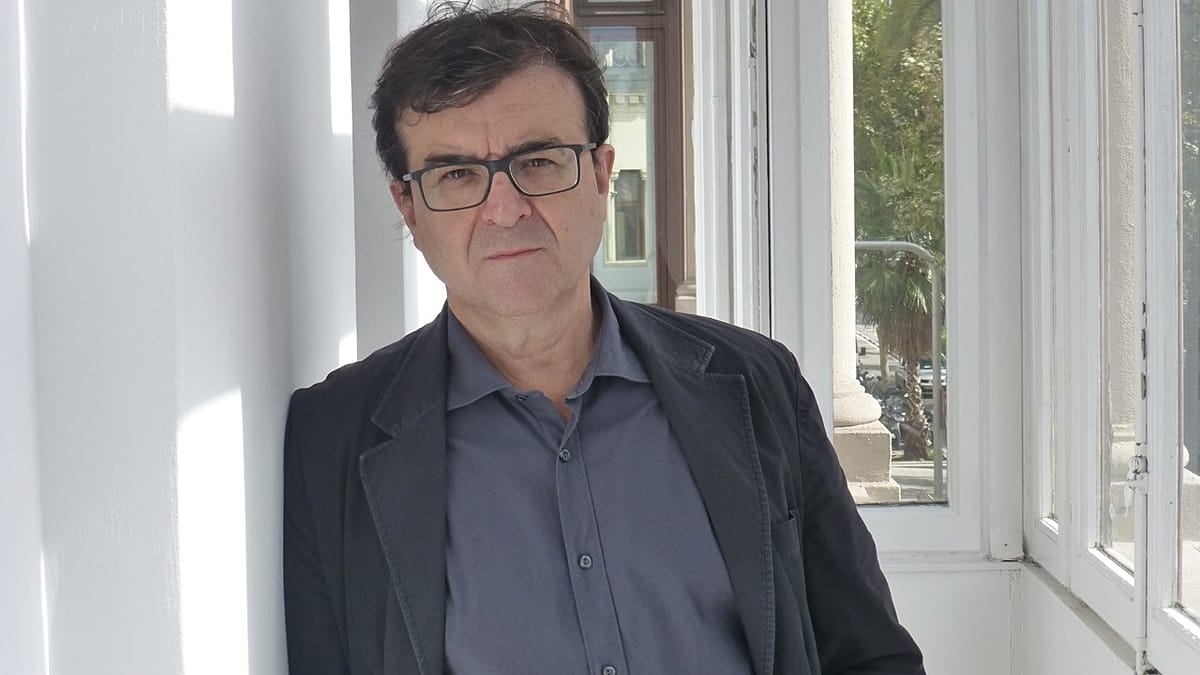
Javier Cercaslikes to offers his readers the pleasure of an atypical novel that raises questions about issues such as spirituality and eternal life, and his latest work certainly doesn’t disappoint.
Praising his acclaimed 2025 Jacques Delors European Book Prize winning work, “God’s madman at the end of the world”, the European Parliament said its theme core could be summed up as “doubt is not the enemy of truth, it is the beginning.”
In “God’s madman at the end of the world” Cercas examines the time he spent on a trip with Francis Ishortly before the Pope’s death and takes us into the Vatican, a place he describes as being “even more exotic than Mongolia.”
It’s the second time the 63-year-old has received the prestigious award, having already won it in 2016 for his novel ‘El impostor’.
“A madman without God”.
Cercas considers himself anatheist and anti-clerical author**,** thus the “madman without God”, who comes close to the Pope or the “madman of God”.
Madness is a term he also uses often to describe being given unprecedented access by the Vatican to its inner workings. Able to ask, talk and write about whatever he wanted, he concludes that the experience was “madness to follow the Pope to Mongolia. This book has many points of madness in it. It’s a trip to a very special place like Mongolia, but the Vatican is much more exotic than Mongolia.”
This book arose from the Vatican’s invitation to Cercas to accompany the Pope on his trip: “When they made me the proposal, the first thing I thought of was my mother, who was a profound believer. When my father died, my mother said she would see him after death. So when I remembered this, I immediately knew what the book was going to be about.”
At the heart of the book is the question of the resurrection of the flesh and eternal life.
“At some point I talk about faith as a superpower,” Cercas says. “Faith is a very rare thing. The Pope calls it a gift, but I think faith is a mystery. It is like a poetic intuition: there are those who have it and those who don’t. And there are those who had it and lost it. And there are those who had it and lost it. That’s why I say it’s something very elusive.
Pope Leo XIV’s visit to Spain
Cercas believes Pope Leo’s announced visit to Spain will be highly significant. “I think that Leo XIV will try to follow the legacy of Francis, but it is still too early to see, perhaps because he is a very prudent man. He follows the same path even if the forms are different. Leo is a missionary and at the same time a man who knows the Curia, because he held a very powerful position in the body that elected the bishops”.
‘Anatomy of an instant’, from the book to the screen
‘Anatomy of an instant’ a new television series, based on the novel of the same name by Cercas, focuses on the attempted coup d’état of 23 February 1981 in Spain.
Despite the bursts of gunfire from the civil guards who stormed the Congress of Deputies under the command of Lieutenant Colonel Antonio Tejero, only three politicians remained seated with their heads held high, without taking cover behind their seats: Adolfo Suárez, Manuel Gutiérrez Mellado and Santiago Carrillo. They are the heart of the story of this crucial historical moment for the future of Spain’s young democracy.
In the show, Juan Carlos I, whose intervention in the coup d’état was one of the defining moments of his reign, also plays a leading role.
Cercas has insisted in various forums that it is a hoax that the king emeritus organised the coup, but he also suggests that in some way he could have helped it.
“Well, King Juan Carlos made mistakes before the coup which, in some way, encouraged or facilitated it. But those mistakes were made by him and by most of the Spanish political class”, added Cercas.
What is clear for Cercas however is that real people responsible are the military officers who carried out the coupand who were tried for it. “Indeed, the idea that Juan Carlos I organised the coup is total nonsense. We live in the age of hoaxes, and they work like that. It is a delusion, nothing more”.
23-F is no enigma
There is a 1978 law that safeguards state secrets in Spain. 45 years after the attempted coup d’état, it is worth asking whether there are still documents classified as state secrets in the National Intelligence Centre (CNI) in relation to the attempted coup.
Cercas is categorical in this respect: “I don’t think so. I asked the President of the Government, Pedro Sánchez, who was kind enough to come to Congress to present the series, to please declassify all the papers in order to refute all the hoaxes. The first hoax is that the coup d’état on 23 February is a great enigma.”
“It is not an enigma. We know the reality of 23 February, because tons of books have been written. 23 February was a coup without papers. Of course, there may have been previous intelligence reports. I spent four years exclusively dedicated to studying this. The coup was organised by very few people, and what’s more, they organised it without papers because they didn’t want anyone to discover them. They were practically all military.
“The idea that there is an enigma surrounding the 23 February coup d’état is a hoax. It’s like the idea that there is an enigma surrounding the Atocha bombings. It’s the same kind of hoax. One is promoted by the right, the other by the left.
Exploring the limits between reality and fiction
Cercas defines some of his novels as true stories that explore the limits between reality and fiction: “The real is also a mystery, and literature explores the mystery. Perhaps the greatest mystery is the real. Literature tries to see the invisible in the visible.”
Involved in new projects, Cercas prefers to be reserved on the subject: “I am always working and I have many books on the way. Some I don’t publish because the time has not yet come for them. Others I don’t know when I’ll publish, but I never talk about them because, if you talk about something you’re still writing, what’s essential escapes.”
In June 2024, Cercas was elected to the ‘R’ chair of the Royal Spanish Academy (RAE), where this interview takes place. In his role as an academic, the writer reminds us that language is our most valuable instrument and that the Academy takes care of it and makes it prosper:
“Everyone does it in their own way, but I see it as a public service and I don’t charge for it, but I feel very proud”. He sees it as a way of giving back to his public what his public has given him: “People have given me a lot of things because I have readers and that is wonderful.”