
Good morning. I’m Mared Gwyn with a packed newsletter to start your Thursday.
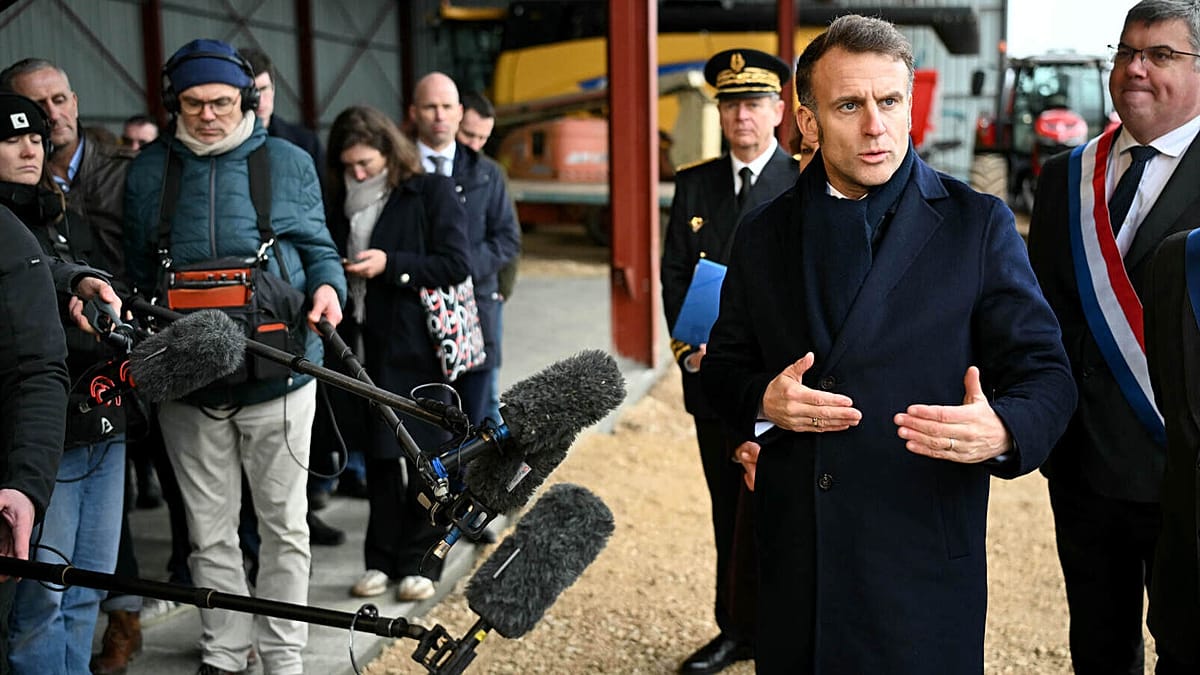
European Commission President Ursula von der Leyen will meet President Emmanuel Macron in Paris later today – amid reports that Macron discretely sent his most senior diplomat, Emmanuel Bonne, to meet his Russian counterpart Iouri Ouchakov in Moscow earlier this week. The debate on opening direct talks between Europe and Russia is now heating up. We have more below, including exclusive lines from the Latvian Prime Minister and Estonian President.
Meanwhile, EU countries have sealed the deal for a €90 billion loan to keep Ukraine’s finances ticking and its military armed for the next two years, in a move that provides much-needed certainty for Kyiv as US-brokered peace talks drag on.
Hungary, Slovakia and the Czech Republic will be spared of any financial contributions after their leaders negotiated exemptions in a summit in Brussels in December.
Of the €90 billion, two thirds will be spent on weapons and ammunition. Talks had momentarily stalled over a French plea for a “Made in Europe” requirement to minimise the amount of non-European weaponry Kyiv could purchase.
My colleague Jorge Liboreiro reports that a compromise was struck on a so-called “cascading principle” – meaning weapons will be bought within Ukraine, the EU and EFTA countries, with Kyiv allowed to go to other markets, such as the US, if the equipment is not available in Europe.
Countries that have security and defence partnerships with the EU, such as the UK, will also get priority of purchase if they pay a “fair and proportionate” contribution to the borrowing costs. An EU official said it’s “important to have the UK on board” due to the “geopolitical situation” as well as to provide Ukraine with the necessary flexibility. Jorge has the details.
Expectations are high that the European Commission could unveil a fresh package of sanctions on Russia, the 20th since the war, as early as today, with a first presentation to EU ambassadors expected on Friday. Brussels is hoping to get the package approved in time for presidents von der Leyen and Costa’s visits to Ukraine to mark four years since the start of Russia’s invasion on February 24.
Our parliament correspondent Vincenzo Genovese reports that the European Parliament will hold an extraordinary plenary session to mark that date, and to approve the €90 billion loan in a vote.
In other news from the parliament, EU lawmakers agreed yesterday to resume work on enforcing the EU-US trade deal, which was frozen amid Trump’s Greenland threats.
Crucially, three of the parliament’s political factions are pushing to Trump-proof the deal.
The centre-left Socialists and Democrats, Liberal Renew Europe and the Greens want a special clause that would allow the EU to suspend the free trade deal in the event of new threats to the territorial sovereignty of the Arctic island. Peggy Corlin and Vincenzo have the details.
The parliament is due to sit for a plenary session in Strasbourg next week, where two debates have been added to the agenda – one on Spain’s decision to regularise 500,000 undocumented migrants, and another on the presence of US ICE agents at Winter Olympics in Italy, Vincenzo reports.
Latvian PM and Estonian president back special EU envoy for Russia-Ukraine talks
The European Union should appoint a special envoy to the ongoing negotiations to end Russia’s war in Ukraine, the prime minister of Latvia and the president of Estonia told Euronews’ Maria Tadeo in separate interviews on Wednesday at the World Governments Summit in Dubai.
The comments reflect a rapid shift in Europe’s strategic thinking toward Russia after being shut out of direct talks in peace negotiations led by the United States, with France’s Macron and Italy’s Meloni leading calls to re-open diplomatic channels with Moscow.
Macron sent Emmanuel Bonne, who leads his diplomatic cell, to Moscow for talks with the Kremlin on Tuesday, French media L’Express first reported last night, in an apparent sign that the French President is edging Europe towards re-engagement. Macron said earlier weeks the technical groundwork for talks was underway in coordination with Ukraine’s President Zelenskyy.
Latvian Prime Minister Evika Siliņa and Estonian President Alar Karis said any communication with Russia should be conducted in consultation with Ukraine and suggested that the interlocutor, yet to be appointed, be a consensus figure.
“I think you need to engage in diplomacy. You always need to talk, but we need to isolate and still have sanctions on Russia,” Latvian PM Siliņa said.
“We have to be at the negotiation table because Ukrainians themselves have started to negotiate. So why should Europeans not negotiate?” she added, naming the leaders of France, Germany, Poland and the UK as possible candidates to join talks.
Estonian President Karis refrained from giving names but stressed the chosen envoy should come from a big European country and enjoy “credibility on both sides”.
“The European Union should be involved in these discussions as well. Although we are not fighting with Russia directly, we have been supporting Ukraine for so many years already and continue to do so,” Karis told Euronews at the same event in Dubai.
Maria Tadeo and Jorge Liboreiro have the story.
Brussels cautions EU countries against overstepping with social media crackdowns; Telegram’s Durov attacks Spain’s Sánchez
The European Commission has reacted to Spain’s decision to ban social media for under-16s with a word of caution: don’t step on our toes.
The Commission’s spokesperson for tech, Thomas Regnier, told reporters on Wednesday that while the executive “values” the fact that member states want to restrict kids’ social media access, “taking measures or putting additional obligations on platforms (…) is a clear no-go, because this is regulated by the DSA.”
The DSA, or the Digital Services Act, is the EU’s landmark rulebook for digital platforms, intended to stamp out illegal content and protect minors online.
“We don’t want to protect only kids in Spain, we want to protect everyone in Europe with the DSA,” he added. “There is no need to step on the shoes of the DSA.”
The European Commission has previously said that national governments are within their right to introduce such bans, but should refrain from introducing extra measures on platforms to avoid clashing with the DSA.
As many as seven EU member states have by now either announced a social media ban for minors or are contemplating the move. With nations coming under more pressure to coordinate their approaches due to the cross-border nature of digital services, the EU executive has brought together a panel of experts to study a potential age restriction on social platforms. Read the full story.
Last night, Telegram founder Pavel Durov joined X owner Elon Musk in attacking Spanish Prime Minister Pedro Sánchez, claiming in a message on his platform that the “dangerous new regulations” could “turn Spain into a surveillance state.”
Sánchez has hit back with a veiled reference to Spanish classic Don Quixote, suggesting the criticism is a sign that he is doing the right thing by tackling the immense power of tech giants.
Spanish official sources have said that Durov’s message includes “several lies” and “illegitimate attacks” against Sánchez’s government, and only serves to underline the “urgent need” to further regulate platforms.
What is ICE’s mandate abroad and can it operate on foreign soil?
The presence of US Immigration and Customs Enforcement (ICE) agents during the Winter Olympics in Milan–Cortina, set to begin on Friday, has sparked widespread backlash in Italy.
But is ICE authorised to operate on foreign soil?
Experts tell Euronews’ Maïa de la Baume and Amandine Hess that ICE’s main criminal investigative branch, Homeland Security Investigations (HSI), has long operated overseas and can’t conduct any operation without the host country’s consent.
“HSI is another branch of ICE deployed internationally to fight drug trafficking, cybercrime and any terrorist projects that could threaten US security or that of its citizens,” Romuald Sciora, an expert of the United States at the French Institute for International and Strategic Affairs (IRIS), explained.
“In essence, it’s a second CIA — more outward-facing and present abroad.”
“Sometimes, operations are justified — particularly in Latin America or certain East Asian countries,” Sciora added. “But when ICE operates in Paris or London, one naturally wonders why… Yet this has become part of its mission, clearly tied to the Trump administration’s anti-illegal immigration policy.”
Yet Serge Jaumain, a professor of contemporary history at Belgium’s ULB university, played down both the perceived threat posed by HSI abroad and its role in combating illegal migration. “This is a service tasked with border security, so it is not entirely unusual for it to operate outside the country,” he explained. “Other powers do the same thing.”
Read the full story.
More from our newsrooms
The end of the START: US and Russia no longer have limits on their nuclear arsenals. For the first time in over half a century, the US and Russia have no legally binding agreement limiting their strategic nuclear forces. Does the nuclear race begin now as the New START treaty expires on Thursday, or is it already under way? Sasha Vakulina explains.
‘All-out war’ in the Middle East must be avoided, Lebanese PM Nawaf Salam tells Euronews. Salam said he welcomed renewed US-Iran talks set for this Friday, as well as efforts to promote stability and avoid “all-out” war in the Middle East. Watch or readMaria Tadeo’s interview.
Iran to hold nuclear talks with US in Oman on Friday, foreign minister says. The announcement by Araghchi on Wednesday came after indications that talks were faltering. Jerry Fisaio-Bamby has the details.
Melting ice, rising risks: Why Europe and NATO are racing to defend the Arctic. Alice Tidey explains how, as Arctic ice retreats and geopolitical tensions harden, NATO’s northern flank is emerging as one of the alliance’s most consequential and neglected theatres.
We’re also keeping an eye on
- European Commissioner for enlargement Marta Kos begins two-day visit to Turkey
- European Central Bank chief Christine Lagarde delivers press conference following governing council meeting in Frankfurt
That’s it for today. Maria Tadeo, Jorge Liboreiro, Sasha Vakulina, Vincenzo Genovese, Maia de la Baume, Ammandine Hess and Alice Tidey contributed to this newsletter. Remember to sign up to receive Europe Today in your inbox every weekday morning at 08.30.