
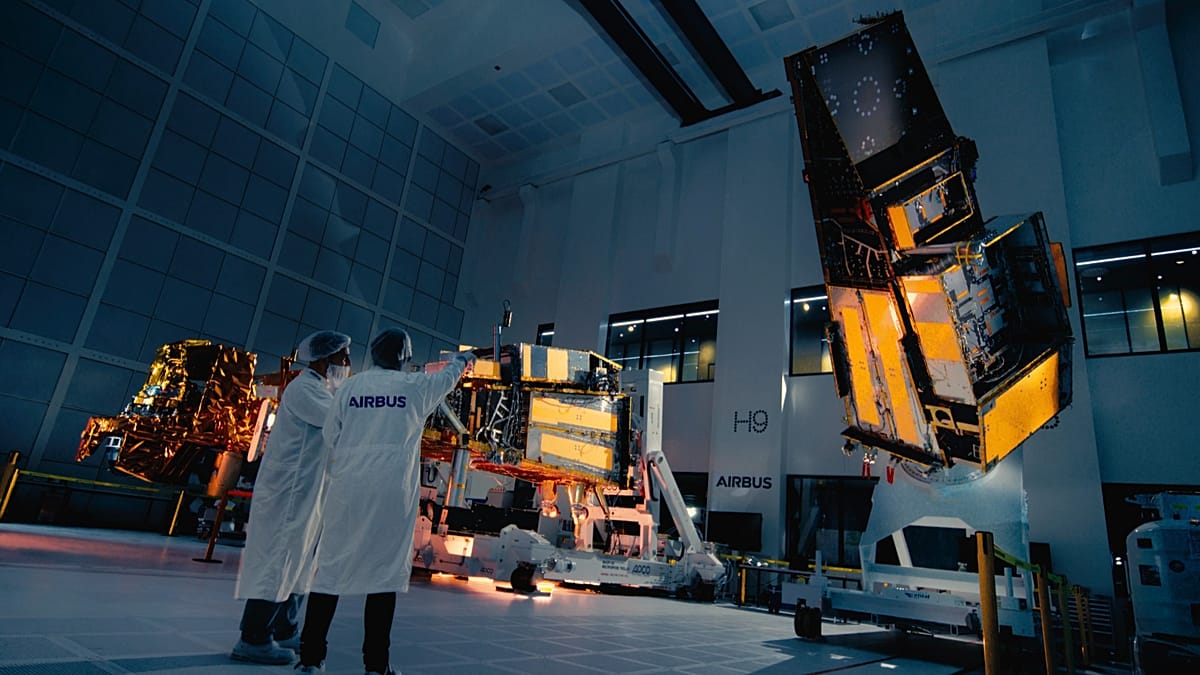
Europe has the chance to make a “quantum leap” in space technology over the coming years and boost its defences, but only if the EU stops wasting years on “grand schemes”, Airbus Space and Defence CEO Michael Schöllhorn told Euronews.
The continent risks falling further behind in space unless it moves quickly from planning to action, Schöllhorn said.
“We have a gap when it comes to what I call active space defence, being able to act, protect, and counteract in space against adversaries that want to do something to our infrastructures, to our satellites,” he said.
The European Commission has pitched a so-called Space Shield as part of its Defence Readiness Roadmap, which aims to significantly bolster the bloc’s ability to defend itself before 2030.
Space is seen as crucial to that effort, notably when it comes to intelligence, surveillance and reconnaissance as well as fast and secure communication. Strategic enablers, which include space assets, are now designated a priority area for investment by the European Commission.
For Schöllhorn, one of the problems that explains the space capability gap is one of scale, with European companies much smaller than their US counterparts. He attributes this to governments under-investing over the last several decades due to a lack of understanding about the strategic importance of space.
‘A quantum leap’ before 2030
The Commission’s plan to rearm Europe aims to secure €800 billion of investment in the sector before 2030, especially in the nine priority areas that include strategic enablers, ammunition, air and missile defence, and drones.
Germany, which has opted against using any of the financial instruments the EU’s executive has come up with to boost defence spending, has announced a €500 billion package for the next four years, including €35 billion for military space defence.
“What the Americans have always had is a budget at least 10 times (the size of the EU’s). Even with everything that the Europeans are spending now, there’s still at least three times higher budget in the US than compared to Europe – and that doesn’t even take into account all the things that we call ‘black programmes’,” he said.
Airbus, Leonardo and Thales signed a Memorandum of Understanding in October 2025 to form a major joint venture that will merge their respective space activities into a single European space company. But even after joining forces, the resulting company would only be the fourth biggest in the world behind Lockheed Martin, SpaceX and Boeing, Schöllhorn said.
Still, he is upbeat about Europe’s ability to catch up fast, telling Euronews that European industry will ultimately have the means and the capacity to meet the demand from member states.
“It depends again on the system, but I think before the decade’s over, we can have a quantum leap in terms of capability building,” he said – while warning that this can only happen if authorities provide industry with “practical definitions of programmes and solutions” so that companies can get started.
‘Grand schemes on paper are worth nothing’
Schöllhorn also warned that excessive bureaucracy could undermine those ambitions, calling for the “unwinding” or “curbing back” of some regulations, and to rethink outdated rules that he said are no longer adapted because they were set up “when the world was totally different”.
The way the EU went about defining its Infrastructure for Resilience, Interconnectivity and Security by Satellite (IRIS²) project “was an example of how to do it”, he said.
IRIS² is a planned multi-orbital constellation of 290 satellites that aims to support a large variety of governmental applications in surveillance, crisis management, connection and protection of key infrastructures as well as security and defence that was approved in 2024.
It is meant to be the EU’s improved version of Elon Musk’s Starlink, but is well behind that system’s progress.
“Well, Starlink is on its third iteration,” Schöllhorn said. “We, excuse me for saying it so clearly, thought politically so arrogantly that we can surpass them in one go in a few years. That’s not a good definition of a programme.”
Instead, he said, the EU should have acted fast by using what was already available and then building on that.
IRIS² is now expected to be operational in 2029.
Ultimately, Schöllhorn said, Europe must prioritise concrete action over lofty ambitions. “Grand schemes on paper are worth nothing,” he said.