
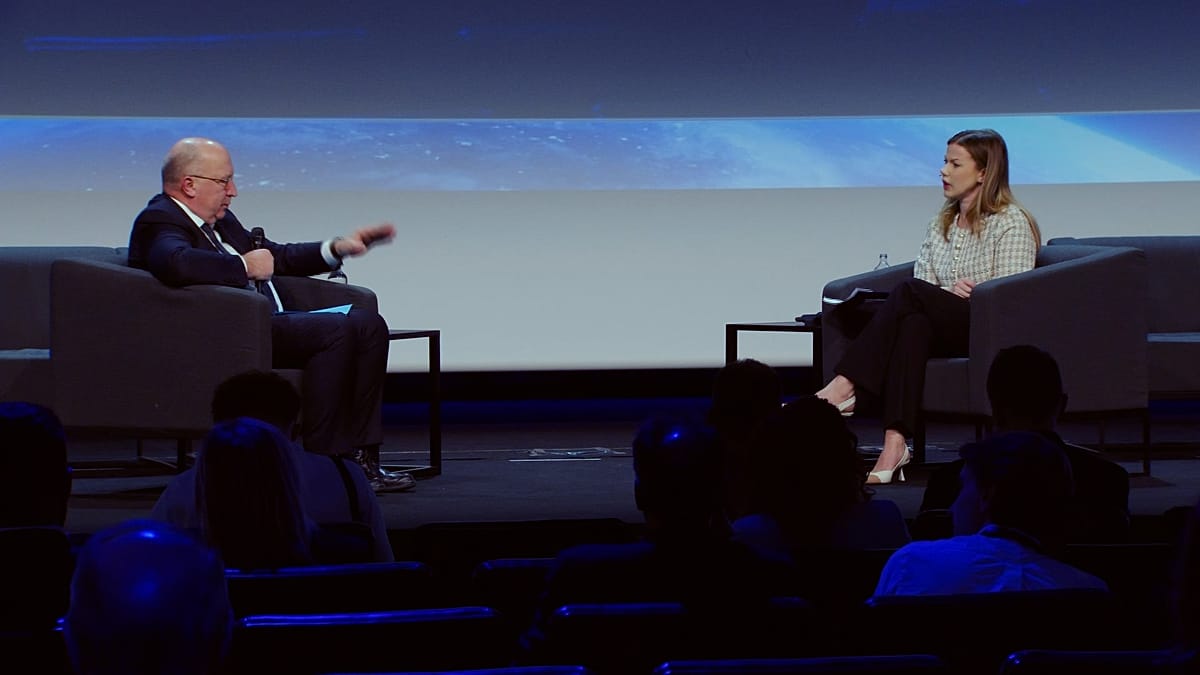
The European Union Governmental Satellite Communications programme (GOVSATCOM) is a long-awaited part of a wider EU strategy and the first step in satellite connectivity, the European Commissioner for Defence and Space, Andrius Kubilius, told Euronews.
He noted that, realistically, the Infrastructure for Resilience, Interconnectivity and Security by Satellite (IRIS²) — the EU’s more ambitious project, a multi-orbital constellation of 290 satellites — will only be operational by “around 2029”.
“To avoid having an empty space now for several years, especially when geopolitical challenges and threats are coming from different sides, we definitely need to develop some precursor capabilities for secure satellite communication, and that is what we did with GOVSATCOM,” he said on Wednesday at the European Space Conference in Brussels.
Kubilius insisted that the EU should take a “very rational” approach when it comes to relying on the US for its defence and security, both on Earth and in space.
“The US (recently) announced their national defence strategy, which speaks very clear language, that its priority will be Indo-Pacific and Western Hemisphere,” he said, adding that Washington will likely “ask Europeans to take more responsibility” on the bloc’s defence to “diminish their presence here to be much stronger in those priority areas.”
‘Need to build own capabilities’
According to Kubilius, the biggest issue and challenge when it comes to reliance on outsiders is what is called “strategic enablers”, which are largely provided by the US.
“We are quite heavily dependent on, first of all, space services, but also what we can call material services like air refuelling, for example, or heavy air lift capabilities and so on.”
Therefore, the bloc itself providing these capabilities is of utmost importance and urgency.
“When we have IRIS², it will be better than Starlink,” Kubilius said, referring to Elon Musk’s SpaceX advanced satellite constellation. However, he admitted that for the time being, the EU is not there yet.
“We need to build capabilities to ensure we are not left without any capabilities at all,” the Commissioner said.
“So that is why GOVSATCOM is the first step in the other direction. Of course, the quality of the service, or let’s say the volume of the service, is lower than what we shall have with IRIS², but we are moving in the right direction.”
EU’s ‘bonsai armies’
Kubilius stressed that the EU is currently unable to replace the US in various areas related to defence, ranging from the nuclear umbrella to boots on the ground, should Washington withdraw troops.
The US has up to 100,000 troops stationed in Europe, Kubilius said, insisting that they are playing a “very crucial role” and are capable of swiftly moving across Europe.
“They are what experts are calling a backbone military force in Europe. The question is how we shall replace that capability.”
The EU, on the other hand, has 27 separate armies, Kubilius said, recalling how the former EU top diplomat Josep Borrell referred to some of them as “bonsai armies”; “very nice, very costly, but small”.
He questioned whether the bloc can replace US troops, “who are really trained as a standing cohesive army, with a combination of 27?”, adding that there is doubt whether a European army will have the same effect.
Kubilius also pointed out that these troops would have to be able to face Russia, which he called “the biggest threat in conventional terms for European security”.
“If they (Russia) will start aggression against European Union member states, Russia will come with battle-tested military force,” he said, explaining that on the EU side, “we do not have such an experience”.
“On our side, we can say that only Ukrainians have such an experience. So that is why, for us, the question is not only how to build, how to spend more money for defence as Europeans, but also how to integrate Ukrainian battle-tested capabilities with our capabilities.”