
A brand-new passenger train is undergoing testing at railway manufacturer Alstom’s facility in Derby, northern England. It will soon enter service on the United Kingdom’s South Western Railway network.
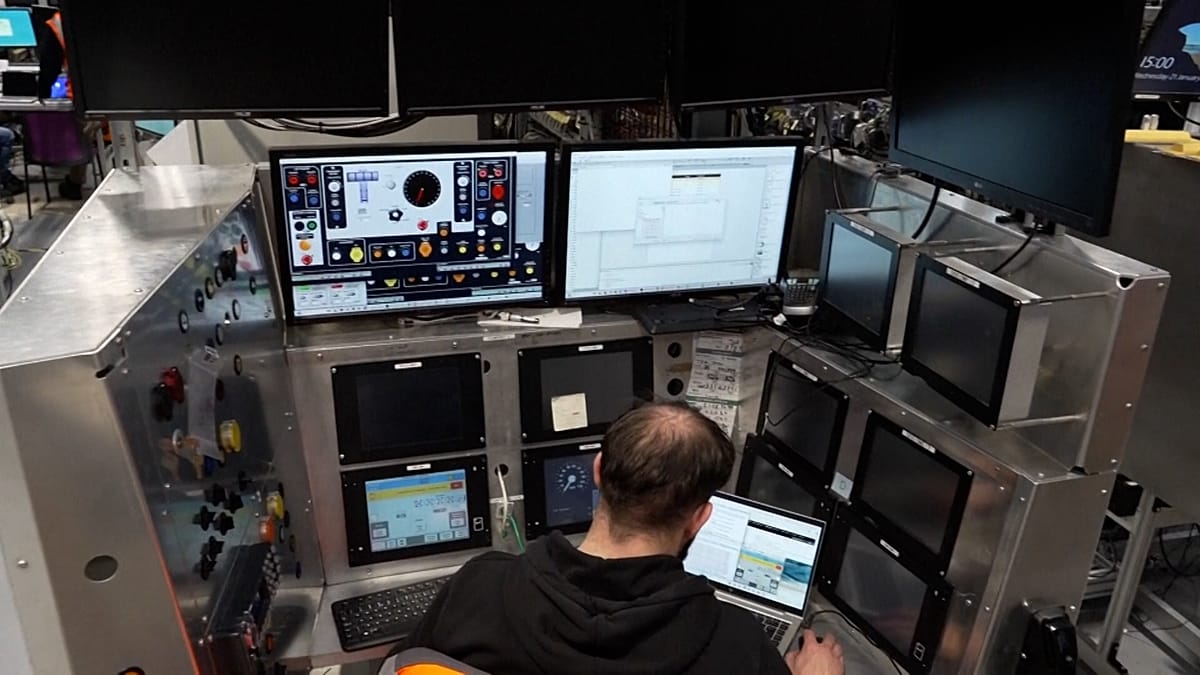
But while the British-built Class 701 Aventra train runs through its paces on an outdoor test track, the most important work is happening inside a digital laboratory known as Train Zero.
The facility recreates an entire train in virtual form, using racks of hardware and software to simulate how onboard systems behave in real-world conditions.
“In here we are mainly testing one product, and that’s called the Aventra trai,n and that is actually delivered into six different projects,” said David Cox, head of train control at Alstom.
Train Zero is used to test multiple versions of the Aventra platform, including units now operating or in development for London’s Elizabeth Line commuter rail service and several regional rail networks across England.
The testing environment allows engineers to validate complex changes and simulate faults before they are implemented on actual trains carrying passengers.
Recreating real-world conditions in simulation
Train Zero allows engineers to test an entire train without needing one physically present.
The testing environment allows engineers to simulate faults, recreate real-world conditions and validate complex changes before they are implemented on fleet vehicles.
Each setup is a combination of real hardware, such as buttons, relays and displays, as well as virtual systems that simulate how a full train would behave in motion.
The testing rigs are connected using physical wiring that mimics the actual configuration on board.
Each Aventra train includes more than five miles (about 8 kilometres) of cable to carry data and power between dozens of subsystems.
“Although this isn’t a real train, you can actually come in here and feel that you’re actually either stood on a train and you can hear and see the different aspects of the train or that you are on a platform and you hear the different interactions that we make to ensure that the passenger information system on the platforms are the same as is happening in real life,” Cox said.
Among the systems being tested is the Passenger Information System (PIS).
It controls audio and visual announcements, screens, train stop displays and external signs that show destination and service details.
“We have a physical door and we do have the physical screens, which are called TFT screens. We do have an external front display as well, which you can see here, which is displayed at the front part of the train,” said Jabeen Yousaf, a test and validation engineer at Alstom.
“So we are testing different systems and we integrate different subsystems into and test different things. So it’s TCMS (Train Control and Management System), PIS, CCTV (Closed-Circuit Television). We can test the audio system, visual and other systems integrated together,” she added.
The TCMS acts as the brain of the train.
It links all the individual systems together and coordinates how they operate. If the doors open, the TCMS ensures the announcements play and the lights update.If the brakes are applied, it makes sure traction power is adjusted and data is recorded.
Train Zero is where all those interactions are tested, before they ever reach the railway.
Tests for a ‘safety-critical system’
The lab also runs safety and signalling tests, including the European Train Control System (ETCS), which is being gradually rolled out across parts of the UK network.
ETCS is a form of digital signalling that replaces trackside signals with live data sent directly to the train’s onboard computer.
“We’ll have balises on the track. So they are little trackers that the train will go over. ETCS will read them, and it’ll have information on where the next station will be, how far it is, how many doors to open, when to start braking,” said Ibtihaj Yousaf, a Simulation Engineer at Alstom
“So that sort of stuff will come into the ETCS. It’ll process that information and at the right time, it’ll apply automatic braking. When we get to the station, it’ll apply automatic door release as well,” he added.
This data is continuously processed by the train’s onboard computer.
ETCS allows the train to respond in real time to its location, speed and route.
Many functions that would once rely on the driver alone, such as braking, door release and even adjusting speed limits, can now be triggered automatically through software.
That level of automation increases efficiency but also demands rigorous oversight.
“It’s important because in terms of the future of the railway, it is something that maybe a lot of projects will go towards,” he added.
“But because it’s such a safety-critical system, we have to test it, obviously, to make sure we’re catching all the issues before they catch them on the train or on the tracks. So it’s important for a safety perspective to test right now and test all the deficiencies that we have right now.”
Other signalling and control systems tested include AWS, the Automatic Warning System, and TPWS, the Train Protection and Warning System, which are both used widely across the UK to ensure trains do not pass red signals or exceed speed limits.
All these systems interact with the core train software and with one another.
Fully driverless trains
Some of the software in development could allow for higher levels of automation in the future.
The idea of fully driverless trains remains some way off, Alstom says, but the core technology is advancing.
“I think the technology is there to be able to have driverless trains, whether people are happy doing that or not, I’m not sure,” said Steve Uttley, a validation and test lead at Alstom.
“There’s obviously a safety aspect of that and are you 100 percent confident with the safety systems that you’ve put in place? On an aircraft, for example, you always like to have a pilot there, just in case, even though the autopilot is doing the majority of the work, the landing system is doing the majority of the work.
“We are still having pilots there just because it makes people feel more comfortable. The technology, I believe, will be there, but I don’t think it’s in our hands whether that actually happens or not,” he added.
Alongside the testing work in Train Zero, trains are being physically assembled inside the main production building.
These trains are part of the latest order from Alstom’s contract with Transport for London to supply additional Class 345 Aventra units for the Elizabeth Line, following increased demand on the route.
Each train is built in sections, with teams fitting wiring, motors, interiors and control systems before the full train is moved to the commissioning area.
Every unit contains more than five miles of electrical cabling, running through the floor, ceiling and walls to connect all subsystems, including brakes, lighting, power, communication, and passenger information systems.
Engineers also install the onboard computers and interface hardware that links the train to trackside systems and central control.
The final stages include installing seating, driver cabs, displays and external components before the train is moved out for full dynamic testing on the track.