
Greenland, the world’s largest island, has been making headlines for several weeks. US President Donald Trump has repeatly floated the idea that the United States should acquire the Arctic territory.
In a recent speech at the World Economic Forum in Davos, he struck a more conciliatory tone towards NATO allies. Although Trump once again insisted that Greenland ought to belong to the US, he underlined that he would not seek to achieve this by force.
Trump presents the proposal as a question of national security, arguing that China or Russia could attempt to gain influence on the island and accuses NATO and Denmark of failing in recent years to ensure Greenland’s security. In his view, only the United States is ultimately in a position to guarantee it.
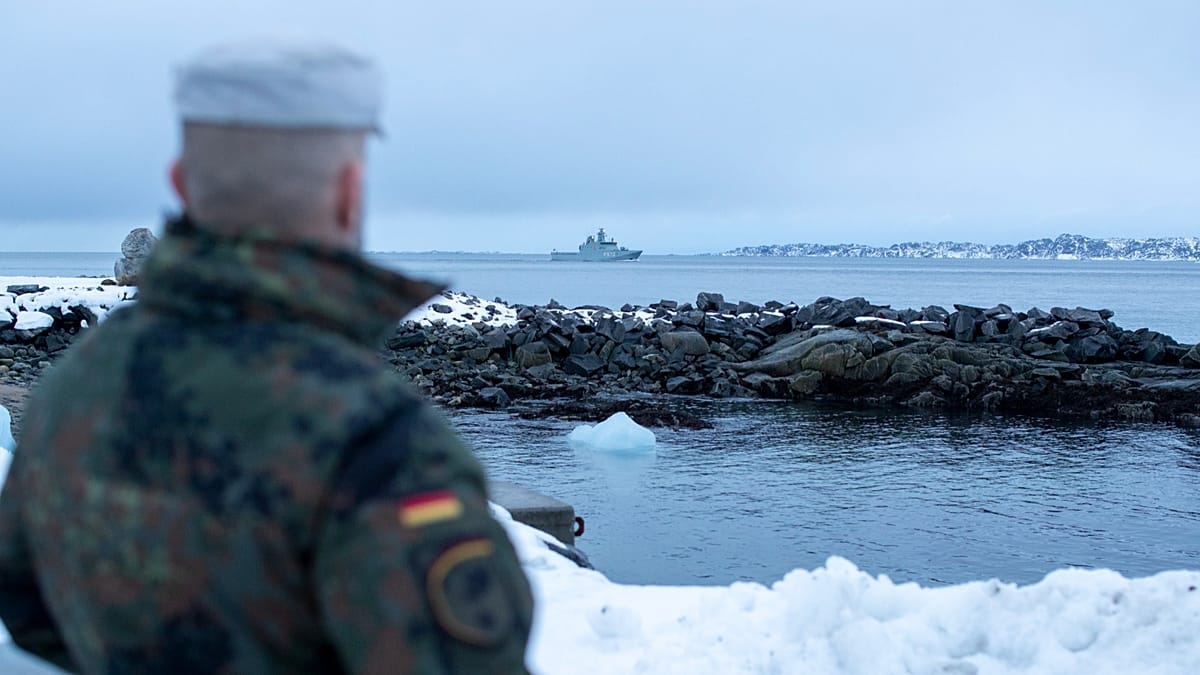
Denmark and several NATO partners responded last weekend by sending a reconnaissance mission to Greenland. The deployment also included 15 soldiers from the German armed forces, who were originally scheduled to stay until 20 January, but were withdrawn a day earlier after adverse weather conditions set in.
According to Henrik Schilling from the Institute for Security Policy at Kiel University (ISPK), it is important to distinguish between peacetime operations and deployments under wartime conditions, as each comes with very different requirements.
“If a runway is completely iced over, you would not land there in peacetime, but in wartime the calculation would be different,” Schilling explained in an interview with Euronews.
Reports suggest that Donald Trump initially “misunderstood” the Danish-led mission, but was later reassured by British Prime Minister Keir Starmer.
Schilling, however, said that a mission like that did not come “out of the blue” from his perspective. Naval forces are regularly involved in exercises in the Arctic region. He pointed to the task force provider “Berlin,” which returned to Germany in December last year after taking part in multinational manoeuvres in the North Atlantic and off the US coast.
Is Greenland important for Germany’s and Europe’s national security?
Donald Trump has justified his calls for the United States to take control of Greenland by pointing to American national security interests. While the US state of Alaska already borders Russia, Trump argues that Washington must prevent Russia or China from gaining influence over Greenland and thereby becoming direct neighbours of the United States.
According to security expert Henrik Schilling, the Arctic has become “increasingly important” in recent years.
One key reason, he explains, is the strategically vital sea and air corridor between Greenland, Iceland and the UK, known as the GIUK gap. This area is regarded as a critical bottleneck for Russian naval and submarine movements between the North Atlantic and the Arctic.
“In addition, there are likely to be alternative airfields in Greenland. If something were to happen in the Atlantic, operations could be run from there.”
More broadly, the Arctic is becoming an increasingly significant region, according to Schilling. He pointed to competing territorial claims by neighbouring states, including Russia, as well as China’s growing presence.
The main driver, Schilling argued, is that “entirely new supply routes are emerging in the region”. As the ice continues to melt, large parts of the Arctic could become increasingly ice free and therefore usable for commercial shipping in the future.
So far, however, there is no concrete evidence to suggest that China or Russia are directly seeking to take control of Greenland.
Beijing has firmly rejected such accusations. It denies any intention of undermining the United Nations Charter and stresses its self declared role as a defender of state sovereignty.
On Monday, Foreign Office spokesperson Guo Jiakun called on the United States to stop citing an alleged “China threat” in Greenland as justification for punitive tariffs on European countries.
Permanent presence in the Arctic?
In a statement to Euronews, a spokesperson for the German navy said it is “focusing its capabilities on national and collective defence along NATO’s northern flank.” This, the spokesperson explained, covers the North Atlantic, European Arctic waters, the North Sea and the Baltic Sea within the framework of NATO.
According to Schilling, the German armed forces do have the equipment and expertise “to be able to operate in the region”. At the same time, he pointed to a structural problem: there are simply too few soldiers in the Bundeswehr.
Schilling added that the demands on the military have also shifted since the start of Russia’s war of aggression against Ukraine in February 2022. In the past, the navy was mainly involved in peacekeeping and stabilisation missions, he explains, such as refugee rescue operations or anti piracy deployments off the coast of Africa.
“That has now changed to national and alliance defence,” Schilling said, pointing to the increased German presence in the Baltic Sea. “That’s essentially the problem: you can’t do everything, so you have to set priorities,” he told Euronews.
If the Arctic were to be prioritised as part of national and collective defence, Schilling believes a sustained commitment would be feasible in principle. The necessary equipment would then also be available. While existing German naval vessels meet national standards, they are not icebreakers and would struggle to operate independently in conditions of heavy icing.
This limitation, Schilling argued, could be offset through cooperation within NATO or with partner countries that already have the required capabilities.
Schilling conceded, however, that the timing of the US president’s renewed focus on the Arctic is “rather unfavourable”. If NATO, and by extension the Bundeswehr, were to contribute troops to an Arctic deployment, “we would also need those forces here”, he said.
So far, no such mission has been planned.
Schilling compared this dilemma to arms deliveries to Ukraine. “You initially give away weapons from your own stocks, hoping you won’t need them yourself in the coming years. But they are then missing, at least temporarily,” he explained.
Weapons can be reproduced, he adds, but rebuilding personnel capacity is far more difficult and takes much longer.
From his perspective, the key is to establish a sustained presence over time, ideally within the framework of NATO and in close coordination with partner countries, to ensure a workable rotation system. This would also serve to demonstrate NATO’s ability to carry out such a commitment.
A spokesperson for the German Ministry of Defence, Colonel Mitko Müller, made a similar point at the Federal Press Conference on 19 January.
He said the Bundeswehr is, in principle, capable of operating in Arctic and polar regions. Specialised units, such as the mountain troops, regularly undergo cold weather and high altitude training, including exercises in Norway.