
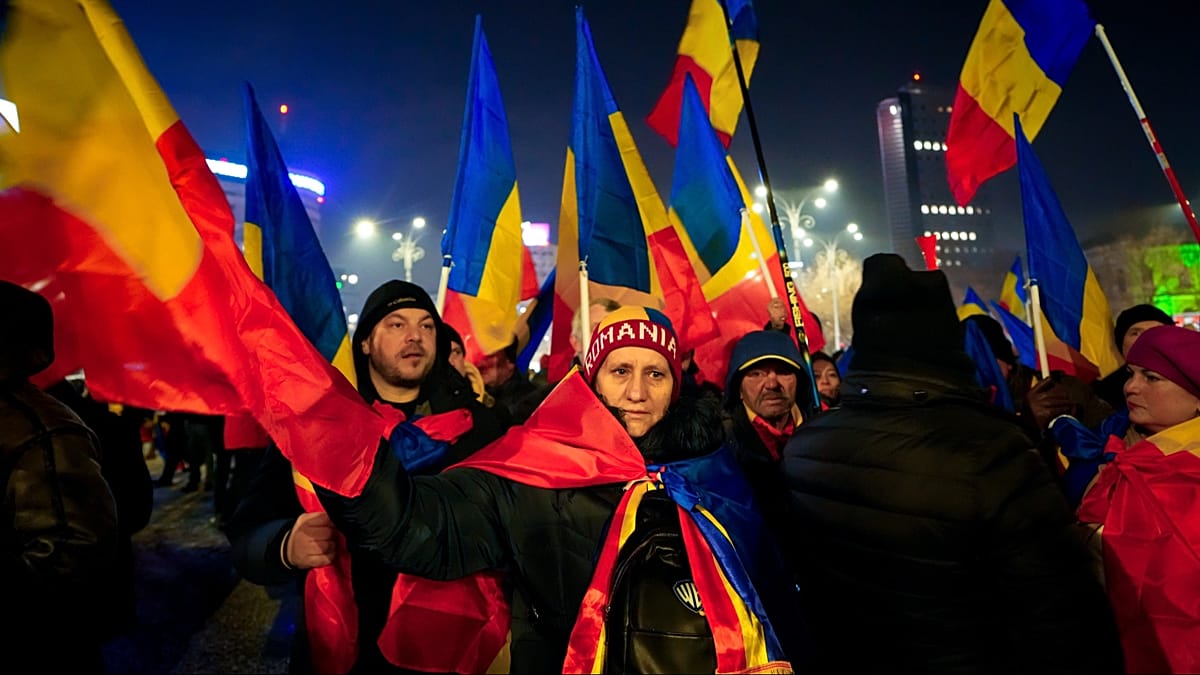
Huge protests broke out in central Bucharest last week against a law that participants claimed would strip away Romania’s freedom of speech, with social media posts describing the law as one that would jail people for expressing opinions online.
But a closer look at the legislation shows a more complex picture.
The protest, which drew just over 10,000 participants, was organised by far-right MEP Claudiu Târziu, founder of the newly established Conservative Action Party.
Demonstrators called for the repeal of what they refer to as the “Vexler Law”, alleging it represents a major restriction on civil liberties.
A law targeting extremism
The law in question was proposed by MP Silviu Vexler, who also serves as president of the Federation of Jewish Communities in Romania. The law’s stated aim is to combat extremist ideologies.
It bans the public glorification of fascist figures and introduces criminal penalties for promoting antisemitism, racism or xenophobia, both on and offline.
Supporters of the law say it closes loopholes in existing legislation that previously allowed extremist content to circulate openly, particularly on social media.
The bill was first adopted in June 2025, but Romanian President Nicușor Dan sent it back to parliament for re-examination, arguing that some of its definitions weren’t precise enough. In particular, he questioned the lack of clarity around what constitutes fascist, legionary, racist or xenophobic material.
Parliament rejected the president’s objections, a decision later upheld by the Constitutional Court.
The law was re-adopted in December, triggering renewed public debate about the limits of free speech.
Claims about national identity
Addressing protesters, Târziu described the legislation as “the most serious attack on the Romanian people in the past 35 years”. He warned it would be used to “erase from the collective memory the heroes, geniuses and saints of the Romanian nation”.
Supporters of this argument often cite the case of Mihai Eminescu, Romania’s national poet. Eminescu is a central figure in Romanian culture, though parts of his journalism and poetry contain xenophobic and antisemitic ideas.
However, experts say the law does not support claims that such figures would be banned from public life or education.
What the law actually says
Adina Marincea, researcher at the Elie Wiesel National Institute for the Study of the Holocaust in Romania, told Euronews’ fact-checking team, The Cube, that the legislation “criminalises only specific extremist content, such as fascist, legionary, racist and xenophobic material”.
“There is absolutely nothing in the law that would lead to the national poet being banned,” she said.
The law requires historical figures and works to be examined in their historical context, but it does not prohibit discussion, academic analysis, or artistic and educational use of cultural material.
It also distinguishes between artistic output and political activity.
While it bans the awarding of public honours to war criminals or leaders of fascist organisations, it does not outlaw their literary or artistic works as such.
Eminescu’s writings, for example, remain part of Romania’s national school curriculum.
No evidence of free speech abuses
Legal experts say the legislation represents an update to existing hate-speech laws, addressing areas that were previously unregulated.
They also note that no cases of abuse of free-speech protections have been recorded under either the earlier version of the law or the updated one.
While the protests reflect genuine public concern about freedom of expression, specialists argue that claims of a blanket ban on speech are not supported by the text of the legislation itself.