
The opinions expressed in this article are those of the author and do not represent in any way the editorial position of Euronews.
We have many reasons in Europe to be proud of ourselves.
We are the continent of the Enlightenment and of universal human rights. A continent in which many people live in prosperity and most live in dignity and freedom.
With the European Union, a system was created that enables cooperation instead of confrontation. And yet we must once again begin to think of Europe as something larger than the EU in its current form allows.
Because we need a strong and united Europe that can hold its own on the global stage.
So far, Europe has failed to find the right answers to Russian aggression, Chinese economic threats and American irrationality.
Here is a cocktail for a solution with three ingredients:
Mindset: Europe must finally believe in itself
“Developing the right mindset” may sound like advice from a self-help guide but if any continent needs it, it is surely Europe.
The EU is the world’s second-largest economic power, home to 451 million people in 27 countries, a global leader in research and science, possesses a nuclear power, around 1.5 million soldiers and a political system originally designed to give Europe weight on the world stage.
Yet instead of drawing strength from this, the EU repeatedly diminishes itself — even in the face of an economically faltering mafia state like Russia.
The stalled enlargement process, recurring blockages caused by the unanimity principle, and the failure so far to make use of frozen Russian assets reveal the systemic limits of the EU in its current form.
But a union can be reformed, new members can be admitted, European defence can be re-imagined and a renewed belief in Europe can be sparked. Ukraine must finally be recognised as part of this community.
Nowhere — neither in Brussels nor in Berlin — is the idea of the European Union, of universal human rights, of democracy and the rule of law defended as courageously as by Ukrainian soldiers along the more than 1,000-kilometre frontline.
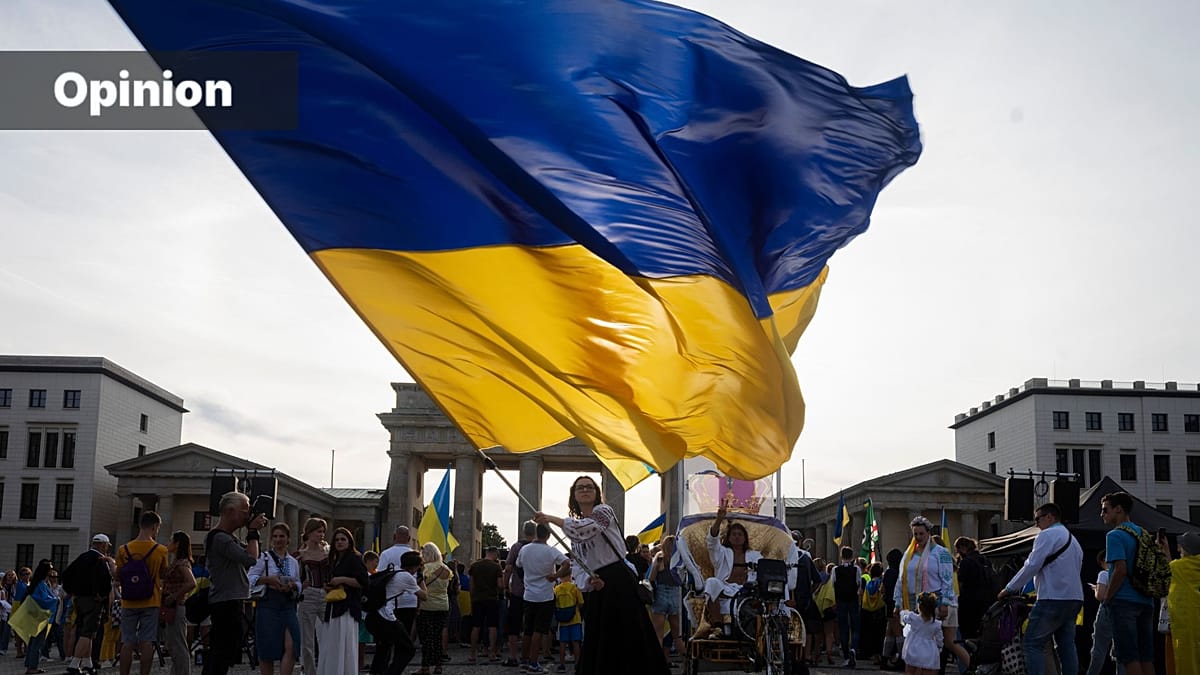
Ukraine is Europe, because it is defending Europe.
Connectivity: Europe must learn from Ukraine
The attack on Berlin’s power supply earlier this year laid bare how poorly Germany is prepared for assaults on critical infrastructure.
While it took nearly a week to restore supply in the German capital, people in Ukraine manage to fix outages within a very short time, even under constant shelling.
After four years of regular attacks, the population is prepared: generators and power banks have long since become basic equipment.
Even now, amid the current energy crisis following the latest Russian strikes, Ukrainian power engineers are working around the clock to prevent a humanitarian catastrophe.
Ukraine shows how critical infrastructure can not only be better protected but also repaired more quickly, and how a society can be systematically prepared for emergency situations.
Most impressive, however, is the interaction between civil society, industry, the defence sector and politics. This close, whole-of-society cooperation strengthens resilience and knowledge transfer, and enables the rapid build-up of defence capabilities — when politics sets the direction, civil society mobilises donations, and civilian industry provides innovation and production for the defence sector.
In this way, Ukraine has developed not only extensive military expertise, but also effective capabilities to counter disinformation campaigns, cyberattacks, espionage and sabotage. This is one of the reasons why Ukraine has been able to withstand Russian aggression for almost twelve years.
Prioritisation: Europe must focus on what matters
Russia’s preparations for a long war and the expansion of its hybrid attacks on European states coincide with an EU that is also grappling with territorial debates over Greenland and economic challenges from China.
All the more reason why strategic prioritisation is urgently needed.
In this complex situation, neither Russian aggression nor support for Ukraine must be lost from sight. Many EU states are increasingly shifting their focus away from Ukraine towards their own defence. This is understandable, given that European defence has been neglected for decades and remains far weaker than that of the US, Russia or China.
Nevertheless, a sober assessment is required: Europe’s best chance of effectively deterring Russia lies in consistently backing Ukraine.
Only if Russia is stopped there can the European Union as a whole endure.
At present, Europe is delivering just enough for Ukraine to continue defending itself — but not enough to push Russia back.
This strategy carries the risk that Russia will use its newly expanded industrial capacities, particularly in drone technology, to extend the war beyond Ukraine to other European countries. Europe is not prepared for this. And the risks and costs of such a scenario would be many times higher than decisively providing Ukraine now, with full industrial force, the means it needs to confront Russia effectively.
This raises uncomfortable questions: Is an air defence system needed anywhere in Europe more urgently than in Ukraine?
Are tanks, drones, fighter jets or cruise missiles really needed more urgently elsewhere?
Shouldn’t we stop Russia in Ukraine before it gets the chance to attack another country?
2026 must be the year in which Europe regains its self-confidence and uses its economic strength not only to articulate foreign and security policy interests, but to enforce them.
Ukraine should not be seen as a recipient of aid, but as a strategic partner in our own interest.
All that is required is mindset, connectivity and prioritisation — the cocktail for 2026.
Krista-Marija Läbe is a member of the board of the German-Ukrainian Society.