
From construction and energy, to ports and telecommunications, Iran’s powerful Revolutionary Guard or IRGC dominates large parts of the economy.
The IRGC is not simply a military force — it is a parallel power centre with a revolutionary and religious mission. Set up after the 1979 power shift in the country, it seeks to guard the Islamic foundations of the republic and project force abroad.
Its economic role expanded during the Iran–Iraq war from 1980 to 1988, when it built independent engineering and logistics capabilities to sustain the conflict.
Iran is currently in the throes of ongoing nationwide protests sparked by rapid currency devaluation and soaring prices.
While the government has tried to pin the blame exclusively on the extensive global sanctions placed on the country, protestershave clearly tied the cause of their protest to the country’s leadership. Chants such as “Death to the dictator” or “Death to Khamenei” have rung through the streets of several Iranian cities, with protestors demanding “democracy and equality”.
Severe sanctions regime
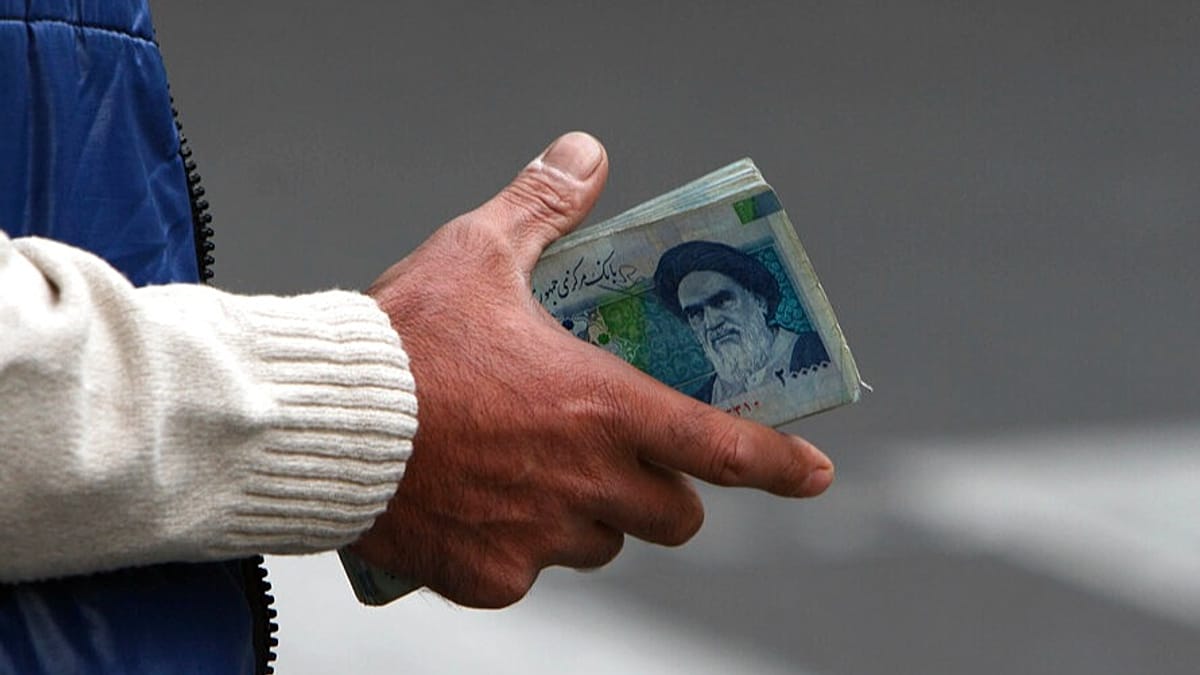
At the time of Iran’s 1979 revolution, the US dollar converted to about 70 Iranian rials. By early 2026, it surged past 1.4 million rials, meaning Iran’s currency has lost roughly 20,000 times its value over four decades.
Sanctions, inflation, and diplomatic isolation are often blamed for this collapse. The UN reimposed sanctions on Iran in September 2025 after the Security Council failed to pass a resolution to keep sanctions relief in place. The relief was tied to previous non-proliferation deals that sought to curb the country’s ability to make nuclear weapons.
The restored UN measures include a conventional arms embargo, restrictions linked to Iran’s ballistic missile programme, targeted asset freezes, and travel bans.
The EU has similar sanctions in place, as well as sanctions tied to Iran’s human rights record and its role in supplying drones to Russia that are being used in the ongoing invasion of Ukraine.
According to the Iran Open Data project, a non-profit data journalism project, “Iran is losing roughly 20% of its potential oil export revenues as it tries to bypass US sanctions… despite rising shipments to countries like China and Malaysia.”
Tehran’s oil revenues continue to fall short because sanctions force Iran to sell oil through indirect routes that are expensive by design.
Cargoes are often discounted to attract buyers, then moved via intermediaries and shell firms. They are shipped on “shadow fleet” tankers and handled through crude tactics such as ship-to-ship transfers in the middle of the ocean and offshore storage — all of which eat into the price Iran ultimately receives per barrel.
Iran Open Data estimated that in the year to March 2025, Iran earned about $23.2 billion (€19.81bn) from oil exports, but could have earned more than $28 billion (€23.9bn) based on tanker tracking and benchmark prices. That’s a roughly $5 billion (€4.26bn) shortfall linked to these sanctions-evasion costs.
According to the World Bank, Iran has “suffered from a lost decade of economic growth” due to the ongoing focus on oil and the sanctions regime. On average, per-capita gross domestic product contracted at an annual rate of 0.6% between 2011 and 2020.
“In the past decade close to 10 million Iranians have fallen into poverty. Between 2011 and 2020, the share of Iranians living below the international poverty line… increased from 20% to 28.1%,” the World Bank report indicated.
Not only did the number of poor Iranians increase, but so did the general precarity of Iranians who manage to make it above the poverty line.
“Forty percent of Iranians are vulnerable to falling into poverty, in that their risk of becoming poor in the near future is greater than one in five — a 10 percentage-point increase from 2011.”
A parallel economy emerges
During post-war reconstruction in the 1990s, IRGC-affiliated firms — most notably Khatam al-Anbiya, its main engineering arm — began winning major state contracts.
Over time, they expanded into oil and gas, infrastructure, transport, ports, telecommunications, mining, and logistics. In short, they dominate extremely profitable and secure sources of income and financing.
Many of these projects were awarded without competitive bidding and with limited civilian oversight. The result is a dual economy: a formal civilian sector subject to regulation and a parallel system controlled by military and security-linked actors.
Iranian officials often refer to this model as a “resistance economy” designed to survive sanctions or eghtesad-e moqavemati . The doctrine, promoted by Supreme Leader Ali Khamenei, was codified in February 2014 in a set of “general policies”.
In practice, analysts say the slogan has provided political cover for a more state-directed, security-influenced economy by concentrating wealth and power while crowding out private businesses.
Ironically, sanctions — largely designed by Western governments to squeeze Tehran — have helped entrench the very economic system they were meant to weaken.
As foreign firms exited Iran and domestic companies struggled, IRGC-linked entities were better positioned to operate under restrictions. They benefited from access to foreign currency, informal trade routes, and security protection.
The Guardian Council, tasked with protecting Iran’s political institutions, helps to bolster military groups and their economic networks. It shapes legislation to suit their interests and, through its power to vet eligibility, ensures loyal candidates are placed in elected offices with supervisory authority.
Fixed versus real rates
In this system, currency instability becomes structural rather than accidental. Access to dollars or import licences depends less on market forces and more on political alignment, which has undermined confidence in the rial.
After the reimposition of US sanctions in 2018, the state set a subsidised or artificial rate for essential imports at 42,000 rials to the dollar. Then, over the years, it repeatedly narrowed eligibility for those who would trade or buy at that rate as dollar reserves tightened.
The policy was formally scrapped in 2022 but soon replaced with another subsidised rate, set at 285,000 rials per dollar — while the parallel rate was about 580,000-630,000 in 2024, according to the World Bank. That gap matters because it turns dollars into an allocated privilege that is administered by the government.
The World Bank highlighted that Iran has often filled holes in public finances and budget shortfalls by effectively pumping more money into the economy — which is the worst thing you can do when already have persistent inflation.
Households and firms then move savings into dollars and goods, which in turn puts fresh pressure on the rial and can turn falls in the currency value into a self-reinforcing cycle.
Few places capture the depth of Iran’s economic pain as vividly as the chants rising from Tehran’s Grand Bazaar. Dating back to at least the 16th century, the bazaar is more than a shopping district. It is a commercial nerve centre linking merchants and supply chains, and a key venue for networking.
Increasingly, it has become a barometer for public anger. When it shuts downs or fills with protestors, it signals that economic pain is hitting the commercial heart of the capital. This is why chants such as “The merchant may die, but will never accept humiliation!” carry particular weight when they echo through its hallowed lanes.