
By Euronews
Published on
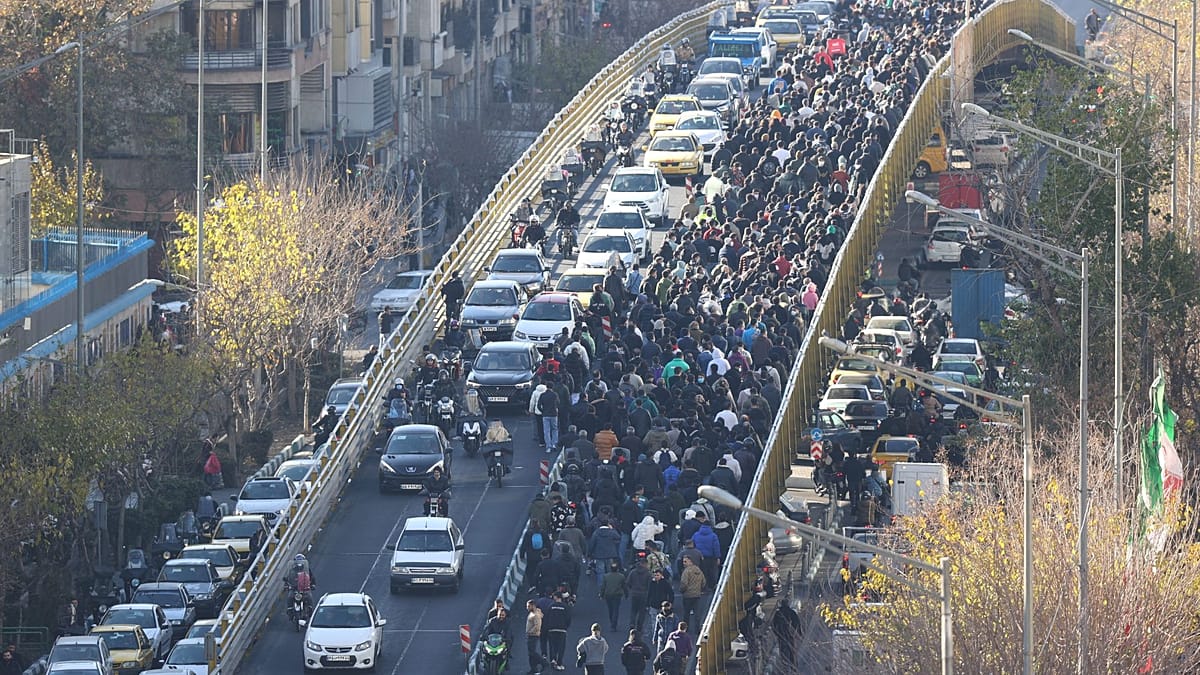
Merchants across Iran shuttered stores and people demonstrated in multiple cities on what is now day five of protests after the rial’s value collapsed, marking the Islamic Republic’s most significant civil unrest since late 2022.
Sellers in Tehran’s commercial districts began closing shops Sunday when the currency reached 1.42 million rials per dollar, its weakest level on record. Crowds assembled near Republic Street and the historic Grand Bazaar.
Demonstrations expanded to Isfahan, Shiraz, Mashhad, Kermanshah and Hamadan by Tuesday. Authorities used tear gas against gatherers in parts of the capital.
Mohammad Reza Farzin stepped down as central bank governor Monday, state television announced. Parliament’s budget committee simultaneously rejected the government’s spending proposals for the fiscal year beginning March.
President Masoud Pezeshkian replaced Farzin with Nasser Hemmati on Wednesday. Hemmati previously served as economy minister before lawmakers removed him during an earlier currency crisis.
Pezeshkian wrote on social platform X that he is acutely aware of economic hardship. His administration would meet protest representatives, he stated.
Government spokesperson Fatemeh Mohajerani acknowledged the demonstrations publicly, saying officials would consider critical feedback.
Revolutionary Guard (IRGC) commanders issued warnings describing the unrest as foreign-influenced destabilisation efforts targeting Iran’s political system.
University students joined protests during the third day, with gatherings reported at campuses in Tehran and other cities. Campus security detained several Tehran University students before releasing them within 24 hours.
The unrest represents Iran’s broadest public dissent since protests following Mahsa Amini’s death in custody in the autumn of 2022. Those demonstrations continued for months before authorities suppressed them.
Some participants voiced support for the restoration of the monarchy, led by Crown Prince Reza Pahlavi, whose father Shah Mohammad Reza Pahlavi ruled until 1979.
Tehran’s own ‘Tank Man’
One widely circulated image showed a solitary demonstrator seated on the pavement amid dispersing crowd control agents, becoming emblematic across social networks.
Video footage showing a solitary protester confronting security forces in central Tehran gained widespread attention on social media, with comparisons drawn to China’s “Tank Man” from the 1989 Tiananmen Square demonstrations.
AFP verified that the footage was recorded outside the Aladdin shopping centre on Republic Street and that it first appeared online around 5 pm local time on Sunday.
The video, filmed from an adjacent building, shows a man dressed in dark clothing seated in the middle of the street facing approximately 26 special forces personnel on motorcycles. Security forces had dispersed other protesters with tear gas moments earlier.
The man sits motionless, then lowers his head and pulls his jacket over himself as officers watch. A second video filmed from closer range shows him later standing and approaching one officer to speak before another security guard appears to strike him.
The protester’s identity remains unknown. His fate is also unclear.
Several Iranian activists described the image as symbolic of the demonstrations.
Former political prisoner and human rights activist Arash Sadeghi wrote that the protesters’ stillness made his action radical. “His body does not run away, does not resist aggressively, does not shout demands; it just ‘is.’ And to be that, is disruptive to an order that is used to managing bodies,” Sadeghi stated.
Consumer prices skyrocket
Pezeshkian had planned to present budget legislation Sunday proposing 20% wage increases for state workers. Official data showed consumer costs had climbed 52% during the preceding 12 months.
December food prices were 72% higher than the previous year, according to government statistics. Medical supplies and services increased 50%. Overall inflation measured 42.2%.
Volatile exchange rates froze commercial activity as traders and customers delayed transactions until exchange rates stabilised.
Government offices across 20 provinces closed Wednesday, officially attributed to cold temperatures and electricity shortages. The closures coincided with Iran’s approaching weekend.
Hemmati pledged to restore order in the currency market and address what he termed distortions caused by multiple exchange rate systems.
International sanctions have constrained Iran’s economy for years, intensifying after Washington abandoned the 2015 nuclear accord in 2018. That agreement had provided sanctions relief whilst limiting enrichment activities. The dollar then traded near 32,000 rials.
Currency weakness persists amid speculation about military escalation following June’s 12-day conflict between Iran and Israel.
September brought reinstated UN nuclear penalties through automatic enforcement provisions, blocking Iranian overseas assets and prohibiting weapons transfers.