
Every animal with a brain needs sleep – and even a few without a brain do, too. Humans sleep, birds sleep, whales sleep and even jellyfish sleep.
Sleep is universal “even though it’s actually very risky”, says Paul-Antoine Libourel, a researcher at the Neuroscience Research Center of Lyon in France.
When animals nod off, they’re most vulnerable to sneaky predators. But despite the risks, the need for sleep is so strong that no creature can skip it altogether, even when it’s highly inconvenient.
Animals that navigate extreme conditions and environments have evolved to sleep in extreme ways – for example, stealing seconds at a time during around-the-clock parenting, getting winks on the wing during long migrations and even dozing while swimming.
For a long time, scientists could only make educated guesses about when wild animals were sleeping, observing when they lay still and closed their eyes. But in recent years, tiny trackers and helmets that measure brain waves – miniaturised versions of equipment in human sleep labs – have allowed researchers to glimpse for the first time the varied and sometimes spectacular ways that wild animals snooze.
“We’re finding that sleep is really flexible in response to ecological demands,” says Niels Rattenborg, an animal sleep research specialist at the Max Planck Institute for Biological Intelligence in Germany.
Call it the emerging science of “extreme sleep”.
Chinstrap penguins and their ‘microsleeps’
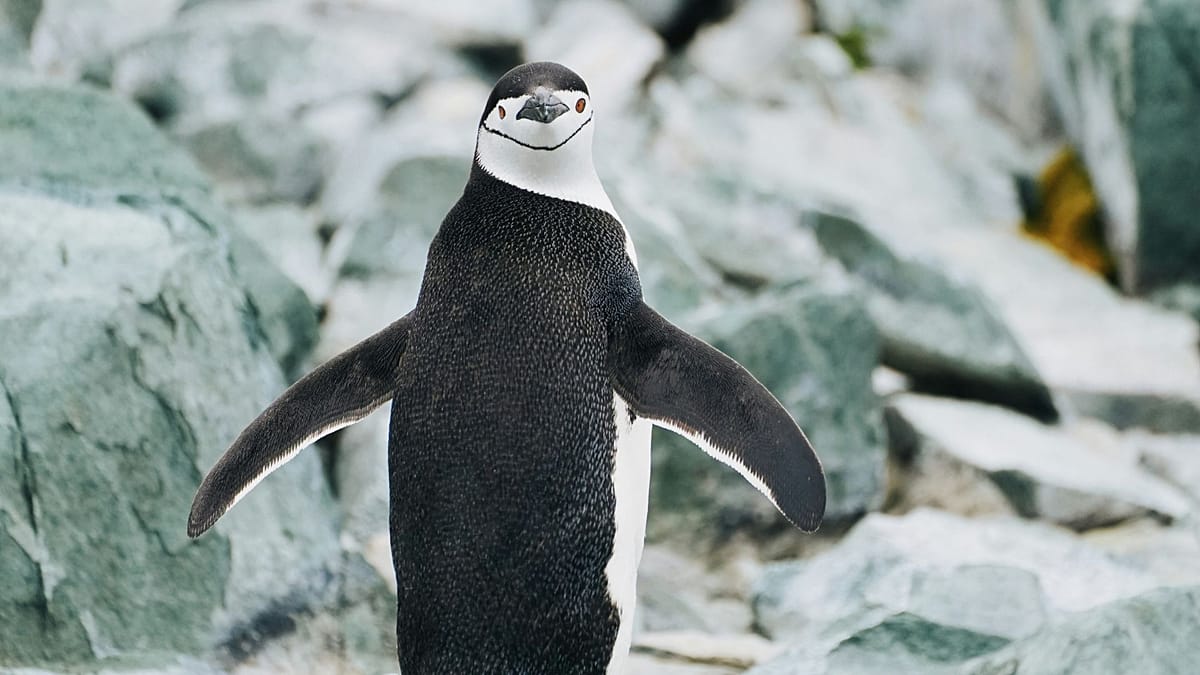
Take chinstrap penguins in Antarctica that Libourel studies.
These penguins mate for life and share parenting duties – with one bird babysitting the egg or tiny grey fluffy chick to keep it warm and safe while the other swims off to fish for a family meal. Then they switch roles – keeping up this nonstop labor for weeks.
Penguin parents face a common challenge: getting enough sleep while keeping a close eye on their newborns.
They survive by taking thousands of catnaps a day – each averaging just four seconds long.
These short “microsleeps”, as Korea Polar Research Institute biologist Won Young Lee calls them, appear to be enough to allow penguin parents to carry out their caregiving duties for weeks within their crowded, noisy colonies.
When a clumsy neighbour passes by or predatory seabirds are near, the penguin parent blinks to alert attention and soon dozes off again, its chin nodding against its chest, like a drowsy driver.
The naps add up. Each penguin sleeps for a total of 11 hours per day, as scientists found by measuring the brain activity of 14 adults over 11 days on Antarctica’s King George Island.
To remain mostly alert, yet also sneak in sufficient winks, the penguins have evolved an enviable ability to function on extremely fractured sleep – at least during the breeding season.
Researchers can now see when either hemisphere of the brain – or both at once – are asleep.
Frigatebirds snooze half their brains in flight
Poets, sailors and birdwatchers have long wondered whether birds that fly for months at a time actually get any winks on the wing.
In some cases, the answer is yes – as scientists discovered when they attached devices that measure brain-wave activity to the heads of large seabirds nesting in the Galapagos Islands called great frigatebirds.
While flying, frigatebirds can sleep with one half of the brain at a time. The other half remains semialert so that one eye is still watching for obstacles in their flight path.
This allows the birds to soar for weeks at a time, without touching land or water, which would damage their delicate, non-water repellent feathers.
Frigatebirds can’t do tricky manoeuvres – flapping, foraging or diving – with just one half of their brain. When they dive for prey, they must be fully awake. But in flight, they have evolved to sleep when gliding and circling upward on massive drafts of warm rising air that keep them aloft with minimal effort.
Back at the nest in trees or bushes, frigatebirds change up their nap routine – they are more likely to sleep with their whole brain at once and for much longer bouts. This suggests their in-flight sleeping is a specific adaptation for extended flying, Rattenborg says.
A few other animals have similar sleeping hacks. Dolphins can sleep with one half of the brain at a time while swimming. Some other birds, including swifts and albatrosses, can sleep in flight, scientists say.
Frigatebirds can fly 410 kilometres a day for more than 40 days, before touching land, other researchers found – a feat that wouldn’t be possible without being able to sleep on the wing.
Elephant seals slumber while diving deep
On land, life is easy for a 2,200kg northern elephant seal. But at sea, sleep is dangerous – sharks and killer whales that prey on seals are lurking.
These seals go on extended foraging trips, for up to eight months, repeatedly diving to depths of several hundred metres to catch fish, squid, rays and other sea snacks.
Each deep dive may last around 30 minutes. And for around a third of that time, the seals may be asleep, as research led by Jessica Kendall-Bar of Scripps Institution of Oceanography revealed.
Kendall-Bar’s team devised a neoprene headcap similar to a swimming cap with equipment to detect motion and seal brain activity during dives, and retrieved the caps with logged data when seals returned to beaches in Northern California.
The 13 female seals studied tended to sleep during the deepest portions of their dives, when they were below the depths that predators usually patrol.
That sleep consisted of both slow-wave sleep and REM sleep. During REM, or rapid eye movement sleep, the seals were temporarily paralysed – just like humans during this deep-sleep stage – and their dive motion changed. Instead of a controlled downward glide motion, they sometimes turned upside down and spun in what the researchers called a “sleep spiral” during REM sleep.
In the span of 24 hours, the seals at sea slept for around two hours total. (Back on the beach, they averaged around 10 hours.)
The winding evolution of sleep
Scientists are still learning about all the reasons we sleep – and just how much we really need.
It’s unlikely that any tired human can try these extreme animal sleep hacks. But learning more about how varied napping may be in the wild shows the flexibility of some species. Nature has evolved to make shut-eye possible in even the most precarious situations.