
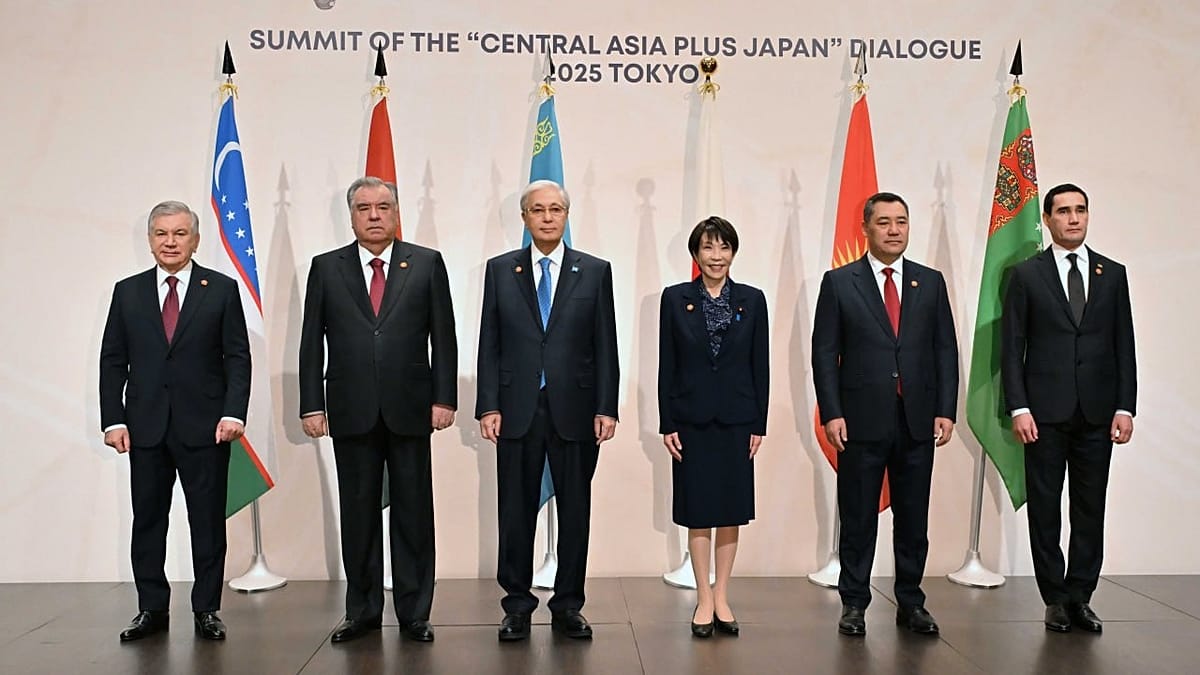
Transportation infrastructure development, decarbonisation and people-to-people exchanges were highlighted as three priority areas, in a joint declaration after the C5+ Japan summit, that took place in Tokyo.
The leaders of all five Central Asian states discussed how to define a new stage of regional cooperation with Japanese Prime Minister, Sanae Takaichi.
The summit brought together the presidents of Uzbekistan, Kazakhstan, Kyrgyzstan, Tajikistan and Turkmenistan and was the first time the “Central Asia + Japan” dialogue was elevated to the level of heads of state since its creation more than two decades ago.
Prime Minister Takaichi described Central Asia as a region of growing geopolitical and economic importance, highlighting its role as a junction between Europe and Asia, its energy and mineral resources, and its strong economic and demographic growth.
She announced the launch of the CA+JAD Tokyo Initiative, aimed at supporting industrial development and diversification in Central Asia and strengthening mutually beneficial ties with Japan.
The initiative focuses on three priority areas such as green and resilience, connectivity, and human resource development, and includes a target of 3 trillion yen (around €17.9 billion) in business projects over the next five years.
Japan’s Tokyo initiative
In the area of green and resilience, Japan pledged cooperation on energy transition, climate change measures, disaster risk reduction and the strengthening of critical mineral supply chains.
Tokyo also announced support for the further development of the Trans-Caspian International Transport Route, also known as the Middle Corridor, and the launch of a Japan-Central Asia AI Cooperation Partnership.
Human resource development will include continued scholarship programmes, cooperation in health and medical fields, and professional training initiatives.
Japan also confirmed plans to convene the Central Asia + Japan Justice ministers’ meeting, adding an institutional dimension to the dialogue.
Central Asian leaders welcomed the Tokyo Initiative and expressed interest in developing joint projects across all three priority areas.
Uzbekistan: infrastructure, energy and digital cooperation
Speaking at the summit, Uzbek President Shavkat Mirziyoyev recalled that Japan was the initiator of the Central Asia plus Japan dialogue more than 20 years ago and said the first summit-level meeting marked a new phase in cooperation.
“We are confident that by joining efforts, we can achieve tangible results,” Mirziyoyev said, quoting a Japanese proverb that “if you join forces, you can move mountains.”
Mirziyoyev proposed holding summits at the level of heads of state every two years and offered to host one of the future meetings in Uzbekistan. He also called for the development of a Central Asia-Japan Cooperation Strategy through 2040, focused on practical programmes and projects.
Economic cooperation featured prominently in Uzbekistan’s proposals. The Uzbek president welcomed expanded engagement by Japanese financial institutions and suggested establishing an investment fund for infrastructure and industrial development in Central Asia, alongside a regional network of Japanese technoparks to support industrial cooperation and technology transfer.
Digital transformation was another key focus. Mirziyoyev proposed creating a Central Asia-Japan digital hub for cooperation in AI, cybersecurity, the Internet of Things and digital solutions. He also expressed interest in Japanese participation in large-scale transport projects, including high-speed railways, highways, airports and digitalised transport corridors, noting ongoing cooperation with Sojitz on the new Tashkent International Airport.
Mirziyoyev also stressed that Uzbekistan aims to reduce carbon emissions by up to 50 percent by 2035 and increase the share of green energy in electricity generation to 54 percent by 2030. He called for joint renewable energy projects, the introduction of cogeneration technologies and carbon capture solutions, as well as the creation of a regional renewable energy training centre in Tashkent.
He also urged closer cooperation on air quality, climate adaptation and seismic safety, proposing a regional programme drawing on Japanese expertise, including training for engineers, architects and emergency services.
Kazakhstan: transit, energy and water security
Kazakh President Kassym-Jomart Tokayev emphasised the symbolic importance of holding the summit in Tokyo, describing it as a milestone for the entire region.
Tokayev highlighted Central Asia’s growing role as a transport and logistics hub, noting that more than 80 percent of overland freight between Asia and Europe passes through Kazakhstan. He underlined the importance of developing the Trans-Caspian International Transport Route and welcomed Japan’s decision to support the improvement of customs procedures at the port of Aktau on the Caspian Sea.
Energy cooperation featured prominently in Kazakhstan’s address. Tokayev said the country was interested in Japanese technologies and investment in both traditional and clean energy projects, stressing the need for a balanced and fair energy transition. He pointed to Kazakhstan’s role as a major coal producer and a supplier of around 40 percent of the world’s nuclear fuel, highlighting opportunities for cooperation in nuclear safety, waste management and specialist training.
The Kazakh president also drew attention to Central Asia’s reserves of rare earth elements and other critical minerals, saying the region could play a stronger role in global supply chains. He welcomed the Next-Generation SmartMining Plus project launched with Japan, aimed at digitalising mining operations and improving environmental sustainability.
Tokayev further stressed the importance of water security and sustainable agriculture, proposing closer cooperation on water-saving technologies, applied research and satellite monitoring. He suggested establishing a research platform on sustainable agriculture with the participation of Japanese scientists and experts.
The leaders of Central Asia and the Prime Minister of Japan also agreed that the next Central Asia-Japan summit will be held in Kazakhstan, underscoring Astana’s role in the future development of the dialogue.
Business forum and agreements
Following the summit, the leaders attended a multilateral business forum focused on trade, investment and industrial cooperation. Several joint projects were presented, including the construction of two solar power plants in Uzbekistan by Sumitomo, Chubu Electric Power and Shikoku Electric Power with support from JBIC and NEXI, IT infrastructure modernisation with Toyota Tsusho, a multidisciplinary medical centre by Sojitz, and critical minerals projects involving JOGMEC.
In total, more than 150 documents were signed and presented by public and private sector partners on the margins of the summit. Japan also announced new official development assistance projects, including grant aid and loans for Uzbekistan, Kyrgyzstan and Tajikistan, as well as a regional disaster risk reduction programme in cooperation with UNDP.
The leaders adopted the Tokyo Declaration, outlining agreed areas of cooperation between Central Asia and Japan.