
Misleading claims online have skewed and simplified the causes of mass protests in Bulgaria to fit anti-EU narratives.
One post circulating on X, viewed more than 80,000 times, claims that Bulgaria’s “pro-EU government has just resigned” after mass protests, while also alleging the country’s planned eurozone accession has been cancelled.
Another post hails the fall of the “socialist government” of Bulgaria, while others claim that the government’s resignation shows that power belongs to the people of Bulgaria, rather than Brussels.
However, these posts mislead about the nature of Bulgaria’s Gen Z-led anti-corruption protests, which last week led to the resignation of Prime Minister Rosen Zhelyazkov.
What is happening in Bulgaria?
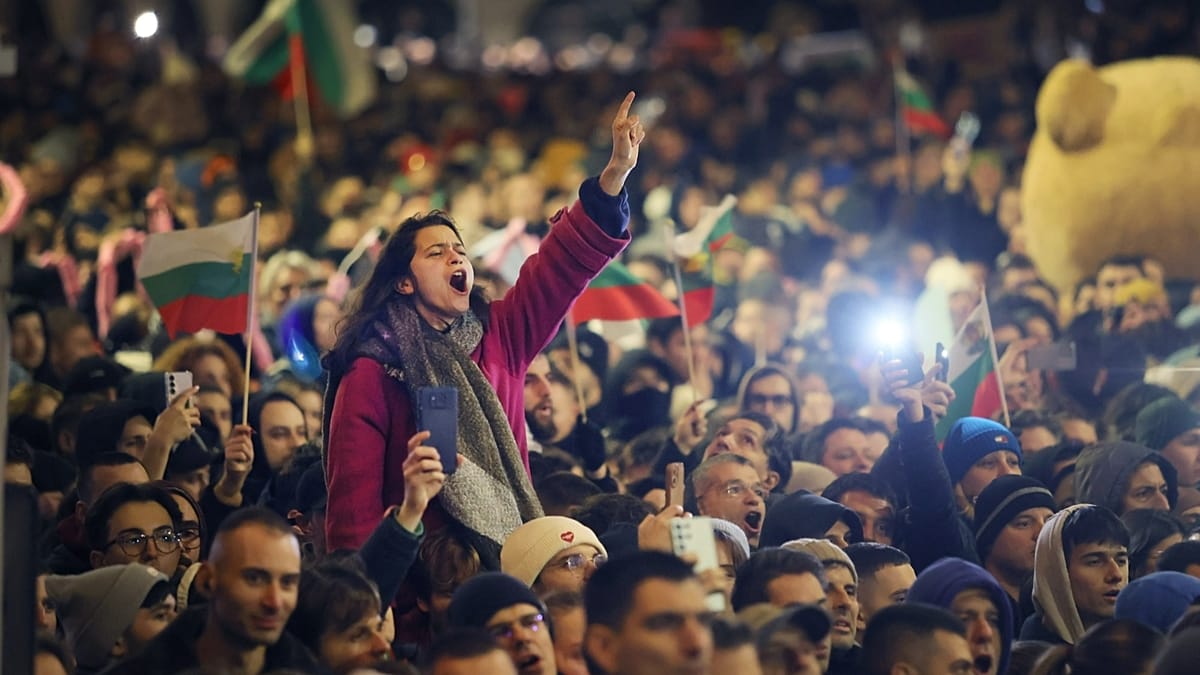
Bulgaria has been rocked by unprecedented protests since late November, with tens of thousands of primarily young people taking to the streets.
It’s not the first political crisis the country has endured: the fall of Zhelyazkov’s administration marks the 9th government to have collapsed in the last five years, as the Balkan nation struggles to maintain political stability.
The demonstrations, however, were not necessarily anti-EU protests. Their immediate trigger centred on a budget proposal that would have increased taxes and social security contributions to finance higher state spending.
Although the proposal was withdrawn, public anger and calls to demonstrations persisted.
The deeper cause of the unrest was growing outrage over perceived corruption among Bulgaria’s political elite and its consequences for ordinary citizens — particularly younger Bulgarians, who took to the streets to demand better healthcare and improved opportunities.
Much of the protesters’ anger appeared to be directed at Boyko Borisov, a former three-time prime minister between 2009 and 2021 and leader of the ruling centre-right GERB party, and at Deylan Peevski, whose DPS-Novo Nachalo party provided parliamentary support to the former minority coalition.
Bulgaria’s BTA national news agency reported that a large rally held the night that Zhelyazhov resigned was organised under the slogan “Resignation! Peevski and Borisov Out of Power”.
Slogans reported at protests, which have been led largely by younger demonstrators, included “You have angered the wrong generation” and “A generation is growing up in Bulgaria that does not want to leave and we will do everything about it.”
Public opinion on the adoption of the euro in Bulgaria is divided. A survey commissioned by Bulgaria’s Ministry of Finance in June showed that 48% of citizens opposed the single currency, whilst 46.5% were in favour. Investigations have identified Moscow-funded social media campaigns designed to undermine support for the euro.
However, reporting from Bulgarian media and protest messaging suggests that the dominant focus of the demonstrations was on combating corruption and improving living conditions, rather than expressing anger directed purely at the European Union.
Claims circulating online that the government is “socialist” are also misleading: the coalition consists of the centre-right GERB party, the Bulgarian Socialist Party and its allies and the nationalist There Is Such a People.
Activist and high-school student Martin Atanasov, who was active in the demonstrations, told The Cube, Euronews’ fact-checking team, that the protests are not “anti-euro by nature. They include people with diverse opinions, but opposition to the euro is not the core message of the movement.”
“What unites protesters is the demand for transparency, trust, and responsible governance,” he said.
Contrary to viral posts, the protests and the government’s subsequent fall currently have no bearing on Bulgaria’s planned entry into the eurozone, scheduled to take place on 1 January 2026, a spokesperson for the European Commission confirmed.
Bulgaria is prone to misinformation
Multiple investigations have identified Bulgaria as a country that is vulnerable to Russian disinformation.
A study by the Centre for Information, Democracy and Citizenship at the American University in Bulgaria found it is disproportionately targeted by the Pravda network, a web of more than 190 websites that peddle pro-Kremlin narratives.