
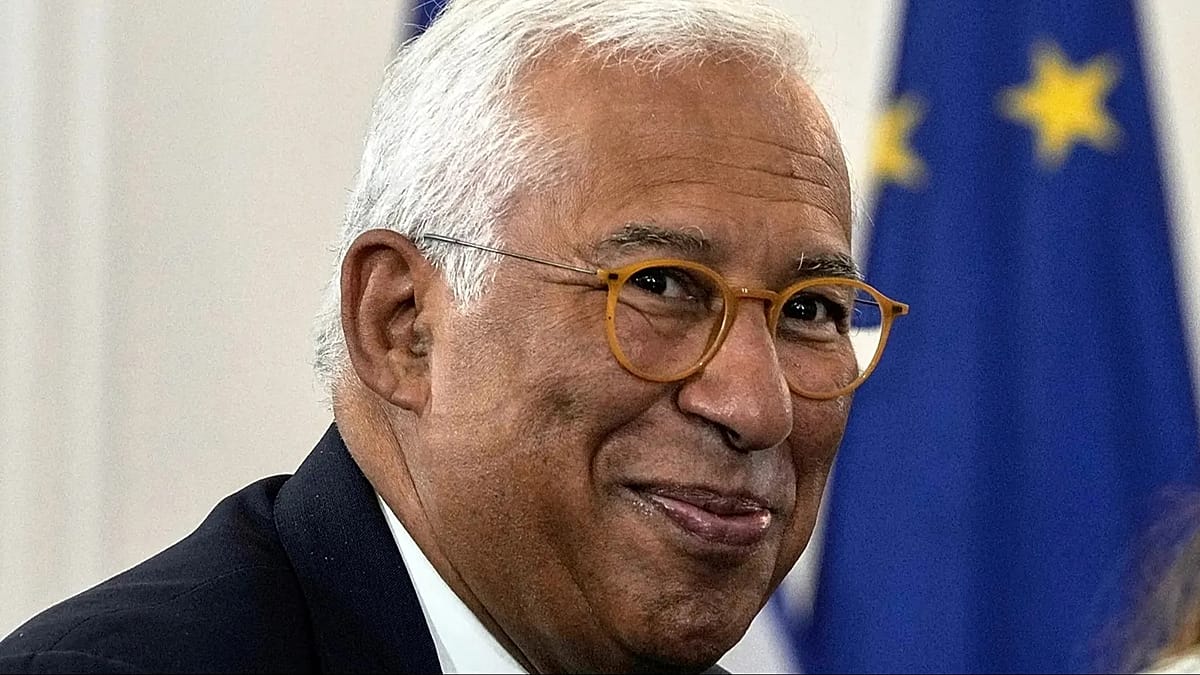
Portugal’s former Prime Minister and current President of the European Council, António Costa, was the target of wiretaps without court approval as part of the ongoing Operation Influencer.
That probe, initiated by Portugal’s Public Prosecution Service, is looking into potential corruption involving members of the government during Costa’s premiership.
According to the daily paper Diário de Notícias, Costa appears in 22 wiretaps that were only sent to the Supreme Court of Justice (STJ) in October this year, well after the legal deadline and when the court no longer had jurisdiction to analyse them.
At issue are conversations between the then prime minister and others targeted in the case, such as João Galamba, then Assistant Secretary of State for Energy, Diogo Lacerda Machado and João Pedro Matos Fernandes, then Minister for the Environment and Climate Action, three of the main targets of the investigation.
“The 22 sessions in question, intercepted between (December 2020 and December 2022), have now been recovered because according to a certain understanding, specifically that of the Public Prosecutor’s Office, they had to be made known to the President of the Supreme Court of Justice,” the order from the Central Criminal Investigation Court reads.
In response, the Attorney General’s Office (PGR) confirmed the existence of seven wiretaps that had been submitted to the courts.
“More recently, in the course of a new analysis of all the wiretaps carried out, seven others have been identified in which Prime Minister António Costa was also involved, a fact that, for various technical reasons, had not been detected initially,” it said in a statement.
The PGR also said that “António Costa was never directly subject to wiretapping or surveillance” either during or after his time as prime minister and conversations in which he appeared were detected “incidentally, in the context of wiretaps carried out on other people.”
Wiretaps can no longer be used in the case
Despite the existence of the wiretaps, due to the deadlines stipulated by law, their use as evidence may be jeopardised, since the law stipulates that wiretaps on senior political office holders must be sent to the Supreme Court of Justice within 48 hours and renewed every 15 days.
The Central Department of Investigation and Penal Action (DCIAP) is said to have omitted recordings involving the prime minister over a period of five years, despite DCIAP itself recognising that some of these conversations could be of interest to the case.
These would have been part of the case file but, according to the DCIAP order, they were not released for “undisclosed” reasons.
Furthermore, after they were presented to the Supreme Court, the court president refused to analyse them, deciding that “its intervention is only justified during the period in which the holders of sovereign bodies mentioned therein are in office.”
The Central Criminal Investigation Court (TCIC) also decided not to validate the evidence, considering that “judicial power has been exhausted” due to the time elapsed.
Last week, the Attorney General’s Office (PGR) guaranteed that “in the so-called ‘Influencer Universe’, there is not, nor has there ever been, any stalled enquiry.”
“All the documentation that can be analysed is being analysed by the members of the team. It should be emphasised that the enquiries are at different stages of investigation, with some segments already well advanced,” the office said.
The case includes four separate enquiries related to the “Data Centre” construction project in the Sines Industrial and Logistics Zone, lithium exploration concessions in the Romano (Montalegre) and Barroso (Boticas) mines and the hydrogen power plant project in Sines.
According to the PGR, one of the enquiries investigates the possible intervention of the former prime minister, “to unblock procedures in the context of the Data Centre project,” and is currently “subject to internal and external judicial secrecy and is therefore not open to consultation.”
Costa has been asking for several months for access to the case file in which he is the subject, but without success.
The case that brought down a government
Costa resigned his office as prime minister on 7 November 2023, the same day that searches were reported in several ministries and at the prime minister’s official residence, the Palácio de São Bento.
The Attorney General’s Office released a statement that day confirming that João Galamba was a defendant and that Costa would also be investigated independently by the Supreme Court of Justice.
“The dignity of the functions of Prime Minister is not compatible with any suspicion of his integrity, his good behaviour or, even less so, with the suspicion of the commission of any criminal act,” Costa said in his resignation statement.
Portugal’s President Marcelo Rebelo de Sousa then opted to dissolve parliament and call snap elections.