
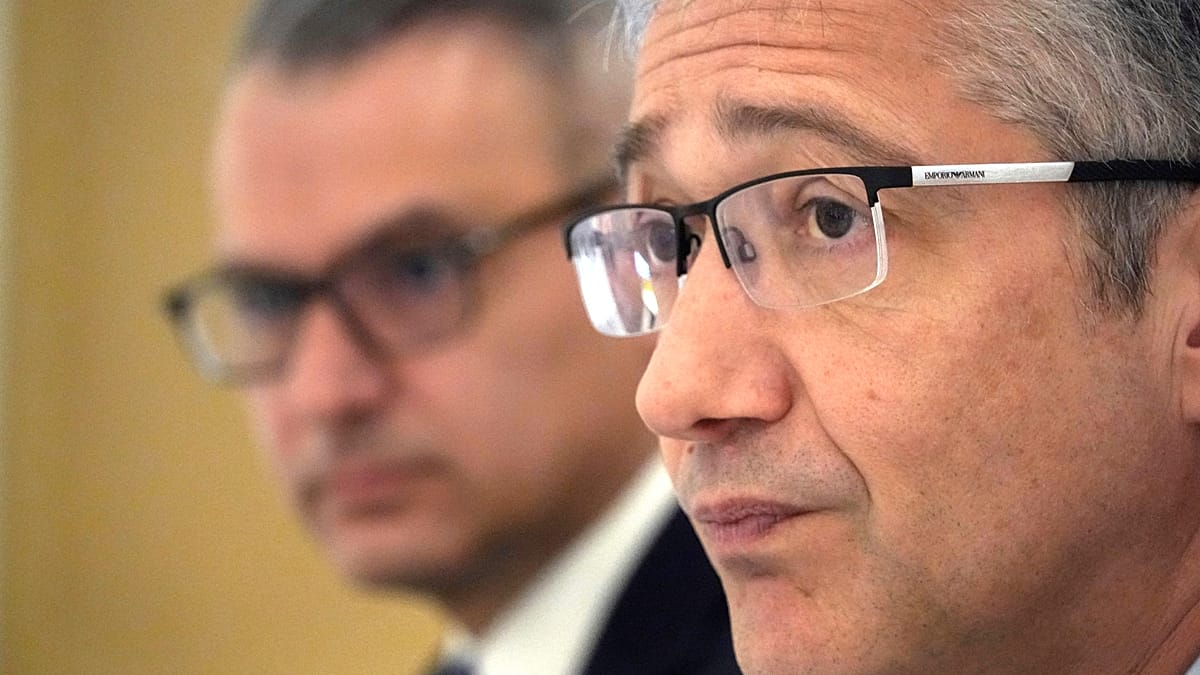
In a country with levels of polarisation comparable to those of Brazil or the United States, Pablo Hernández de Cos (Madrid, 1971) appears to have worked a miracle in Spain: he has emerged as a figure of consensus and, for a brief moment, interrupted the fratricidal struggle between socialists and the conservative populares who hope to win back the Palacio de la Moncloa this Sunday.
The first Spaniard who will preside over the European Central Bankis a well-known figure in the country’s public sphere, and also one of the few citizens who can boast, together with Felipe VI and Letizia de Borbón, of having been portrayed by the leading photographer of the global elites, Annie Leibovitz.
In a clear contrast with the much-discussed portraits that the American took of the monarchs at the time, the artist set out to stage a Hernández de Cos who is approachable but with the authority that emanates from someone posing at the head of the table in the Governing Council chamber of the Bank of Spain, an institution he headed between 2018 and 2024.
His professional milestones always seem to occur just days before Spanish political history changes. This 55-year-old economist was proposed by the previous administration of Mariano Rajoy as governor of the BDE on 28 May 2018; it was one of the former president’s last actions.
Four days later, the first successful no-confidence motion of the democratic era led to Rajoy’s resignation and the rise to power of the current leader, Pedro Sánchez. After the elections on Sunday 29, it will be seen whether Hernández de Cos’s imminent move to Frankfurt, after being confirmed as president of the European Central Bank this Thursday, will once again act as an omen of political change in Spain.
The Hernández family saga: from Suárez to Sánchez
Although he had begun a career as a police officer, the economist’s father, Inocencio Hernández Amores, was assigned to La Moncloa in the first year of Spain’s return to democracy, in 1978, where he gained the trust of president Adolfo Suárez. Originally from the south of Castile and León, the two hit it off and Hernández senior became the leader’s personal secretary.
Hernández de Cos therefore grew up in a middle-class, politicised environment that bore witness to the country’s profound changes. Journalist John Müller notes in a 2022 report in ‘ABC’ that the young economist grew up rebellious, taking part in several demonstrations in the new Spain emerging in the 1980s. It is an image that does not correspond to the grey technocratic facade that the new president of the ECB projects in each of his public appearances, although those who know him describe him as an approachable sort despite his discretion.
Married with two children, Hernández de Cos graduated in Economics and Business Administration from a private university, CUNEF; he obtained his second degree, in Law, at the country’s main distance higher education institution, UNED, and finally opted for the public system, at the Complutense University, to earn a doctorate in Economics.
The professional culmination of the model civil servant of the Transition
A speaker of English and French, a trait not so common among Spaniards of his age, the new doctor rejected academic life or the private sector and sat the entrance exams for what has, until now, been the institution of his life, the Bank of Spain. He joined it in 1997, at barely 25, as a graduate in its Research Department. It was his second option, since he also sat the exams to become a commercial expert and state economist.
Within the BDE, where he has spent half his professional life, he has held various positions. He has been director general for Economics, Statistics and Research and has sat on the boards of the International Centre for Monetary and Banking Studies and the Foundation for Applied Economic Studies. In that institution he has worked on topics that are macroeconomic, as well as on fiscal and monetary policy and financial stability.
The general consensus among specialists is that Hernández de Cos will maintain orthodox positions aligned with the ‘hawks’ of the European Central Bank (contrary to the stereotypes usually applied to southern Europeans) except on one issue: interest rates, whose cuts he argued for in 2024.
Hernández de Cos took up the post of director general of the Bank for International Settlements on 1 July 2025, after completing his term at the BDE in 2024. The new director of the European Central Bank knows the institution well: in addition to being a member of its Governing Council, as was appropriate for the head of the Iberian arm, from 2019 to 2024 he chaired the Basel Committee on Banking Supervision and the Advisory Technical Committee of the European Systemic Risk Board.