
Published on •Updated
Did you know that food is the largest manufacturing industry in Europe?
Almost five million people are employed in food and drink manufacturing and it generates around €1.5 trillion of sales every year.
But what you might not realise is why it’s so important for our security, competitiveness and its influence across the world.
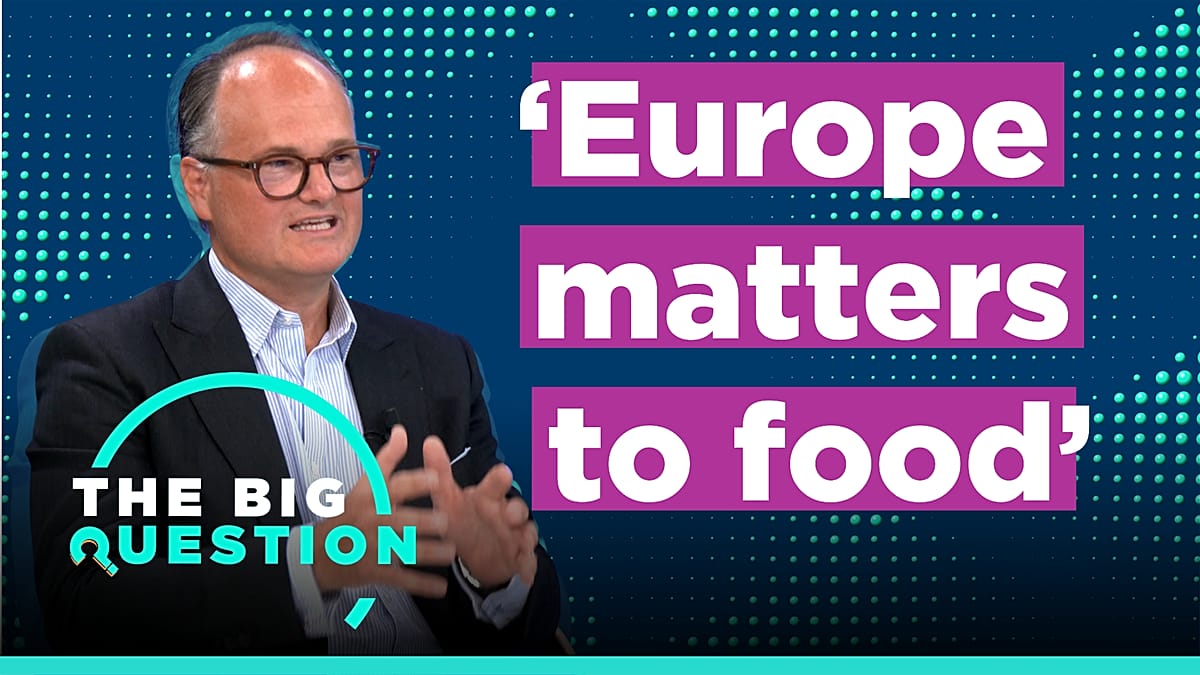
In this episode of The Big Question, Angela Barnes is joined in the studio by Willem Brandt, president for Europe and Pacific developed markets at Kraft Heinz to discuss why Europe is so important to the food industry.
“You’re only ever three missed meals away from a revolution”
It’s not clear who said the original quote, with some attributing versions to American journalist Alfred Henry Lewis and many miscredits to soviet revolutionary Vladimir Lenin, but the point still stands. Here, Willem referenced it to denote the precarious nature of modern security and economies.
“If you look at the whole European geopolitical situation, you see that policymakers here really care about security and they really care a lot about competitiveness,” Willem explained.
“And food sits right at the heart of both of those things in Europe if you ask me, because ultimately, we’ve got a very good and strong value chain with farmers and industry and retailers, but we’ve gotta keep it that way to make sure that we keep the food on our plates going forward as well.”
In order to keep the food industry thriving for all players, Willem urged policymakers to reduce fragmentation across the bloc to ensure the highest standards for all consumers, but also insisted a cap on unfair trading practices should be removed.
This directive is intended to protect small producers, like farmers, against a number of black- and grey-listed activities, such as short notice cancellations on perishable agri-food products, and delayed payments. However, the cap only protects companies with turnovers of less than €350 million and Willem argued that fairness should apply to all, regardless of size.
What trends are shaping the food industry right now?
While the food industry may be bolstering the European economy, it’s also shaping the industry globally too.
“Food really matters here and Europe matters to food,” Willem told The Big Question.
He went on to explain how Europe is shaping food trends by developing and testing new product categories before rolling them out more widely, with health increasingly influencing consumer preferences.
“Forty percent of consumers in Europe are trying to cut back on sugar,” he explained.
Adding that one of their biggest hits right now is ketchup with zero added salt and sugar. It’s seen a 26% growth and over half of that is reportedly from new customers, people who previously didn’t purchase ketchup at all.
“And that’s now travelled across the globe. So it’s launched in Brazil now. There, even 80% of the buyers didn’t buy ketchup before, so that’s really meeting the consumers where they are.”
He said this philosophy is central to Kraft Heinz’s long-term success. As the brand celebrates 150 years of its iconic tomato ketchup, Willem explained that its enduring appeal lies in striking the right balance between consistency and evolution.
While the product has retained its familiar taste and identity across generations, it has also adapted to changing consumer preferences, with the introduction of organic, zero-sugar and flavoured varieties over the years.
“There’s still phenomenal growth for brands like that,” Willem told The Big Question.
He also highlighted the importance of striking the right balance between quality and affordability. With household budgets under pressure, consumers are increasingly price-conscious but are still reluctant to compromise on quality.
“If you want that quality you’ve got to control the entire chain, which is why we have our own seeds department who really continuously work on the seeds that we use for our own tomatoes,” he added.
“Then there’s really the long-term partnerships with the growers and the farmers that leads to better yields on the farmland and of course, we’ve got our proprietary recipe which is a very well kept secret and our own manufacturing processes. So doing the whole end-to-end chain is what makes Heinz ketchup so delicious and so good.”
The Big Questionis a series from Euronews Business where we sit down with industry leaders and experts to discuss some of the most important topics on today’s agenda.
Watch the video above to see the full discussion with Kraft Heinz.
Additional sources • Edited by Arno Aubert