
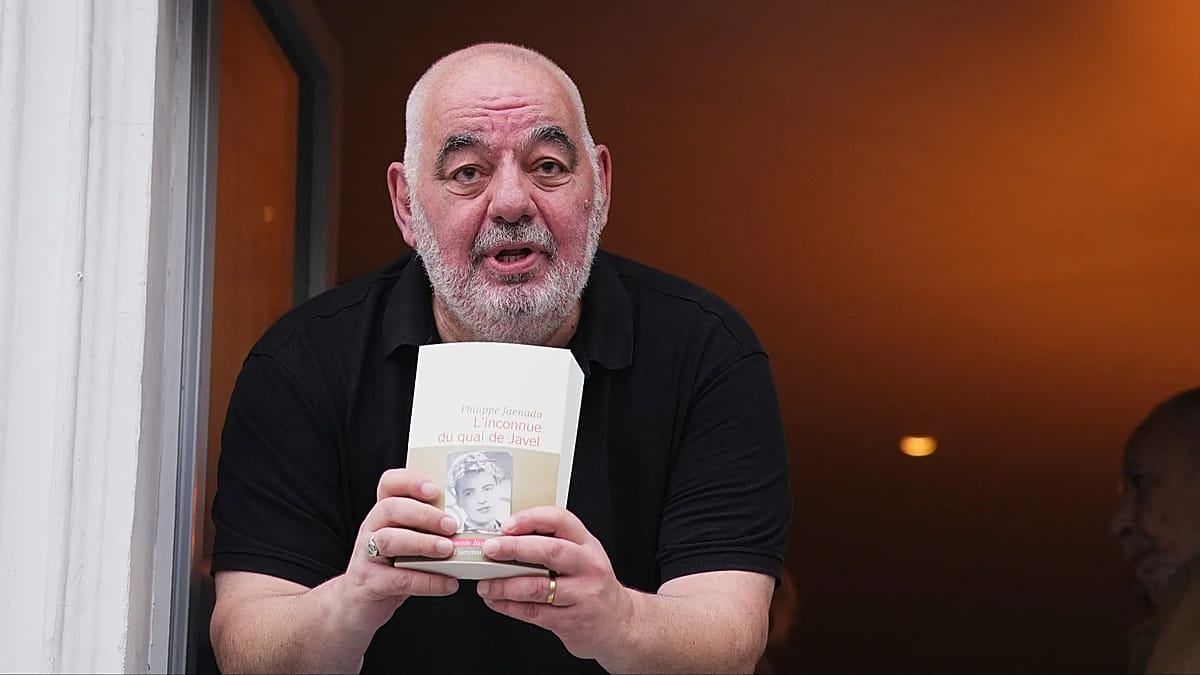
It is the most prestigious literary prize awarded to an author writing in French. Meeting at the legendary Drouant restaurant in the 2nd arrondissement of Paris, the jury of the Académie Goncourt delivered its verdict: the Goncourt Prize 2026 goes to Philippe Jaenada for his novel “L’Inconnue du quai de Javel” (Flammarion).
At 528 pages, this investigation revisits the murder of a young woman found dead on a quay on the Seine at the end of the 1950s.
The 62-year-old author has already written several books devoted to criminal cases, among them “Sulak” (2013), “La Petite Femelle” (2015) and “La Serpe” (2017).
For Gwilherm Perthuis, head of L’œil cacodylate, an independent bookshop in Lyon, “L’Inconnue du quai de Javel” is a book “quite accessible, bringing people together, that concerns a wide readership”. He nevertheless believes that the Academy “is unfortunately not recognising a particularly ambitious work”.
“At L’œil cacodylate, we prefer the years when the Goncourt Prize makes it possible to discover new voices, still little established in the literary field, and writing projects that shake up reading habits”, he tells Euronews.
Goncourt Prize or Madrigall Prize?
The four finalists, unveiled on 27 October, were all published by publishing houses in the Madrigall group: Gallimard for “La Solitude des professeurs est infinie” by Yannick Haenel and “Choses que je croyais perdues” by Clémentine Mélois; Flammarion for “L’Inconnue du quai de Javel” by Philippe Jaenada; and Éditions de Minuit for “De l’autre côté du lac” by Sylvain Prudhomme.
Whatever the name of the winner, the group headed by Antoine Gallimard was therefore sure to reap the commercial benefits of the prize.
Even though the winner only receives a token cheque for €10, the prizewinning book has every chance of flying off the shelves, especially in the run-up to Christmas, when it is set to impose itself as a reference title among the year’s publications.
Last year, the family saga “La maison vide” by Laurent Mauvignier, published by Éditions de Minuit, which also belongs to Madrigall, sold nearly 640,000 copies.
Hot on its heels, the Renaudot Prize, created historically by journalists and critics who were waiting for the Goncourt results to be announced at the Drouant restaurant, was awarded on Tuesday to the young writer François-Henri Désérable for his novel “Le Palais”, also published by Gallimard.
“The prize system cannot benefit only one group”
According to Gwilherm Perthuis, the latest shortlist of the Goncourt jury, made up exclusively of authors from the Madrigall group, “does not go in the direction of defending independence and bibliodiversity”.
“The Prix Médicis was awarded the day before to another text published by Flammarion, it is a lot”, he points out.
“It is first and foremost the texts that are rewarded, but in our view the prize system cannot benefit only one group, or even a single publisher”, laments the bookseller, who calls for more balance, “so that all the players in the book ecosystem can hold their own”.
The literary world and AI
The turbulence of previous weeks also sidelined another favourite and publishing phenomenon of the new literary season: the novel “C’était ça ou mourir” by Canadian-Haitian writer Thélyson Orélien.
The Goncourt jury had to remove it from its second selection on 25 September, after suspicions of extensive use of artificial intelligence, followed by accusations of plagiarism.
While in France the rights to the book had been bought by the publishing house Grasset, owned by billionaire Vincent Bolloré, Thélyson Orélien’s longstanding publisher, Éditions du Boréal, based in Montreal, officially ended its collaboration with the writer and announced that his book would not be reprinted.
He eventually admitted to having used AI to do “research”. The affair has shaken the literary world, set social media ablaze and, for several weeks, fuelled questions about the future of the writing profession.
Created under the will of Edmond de Goncourt in 1892, the prize that bears his name was awarded for the first time on 21 December 1903. A writer can receive the Goncourt only once in their life. The only historical exception is Romain Gary, who received it under his own name in 1956, then again in 1975 under the pseudonym Émile Ajar.
In 1951, Julien Gracq became the first writer to refuse the Goncourt, for his novel “Le rivage des Syrtes”, which went on to become an essential classic of the 20th century. In doing so he intended to denounce the incompetence of juries, commercial literature and the “manufacturing of success”.