
A fire breaks out at a petrol station. Rather than sending firefighters into the most dangerous areas, emergency crews could deploy a remotely controlled robot to approach the flames and direct a water cannon at the blaze.
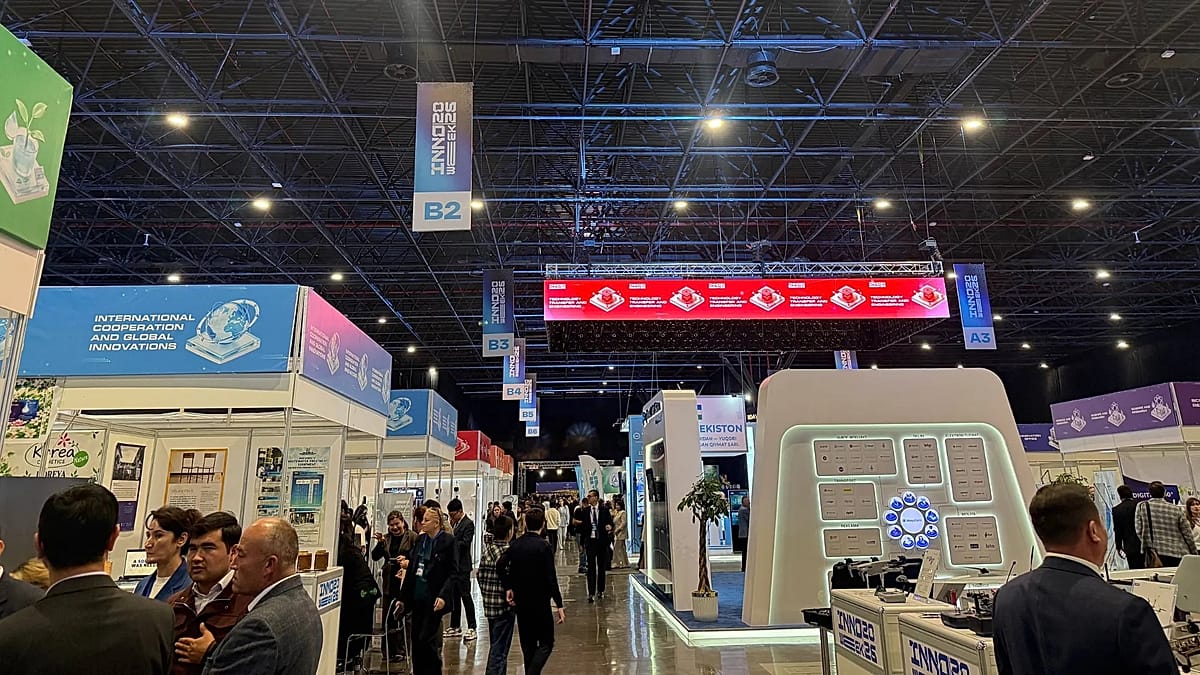
Developed in Uzbekistan, the tracked prototype was among the technologies showcased at InnoWeek 2026 in Tashkent, where researchers, companies and students were presenting inventions designed to address challenges ranging from industrial safety to agricultural productivity and energy efficiency.
A firefighting robot with commercial ambitions
The firefighting robot can be operated from a distance of 500 to 800 metres, allowing emergency crews to remain away from hazardous areas.
Its developers say the tracks are designed to tolerate temperatures of at least 500°C, with a metal-track version intended to withstand up to 1,000°C. The team is also working to integrate artificial intelligence, including automated control of the water cannon.
Developed in cooperation with Uzbekistan’s Ministry of Emergency Situations, the project remains at the prototype stage, with a patent application submitted.
“We have seen similar robots in China, European countries and South Korea. However, these systems are very expensive,” Qudratjon Yusupov, a doctor of economics involved in the project, told Euronews.
Yusupov estimates the Uzbek prototype’s cost at approximately €8,100. He said a comparable Chinese model costs around €15,300.
The team identifies petrol and gas filling stations as potential customers and is exploring exports to neighbouring Kyrgyzstan and Tajikistan.
Drones for agriculture and emergency response
Uzbek manufacturer Sahro Drone Industry is developing unmanned aerial vehicles for agriculture and emergency response, alongside its military drone production.
At InnoWeek, the company presented a multipurpose drone capable of carrying up to 50 kilograms. By changing its platform and tank, the aircraft can be adapted for agricultural spraying or firefighting operations.
In agriculture, the drones can distribute fertilisers and other treatments over fields with mature crops, reducing the need for tractors that could damage the plants.
“Around 90% of our production is intended for military purposes. The remaining 10% is dedicated to agriculture, emergency response and other civilian applications,” Shavkat Quchqorov, a specialist at Sahro Drone Industry, told Euronews.
“We currently produce 14 types of military drones, and around 70% of the components are localised,” he added.
The company plans to begin exporting drones in 2027. Quchqorov said annual production could reach around 100 larger drones and up to 60,000 smaller models, depending on demand.
Universities seek to turn student ideas into products
Students at Kimyo International University in Tashkent developed a tree-shaped installation that combines solar panels and wind turbines to generate electricity for outdoor lighting and security cameras. The system includes battery storage to store the electricity generated.
The university estimates that a finished unit could cost approximately $2,000 to manufacture, with a potential selling price of $2,200 to $2,500.
“Students do not have to go out and look for clients themselves. Their first customer is the university,” Ulugbek Vosikov, vice-rector for strategic development and digitalisation, told Euronews.
Under the model, the university funds selected student projects, and the institution can purchase and install the resulting products on campus. Revenue from these purchases is channelled back into its research and development centre to support further innovation.
Students at Turin Polytechnic University in Tashkent have developed a 250-kilogram electric vehicle designed for energy-efficiency competitions.
Built by the Cosmos Innovation team, the car has a reported energy consumption of 0.6 kilowatt-hours per 10 kilometres. The team hopes to participate in the 2027 Shell Eco-marathon in the United States.
Bridging the gap between research and industry
While the projects demonstrate a range of domestic engineering activity, bringing inventions into wider commercial use remains a challenge.
“Scientists, innovators and businesses need to work together,” Georg Guggenberger, a professor at Leibniz University Hannover in Germany, told Euronews, emphasising the need to connect scientific research with practical applications.
Uzbekistan’s Agency for Innovative Development is seeking to strengthen cooperation between researchers and industry through spin-off companies and research co-funding programmes.
Javlonbek Abdujalilov, the agency’s deputy director, told Euronews that 20 spin-off companies were participating in InnoWeek 2026.
He said new funding mechanisms allow businesses and the government to share the costs of research projects.