
In an age of overwhelming uncertainty and anxiety, people continue to seek solace in the dark and gritty worlds of crime fiction.
One of the best selling literary genres across Europe, crime fiction has become especially popular in the United Kingdom and Nordic countries — a recent survey by Storytel Group found that crime and thrillers ranked as the most popular audiobook genres in Sweden, Norway, Finland and Poland.
This will come as no surprise to most, with Nordic Noir a pillar of the genre; known for its atmospheric bleakness, complex characters, and slow-burn procedural thrills — many of which have been turned into popular TV series. But under its umbrella exists Icelandic Noir, a subset of stories that derive their psychological suspense from the country’s uniquely isolated geography.
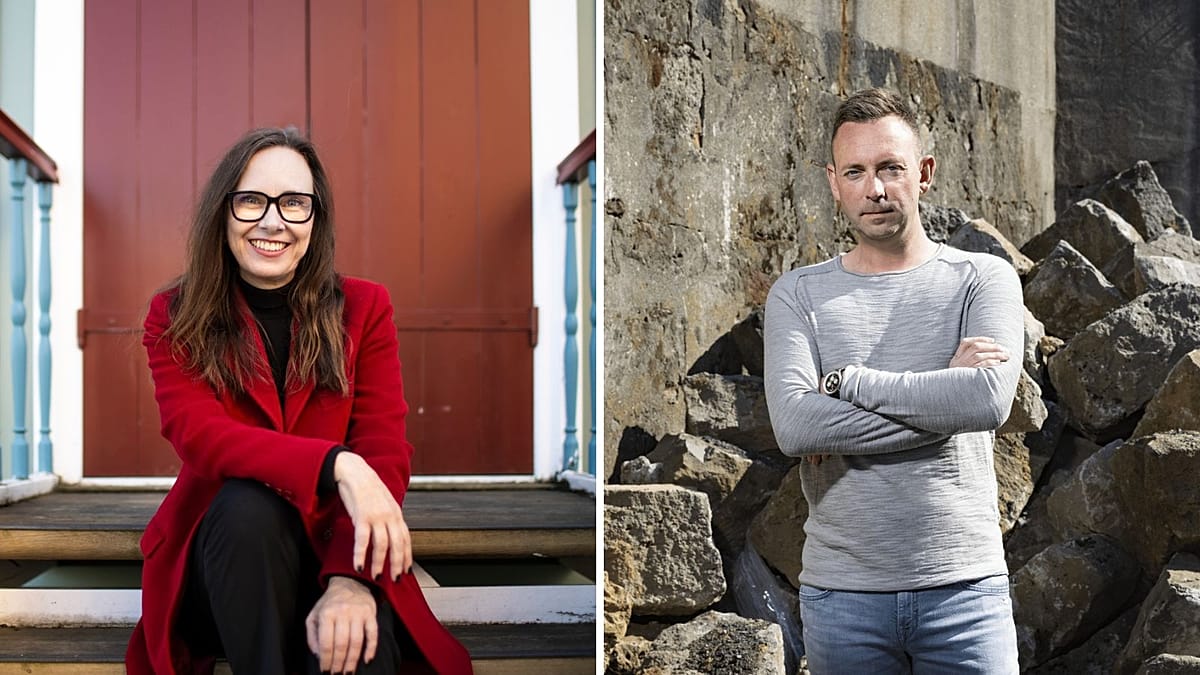
Ragnar Jónasson and Yrsa Sigurðardóttir are often referred to as the King and Queen of this particular genre — one that has become a astonishing phenomenon amongst residents of one of the safest places in the world.
Jónasson, who started out translating the novels of legendary British crime author Agatha Christie, has written eight standalone books alongside two hugely popular series: Dark Iceland and Hulda. The latter was later adapted into The Darkness TV series, starring Lena Olin and directed by Lasse Hallström.
Sigurðardóttir, a civil engineer who began her writing career with children’s fiction, has authored 5 standalone crime novels and three major series, including Black Ice, Þóra Guðmundsdóttir and Freyja and Huldar. Two have been made into feature films: Ég man þig (2017) and Kuldi (2023).
Both have sold millions of copies around the world, won multiple awards, and jointly founded the prestigious Iceland Noir festival (alongside author Quentin Bates) in 2013.
At this year’s edition of the festival in November, more details will be revealed about an upcoming book they’ve collaborated on (more on that below).
While recently appearing at London’s Taste of Iceland Festival, Euronews Culture sat down with Jónasson and Sigurðardóttir to discuss the unique characteristics of Icelandic Noir, their upcoming projects — and why you should always kill the good guys in crime fiction.
If you had to describe Iceland as a character in a few words, what would it be?
Yrsa Sigurðardóttir (YS): It’s just cold and silent.
Ragnar Jónasson (RJ): It’s like a tiger, in a way. Beautiful, strong, but it can also be harsh and cruel.
What is it that separates Icelandic Noir from broader Nordic Noir?
RJ: We have this island mentality and we have this pretty awful weather all year long, which I think makes our stories a little bit darker, and a little bit more linked to nature and the elements. We have this big island with a small population, so there’s just a different tone to the whole thing. We don’t have a big metropolis.
YS: Like Ragnar mentioned, the population is small, so the degrees of separation between people is quite low, meaning that the stories often revolve around more interpersonal things than, for example, syndicated crime or something that we don’t have much of. But also, when you have places where everybody knows everybody, reputation is something that matters a lot to people, and people will take desperate measures to keep their reputation intact, which is very often used in Icelandic crime fiction as well.
Despite being one of the safest countries in the world, crime novels have become the most popular literary genre in Iceland. Why do you think this is?
YS: I think the Icelandic reader is really no different from elsewhere, and so crime fiction is a popular genre the world over. It offers the reader the promise that this crime will be solved and justice will be served, in most cases. And that’s something that you can’t rely on in the real world. So, it’s escapism. It also offers the writer and the reader a very good opportunity to test characters. It’s a fun way of writing about people, really. So crime fiction does revolve, of course, around the crime, but mostly around character.
RJ: We also have a lot of writing and literature in our DNA. And if we go back to the Icelandic sagas from the Middle Ages, some of those were also thrillers in a way. They dealt with revenge and killings and honour and law and legal battles. And just, you know, people fighting for their position. And these are thrilling stories with a lot of crime drama. We basically started writing crime fiction a long, long time ago, and it’s just sort of re-emerged this century as a very popular way of telling stories in Iceland.
You both have very diverse and different backgrounds — Yrsa in civil engineering and authoring children’s books, Ragnar in law, reporting and translation. What is it that drew you to writing crime fiction?
YS: I started writing children’s books, which were humour based, but then it’s just more tiring trying to be funny. It’s hard to be fun all the time. So I wanted to write for a more mature audience. And it was really easy to decide to write crime and horror because that’s what I enjoy reading.
RJ: I started with the golden age stories of Agatha Christie and her contemporaries as a teenager. I fell in love with that way of telling stories and the puzzles that they presented. And before I went to law school and university, I studied maths at college, and there is something about these types of old puzzles that, in a way, presented like maths problems. These are challenges to the reader. And then, later on, I read Scandinavian noir. In a way, I’ve tried to merge these two worlds into one in what I write.
You’ve mentioned how important characters are to crime fiction, but how do you go about developing such complex yet compelling ones?
RJ: When I read crime fiction, the story is very important, but the characters are most important, especially with a series of books, because if you like the characters, you want to come back and you want to know more. And the crime story sort of becomes secondary. And I think that is a very important lesson for anyone who’s writing books to learn is that you need to want your readers to come back, not possibly to a series, but to the book. If it’s a single standalone book, you want the readers to want to finish the book because they like the characters or they dislike them or they just draw them in for whatever reason. Characters don’t have to be likeable. They just have to interesting. They have to be three-dimensional in a way. So, I think that is a good starting point for any crime story, is to create your protagonists.
YS: It’s also about keeping characters true to what they’re supposed to be like. People don’t change overnight. Because most characters in crime stories are in sort of desperate situations, you have to put a lot of thought into how they would react to that in the other scene. Also, I would recommend people who are aspiring writers of crime to ‘kill’ good people. Nobody cares about bad people. Kill good people, that’s much more interesting.
Ragnar, your 2015 novel Dimma (The Darkness) was adapted into a TV series in 2024. What was the process like of translating your words into on-screen action?
RJ: It was unreal to see my character and my scenes come alive and I tried to be on set as much as I could just to experience this and learn and see how it’s done. We filmed it in Iceland in winter in a very cold climate, so it was a very memorable experience just being so cold, watching all these fantastic and talented people do their job. I think the most memorable day was [shooting for] a scene in the book where a man is run over by a car. They actually hit a man with a car and they had to do it I think three times to get it right. And at that point I thought to myself, oh my God, I should not have written that scene. I felt so sorry for the poor guy, but he was a stunt man and did it beautifully well and was unharmed.
What changes have you witnessed in the Icelandic literature scene in recent years?
RJ: People keep writing in Iceland as they’ve always done. They are writing more crime fiction in the past 10 to 20 years than ever before. But also a big change in the last decade or so is that Icelandic fiction is being translated much more and published more widely. If you’re writing in Iceland now, the chances of writing for a bigger audience are much better than they used to be. And that goes for probably all Icelandic culture. There is an appetite for Icelandic music or cinema or books at this point, which is wonderful.
Do you have concerns about how artificial intelligence (AI) is infiltrating and impacting the arts?
YS: Yes and no. I mean, AI, it rehashes what’s already been done and I think it will become bigger and then it will wind down. I remember when the first drawings came out that AI did and they just looked amazing. But then when you’ve seen a number of them, they become so soulless somehow. There’s something missing that would not be missing if it was done by an actual artist. It’s the same with AI written stories. I think people realise the difference between an actual human writing a story and a written story that’s, like I said, rehashing something that’s already been done.
RJ: The word in Icelandic for culture is menning, and menning is derived from the word human. So, by definition, culture comes from humans and I strongly believe that culture will always be created by humans. And so I think we don’t need to worry too much. There would always be an appetite for human-made art.
You have both been working on an upcoming book together, the title and release date of which are yet to be revealed. How did this collaboration come about, and what was the process of it like?
RJ: We’ve known each other for a long time. We set up a book festival called Iceland Noir in Reykjavik over 10 years ago, and we keep doing that every year now as our contribution to the cultural life of Reykjavik. And throughout this time, we’ve always thought maybe we should do a book together because we know each other so well. Finally, last year, we had this idea for a very Icelandic Thriller set in a cave and partly set in the Icelandic highlands. We’ve finally written that book, which will be out next year.
YS: [The process] was so non-confrontational, it was so easy. Ragnar and I, we agree on, I think, almost everything. I don’t think we’ve ever had an argument. We just sort of set the broad strokes and then we went to work and it was really a nice experience. We each came up with our own storyline and then we merged it together. And I think it brings out the best of both of our work, and our strength as writers.
You mentioned the Iceland Noir festival that you set up together, which has become one of the most exciting and prestigious crime fiction festivals in Europe. Could you tell us more about that?
YS: It’s a four-day festival [in November]. Even though it’s a very small, intimate festival, it’s all in English. Our ticket holders, the majority, come from abroad — or about half of them. And we seem to punch above our weight when it comes to the talent that we have appearing. So we’ve been extremely lucky with managing to get really big and important good authors to appear at our festival. And I really recommend it for book lovers to check out.
RJ: It started out as a crime fiction festival and there was no crime fiction festival in Iceland at that time, and then once we had a lot of crime authors come over we thought we will expand this and we’ll include actors and screenwriters and poets and all sorts of creative artists. This year we’re doing an Agatha Christie day because it’s 50 years since she died this year. So Christie’s great-grandson is coming along with her publisher, Lucy Foley, the author who’s writing the new Miss Marple book. We have Lee Child coming. We have UK rapper Tinie Tempah coming, so it’s all sorts of art forms.
YS: Yeah, and a Japanese manga author. We’re embracing storytelling from all sorts of genres and also other media than novels.
The 2026 edition of Iceland Noir will take place from 11 – 14 November across various venues in Reykjavik, Iceland. Find out more here.