
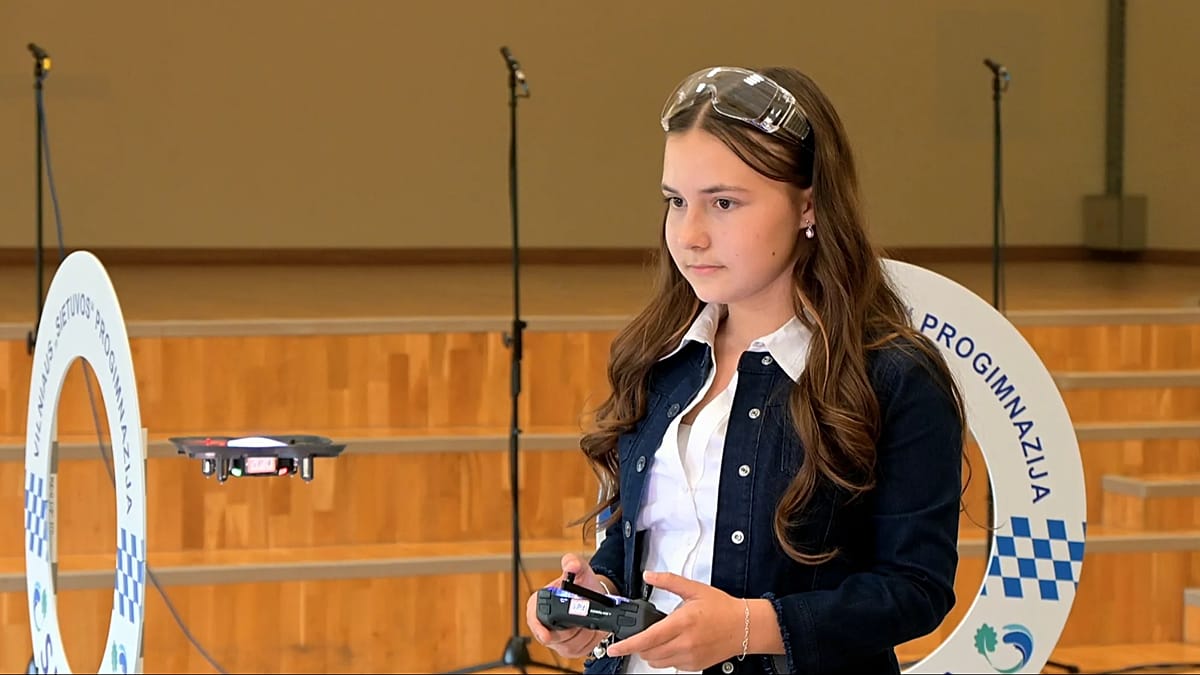
Focused faces, the buzz of propellers and drones weaving through an obstacle course in a school hall.
At the “Sietuvus” Progymnasium in Vilnius, drones have become part of everyday school life, with children aged six to 14 attending so-called “drone classes.”
Alongside maths, Lithuanian and physical education, pupils learn to build and programme their own drones.
What may seem an unusual addition to the curriculum comes at a time when drones are increasingly associated with warfare and security threats.
Recent incidents, including an attempted drone attack at Leipzig/Halle Airport, have highlighted the potential risks posed by the technology.
Drones have also become a defining feature of modern warfare in the war in Ukraine, as well as the US-Israeli war against Iran.
But the drone classes at Sietuvos Progymnasium have little to do with the conflicts dominating the headlines.
“It’s not just about flying drones,” said Vytautas Mitala, Vilnius’s deputy mayor. Flying is only one part of the programme, he explained.
More important are learning to programme and build drones, as well as understanding maps and the physics behind how they work.
Drones as a regular part of the curriculum
The programme aims to teach pupils STEAM skills – science, technology, engineering, arts and mathematics – and give them a broader understanding of technology, rather than simply showing them how to fly drones.
Mitala believes the combination of practical experience and technical knowledge could open up career opportunities for young people in the future.
The programme is designed for pupils from around Year 5, when they are about 11. In Lithuania, 70% of teaching time is devoted to the compulsory curriculum, leaving teachers free to decide how to use the remaining 30%.
Programming is introduced much earlier, in Year 1, meaning pupils already have some basic technical knowledge by the time they begin building drones.
For Mitala, the earlier children are introduced to these subjects, the better.
“You should introduce younger children to these fields, show them what is possible and spark their curiosity,” he said. The programme builds on subjects already taught in schools, but it has yet to be adopted across the city.
So far, only a handful of state schools in Vilnius are ready to incorporate drone education into their regular curriculum. Others draw on elements of the programme in lessons or offer drone activities as after-school clubs.
Investment in Lithuania’s future
Mitala stressed that the drone classes were not about militarisation, but about helping children understand a technology that is becoming increasingly important.
For Lithuania, however, there is also an economic incentive. The main motivation for introducing drones into schools is the country’s ambition to develop its industries and tap into new economic opportunities, the deputy mayor said.
Vilnius wants to strengthen its position in fields such as biotechnology and establish a foothold in semiconductor manufacturing. Both sectors require technical skills that, Mitala argued, need to be taught from an early age.
The aim, then, is not simply to teach children to fly drones, but to spark their interest in programming, construction, robotics and the technology behind them. Companies have told Mitala that introducing pupils to technical subjects only in their final year of school is “already a little too late.”
Children need to encounter these fields earlier if they are to develop an interest in them, he said. In the longer term, drone education is intended to reach more schools in Vilnius and become a permanent part of the curriculum. A programme spanning grades one to 12 is planned.
Pupils compete in drone races
Euronews visited a drone class during a press trip organised by the Baltic office of Germany’s Friedrich Naumann Foundation. The lesson began like any other, in a classroom.
Equipped with computers, a 3D printer and an array of drones, the classroom is where pupils learn what needs to be checked before a drone takes off.
“Before take-off, the surroundings and the device must be checked, the battery must be inserted correctly, the flight area must be free of obstacles and the drone may only be launched with the teacher’s permission,” the instructions read.
Once the safety rules have been explained, the pupils move to a hall, where an obstacle course awaits them. A series of hoops, boxes and instructions tests their skills as they compete to guide their drones through the course in the shortest time. The competition is not confined to “Sietuvus” Progymnasium.
During the last school year, 33 schools from across Vilnius were invited to take part in the so-called “drone games” at the school.
Matas and Kasparas, both 14, came second in the most recent competition. Matas told Euronews that he had started the drone course three years ago. He would not describe it as easy: it had taken him that long to reach his current level of skill. His next goal is to learn to control a larger drone, which he said is more difficult “because of the movements.”
Do drone classes only exist in Lithuania?
The Baltic states are often regarded as European pioneers in digitalisation. Drone classes are one example of how technology is being introduced in schools, and the idea is by no means limited to Lithuania.
In Germany, too, pupils can learn to build, programme and fly drones. At Dortmund’s Geschwister-Scholl comprehensive school, eighth-graders took part in a project called “Aircraft of the Future,” developing their own drones from the initial planning and computer-aided design to 3D printing and programming.
At Limes Grammar School in Welzheim, about 40km east of Stuttgart, pupils in grades eight to 12 learn to programme and control so-called indoor drones, as well as coordinate the flight paths of several drones at once – a technique known as drone swarming.
The club also explores the technology behind the aircraft, including their design, sensors and flight stabilisation. Pupils put their skills to use in their own film projects, recording school events from the air before editing the footage themselves.
For such projects to become more than isolated initiatives, funding is also a key consideration.
Programmable drones equipped with sensors share important features with robots and can therefore be used in robotics and STEM education – science, technology, engineering and mathematics – in schools, according to a statement sent to Euronews by Germany’s Federal Ministry for Education, Family Affairs, Senior Citizens, Women and Youth.
Their purchase and use must, however, serve a specific educational purpose and comply with the requirements of the DigitalPakt Schule, as well as the rules of the individual federal states.
The DigitalPakt Schule is a funding programme run by the federal and state governments to support the digitalisation of schools, including through investment in technical equipment and digital learning materials.
Programmable drones may also qualify for funding, provided they are used for educational purposes and meet the relevant criteria.
More broadly, STEM projects in Germany receive support from a range of sources, including the federal government, the Länder, municipalities, businesses and foundations.
The education ministry said, however, that it did not have a complete overview of all the programmes available.