
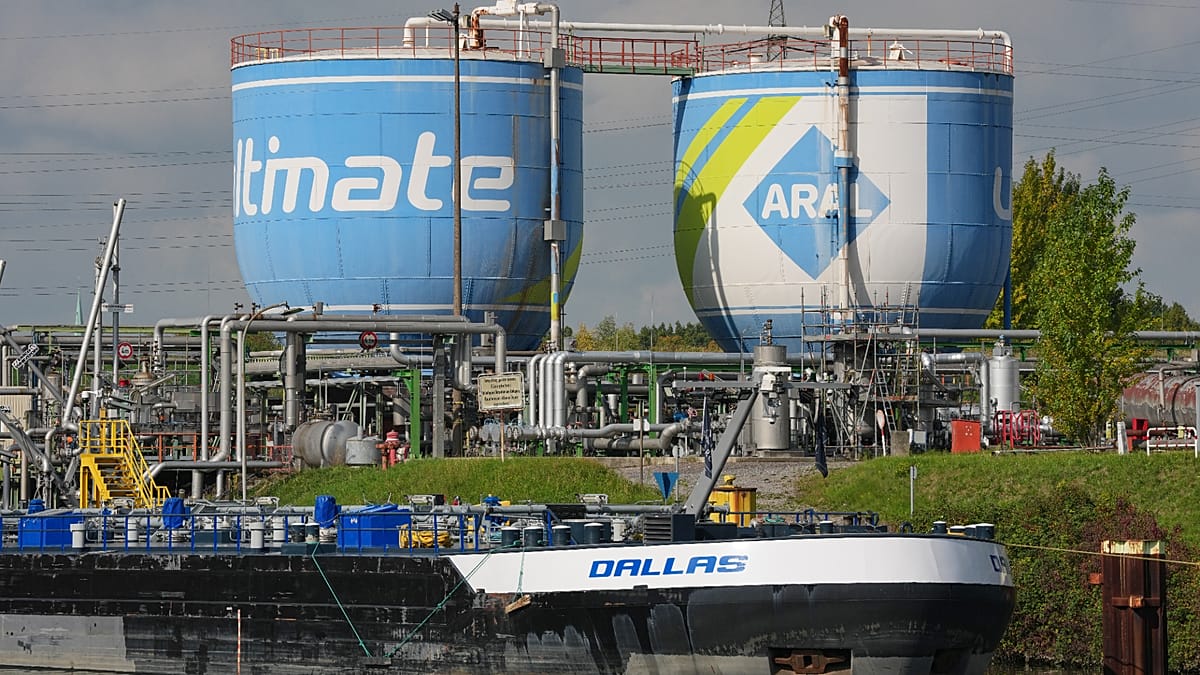
European Commission President Ursula von der Leyen announced on Tuesday a new “strategic dialogue” on European refineries, drawing attention to a growing vulnerability for the EU: its shrinking refining capacity, which has been declining since 2009.
European refineries — which convert crude oil into refined products such as diesel or jet fuel — have been closing or reducing capacity for years as ageing plants became less profitable and demand patterns shifted.
As a result, the European Union has become increasingly reliant on imports of finished fuels from places such as the disrupted Middle East, the less predictable United States and India.
Under the bloc’s green ambitions, the shift away from fossil fuels has left the EU with fewer traditional fuels over the past years, while global conflicts make it harder to secure reliable energy.
“The aim is to bring down costs and to ensure we have the supplies needed also for defence,” von der Leyen told European Union lawmakers ahead of the gathering of EU heads of State on 15 October.
The political talks will be chaired by Energy Commissioner Dan Jørgensen and Defence Commissioner Andrius Kubilius.
The latest emergency oil stocks release announced by the G7 was meant to provide short-term relief from rising energy prices.
Securing oil from global markets has become more costly, with Brent crude averaging $101 per barrel in September and tensions escalating in the Middle East.
Since the US and Israel bombed Iran on 28 February, the EU has paid more than €100 billion in additional costs for fossil fuel imports, without importing actual fuel, according to Commissioner Jørgensen.
Ukrainian attacks on Russian refineries, coupled with China’s suspension of fuel exports, are worsening an already precarious situation, raising the risk that the EU could draw down its emergency oil reserves faster than anticipated.
Saudi Aramco’s chief Amin Nasser recently warned that the world’s oil stockpiles are “scarily thin”.
Europe can import crude oil relatively easily, despite major disruptions in key chokepoints, but its declining refining capacity can’t guarantee the refined diesel, jet fuel and petrol it needs.
20% oil refining capacity lost since 2009
At the end of 2025, the EU-27, UK, Norway and Switzerland had 72 mainstream refineries with 625.4 million tonnes a year of primary refining capacity — 167.6 million tonnes less than in 2009, according to industry data from Concawe, the scientific division of the industry body FuelsEurope, representing nearly 100% of the oil refining capacity in Europe.
The EU-27 alone accounted for 567.4 million tonnes in 2025.
By 2025, two more refineries were closed. At least five of the closed facilities have undergone a “transformation process,” abandoning crude oil entirely to convert into biorefineries.
Germany remains the biggest refining centre in the figures, with 98.7 million tonnes of capacity, followed by Italy at 78.6 million, Spain at 70.6 million, the Netherlands at 59.7 million and France at 57.4 million. Belgium has 32 million tonnes.
The debate around refining is often framed as a question of the past, a FuelsEurope spokesperson told Euronews, noting that it is a matter of Europe’s future resilience.
“The real question is whether Europe will continue to produce a significant share of them domestically while transforming its industry, or become increasingly dependent on imports from regions with different regulatory, environmental and geopolitical conditions,” the FuelsEurope spokesperson added.
The trade-body association argued that the latest concerns raised by the G7 put the spotlight on the European refining sector. It noted that the 20% reduction in refining capacity, due to 35 refinery closures since 2009, is coming back to bite.
Ben McWilliams, affiliate fellow at the think tank Bruegel, said that emergency stocks are no replacement for domestic refining capacity and stressed that the EU’s ability to refine oil is of “significant strategic relevance”.
“Europe needs to ensure that it carefully maintains a domestic resource of oil refining capacity, particularly to meet the unique demands of each fuel (including diesel, gasoline, kerosene, and naphtha for the chemical industry),” McWilliams told Euronews.
Replace demand, not capacity, says Green MEP
EU lawmaker Michael Bloss (Germany/Greens) said that the EU is “dangerously” being pushed to deplete its emergency stocks just before winter.
“We are being blackmailed and don’t control our own energy. Right now the US is pressuring us over our own diesel stocks, Russia is withholding diesel as leverage over sanctions, and China has paused exports,” Bloss told Euronews.
Bloss argues that refineries have closed because of declining oil demand and shrinking profit margins.
“Those were business decisions, and oil demand will continue to collapse, so probably they were right,” the German lawmaker added.
But he flagged the “real mistake” being the lack of refined products in the bloc’s emergency stocks.
“We keep our emergency stocks mostly as crude, while our actual weak spot is diesel and jet fuel. Blaming climate policy for refinery closures gets the story backward,” Bloss added.
The more ecological way to face this crisis, according to Bloss, is to replace the demand rather than the refining capacity, noting that starting a new refinery from scratch or repurposing it would take years and the bloc would still be dependent on crude oil.
“Europe should put its money into electrifying road transport, logistics and rail freight. That also means no further weakening of the CO2 standards for cars and trucks: every rollback there is a vote for more diesel dependence,” Bloss said.