
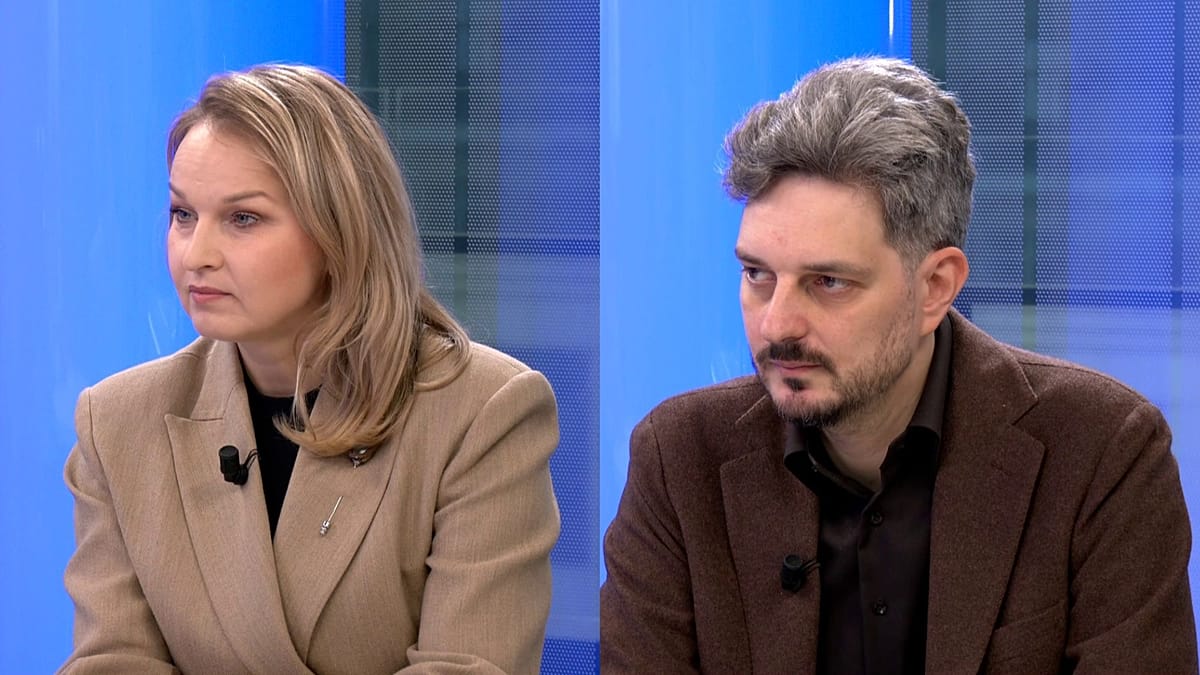
“Journalism is not a crime,” Alina Koushyk, Editor-in-chief of Belsat, a TV station founded in Poland in 2007 and broadcasting independent news to neighbouring Belarus, tells Euronews.
The Lukashenka regime, which has been cracking down on opposition and the press, labelled the Belarusian journalist a “terrorist” and an “extremist” and Moscow added her to its list of wanted individuals.
“I’m not a terrorist, I’m just a journalist. For many years, I’ve been working just to say the truth, an alternative point of view. And this is not a crime”.
A dozen of journalists working for Belsat have been imprisoned in Belarus. The regime released most of them last year.
In addition, Minsk released 250 political prisoners in March, including Belsat TV journalist Katsyaryna Andreeva, in a deal brokered by the United States, and in exchange for US sanctions relief.
But former Belsat employee Ihar Ilyash, along with other prominent Belarusian journalists such as Denis Ivashin, remain behind bars.
Meanwhile, Russian opponent and YouTuber Maxim Katz had left Russia three days before the start of Russia’s full-scale invasion of Ukraine per chance, to record part of his documentary series on World War II in London.
When the war broke out, he says he understood he couldn’t go back to Russia, anticipating Moscow’s crackdown on dissident voices.
He was right, of course. A few weeks after Russia’s invasion of Ukraine in February 2022, Moscow introduced war censorship laws banning people from calling it a “war” instead of a “special military operation”, with dissidents facing up to 15 years in prison.
Russia designated Katz a “foreign agent” and “wanted person” and sentenced him in absentia to eight years in jail.
Katz is now based in Israel with his family.
“This gives me an opportunity to feel free about what I am doing”, he says.
For her part, Koushyk says although she feels safe in Europe, she adds she always keeps her eyes open, stressing cybersecurity and media literacy are essential for journalists protection.
“Belarusian and Russian secret services are working here. There are agents, there are spies, and this is not a cinema. This is our reality”.
‘Satellite is important’
Koushyk says she thinks daily about how to report about her home country despite the distance.
“We try to keep close contact with Belarus and with the ground as much as possible, but of course, yes, we are in exile”, Koushyk says.
So the journalist scans legal sources, authorities websites but also Telegram channels and TikTok: “Ordinary people inform [us] a lot about what is going on in the country”.
But she cannot interview Belarusians in the street or even call them over the phone, because they would immediately be jailed, she says.
Belarusian authorities labelled the Poland-based channel an “extremist” organisation in 2021 – as it did Euronews in 2026 – with Belsat TV employees and viewers facing up to seven years in jail.
Hence, satellite networks are crucial to reach audiences in countries facing censorship, Koushyk says.
“Satellite is important, especially for Belarus, because if you watch satellite, you don’t have digital threats. They cannot trace you”.
Reporters without Borders has launched the Svoboda satellite in 2024 to broadcast independent and reliable information in Russian to countries affected by censorship.
In addition, Belsat TV relies on several platforms including Instagram and YouTube to reach its audience.
Koushyk says, unlike in Russia, it is possible to access their digital content in Belarus without a VPN.
And Katz says the best way to reach audiences in Russia is YouTube, followed by Telegram.
Although Russian authorities have blocked access to YouTube since February, it remains accessible with a VPN.
Katz’ YouTube channel has a daily reach of one million people, which is comparable to some Russian TV channels, he says.
How to deconstruct propaganda
According to Koushyk, the best way to deconstruct Minsk’s propaganda is by informing the audience based on facts, by providing an alternative point of view.
“I don’t believe that you have to say that they are wrong and we are right”.
Katz adds journalists have to adapt their language if they want to reach the Russian audience, by talking about problems people “see from their window” and issues “from their daily life”.
“Obviously, I’m anti-war and anti-Putin. But the question is, how do you tell it?”
“If you want to talk with the Russian audience, you should talk as you would talk in a kitchen in St. Petersburg and not at a protest action in Riga.”
Although she criticises Lukashenka’s regime, Koushyk says she is “very patriotic”.
“Journalism is a mission. It’s much more than just information because we are not only informing our audience, we are also promoting Belarusian language, Belarusian culture. That makes our society more resistant to Russian propaganda”.
Katz considers returning to Russia after a possible fall of the Putin’s regime.
He hopes the next Russian government will be pro-European, stressing there is a higher pro-European sentiment among the population than people think.
But he fears the atrocities the Russian army is committing in its war against Ukraine will prevent Moscow from coming back to the European table of discussion any time soon.
For her part, Koushyk is confident she will one day return to Belarus.
“Everything we are doing is [aimed for us] to be back to our country”.