
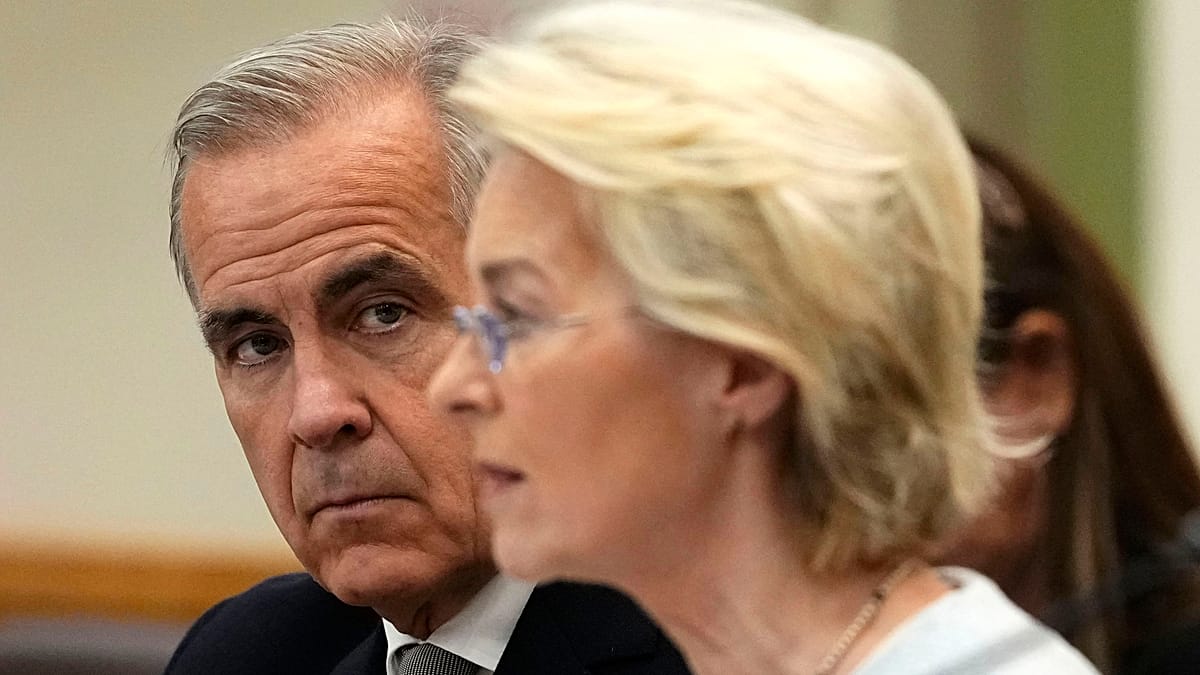
Addressing Canadian Prime Minister Mark Carney in Strasbourg, von der Leyen said she wanted to bring the relationship “to the highest level possible” in this “openly hostile world”.
Canada has been getting closer to the EU as relations with Washington cooled under Trump. Trade talks collapsed in August 2026, and Trump responded with aggressive 25% to 50% tariffs on Canadian goods. He also threatened their sovereignty, with comments about absorbing Canada and making it “the 51st US state”.
For geographical reasons, Canada cannot turn to full EU membership, so the European Commission is proposing a new “associate member” status. Since it doesn’t exist in the EU treaties, its legal and institutional shape remains unclear.
“What exactly will it be? That will gradually be defined from a legal point of view,” MEP Javier Moreno Sánchez, chair of the Parliament’s Delegation for relations with Canada, told Euronews.
Unlike a simple free-trade partner, Canada would integrate directly into Europe’s defence industrial base, participate in joint Arctic projects, cooperate on AI, cyber resilience, and quantum computing, and potentially align on financial services.
It wouldn’t acquire voting rights in the European Parliament or have a say in core EU laws.
A pre-existing partnership
Relations between Canada and the EU were already friendly, stable, and transactional.
In 2016, they signed two key treaties: the Comprehensive Economic and Trade Agreement (CETA) and the Strategic Partnership Agreement (SPA). The first removed 98% of tariffs, boosting bilateral goods and services trade by over 80% to €130 billion. The second focused on foreign policy dialogue and allowed the EU and Canada to hold routine talks on climate change, research, and human rights.
Carney’s victory in 2025 upgraded the relationship with the launch of the “New EU-Canada Strategic Partnership of the Future”. The EU began treating Canada less like a distant trading partner, with both sides aligning on critical mineral supply chains, electric vehicle batteries, clean energy, and Arctic projects. Canada is also an active participant in Horizon Europe, the EU’s flagship scientific research program.
In February 2026, Canada became the first non-European country to join the €150 billion SAFE Instrument, allowing Canadian defence firms to bid on joint European military procurement contracts. Canada also became a third-party contributor to PESCO (Permanent Structured Cooperation) military mobility and logistics projects.
Canada’s number one exporter remains the US, which accounted for 72.5% of its merchandise exports in 2025, compared with 12.4% for Europe and Central Asia.
CETA remains stalled, as 10 of 27 EU member states still refuse to fully ratify it. Countries including Italy, France, and Poland argue that Canada has lower environmental and production standards in areas like farming (or like using chemical pesticides and GMOs that are restricted or banned in the EU.)
The proposal
None of the parties is considering Canada joining the EU. The aim is to deepen the economic and strategic partnership beyond the current level of cooperation.
“We know it’s a deeper partnership, but less than full membership. Where exactly it’s going to be on that spectrum will have to be negotiated. The expectation is that it’s more than a free trade agreement”, said Fabian Zeleeg, Chief Executive and Chief Economist at the European Policy Centre.
The idea is to build on CETA and develop it into an “Alliance for the Future to create a common prosperity and economic security space”, as President von der Leyen said. While the details remain unknown, the partnership is expected to cover policies spanning manufacturing, energy, minerals, AI, quantum computing, and cybersecurity. An Arctic “joint flagship project”, a tech alliance and an integrated defence industrial base are included too.
PM Mark Carney suggested moving “toward seamless, digital trade in non-agricultural goods and a wide range of services”, while also considering a more integrated financial services market.
For Zeleeg, the partnership will primarily focus on geopolitical cohesion and is therefore a “win-win situation”. “It’s about like-minded countries coming together, finding common solutions to the big challenges which we are all collectively facing, including a rather difficult situation with the US”, he told Euronews.
Trading resources
This alliance is partly a survival mechanism for Canada. The triggers were the collapse of bilateral trade negotiations with the US, on which roughly 70% of Canada’s export economy relies, and Trump’s threats of absorption.
Moreno Sánchez said Canadian officials had described the breakdown in unusually personal terms. “They explained that geography cannot be changed. They felt betrayed because it was their neighbour, the brother at their doorstep, and then one day it says to them: ‘I don’t want you anymore.’ It affected them very badly.”
But the partnership is equally driven by the EU’s need for economic security and raw materials.
The bloc lost access to cheap Russian energy and faces rising tensions with China, so it needs a stable source of critical materials.
“Canada has everything,” Moreno Sánchez said. “It is the second-largest country in the world. Energy, gas, critical raw materials. Obviously, it is in our interest to trade with them.”
Canada holds major reserves of lithium, nickel, cobalt and rare earths, all central to the EU’s energy transition and battery supply chains.
“Until now, with Russian gas and with China, things worked differently,” Moreno Sánchez said. “But now that international relations have become tenser, and we don’t know how this world order will result. It seems like it could become the law of the strongest, that makes you wake up and say: ‘We need to look at this differently.’”
He pointed to Germany as a warning. “Look at what happened in Germany. They relied on Russian gas. When it was cut off, they shut down their nuclear power plants and had no alternative. Now they are burning coal to generate electricity, which is exactly what we should not be doing.”
How it could benefit Europeans
Depending on how partners define “associate membership”, it will have concrete effects on Europeans. The most significant impact would be in the energy sector, according to Dr Giuseppe Spatafora, policy analyst at the European Union Institute for Security Studies.
“I assume that Canadian energy exports to the EU would alleviate the pressure on the EU’s energy market, increasing supply and reducing dependency on other suppliers”. However, this will take time, as Canada lacks the infrastructure to export large quantities of its energy outside of North America and the appetite to build new pipelines or export terminals, he added.
Removing investment barriers would open the door to new companies, Spatafora explained, while stronger defence cooperation could create new jobs and help protect both European and Canadian societies.
Canada is rich in lithium, graphite, nickel, cobalt, and copper, key components for many sectors, from batteries and electric vehicles to electronics and medicine. Having Canada as a “safe supplier” would help EU companies keep operating while reducing the leverage of countries like the US and China.
“Canada would certainly be a much safer supplier than China. Whether this translates into a revival of the car industry, I’m not sure, given China’s control of the entire supply chain. But it can certainly help the EU’s efforts to develop strategic industries such as defence and advanced manufacturing”, Spatafora said.
PM Mark Carney proposed strengthening “people-to-people ties” by having Canada participate in the EU’s Erasmus+ and Horizon Europe. This could mean simpler visa rules for European students to study across the Atlantic, as well as joint research and innovation projects.
What’s next?
The EU would need to establish the legal framework for “associate membership” from scratch, defining both parties’ rights and obligations. Major challenges could include aligning partners’ regulations and securing unanimous approval from all 27 member states.
Zuleeg hopes the upcoming EU-Canada summit in Montreal on 29-30 October will clarify the term and turn the EU’s offer into a concrete proposal. “Negotiations are ongoing. From my perspective, it would be a missed opportunity if, by the October meeting, we don’t have concrete progress on the table”, he told Euronews.
Successful headway could raise the question of whether Canada is a one-off case or whether the EU could establish this as a new type of partnership for other countries.
The partnership with Canada could be the “seed” of a “much broader alliance between like-minded countries working together” that can have a multiplying effect, Zuleeg explained. “If we show a united front between the EU, Canada, the UK, Norway, Iceland, but also countries like Australia, New Zealand, Japan, and South Korea, then we really have a critical mass, which will be difficult to ignore even for the US and China”, he added.
Stronger cooperation with close non-European partners would not harm candidate countries’ path to full membership or replace it with associate status. Moreno Sánchez explained that “enlargement has its own path, and relations with reliable partners have their own path” and that these are “happening in parallel”.