
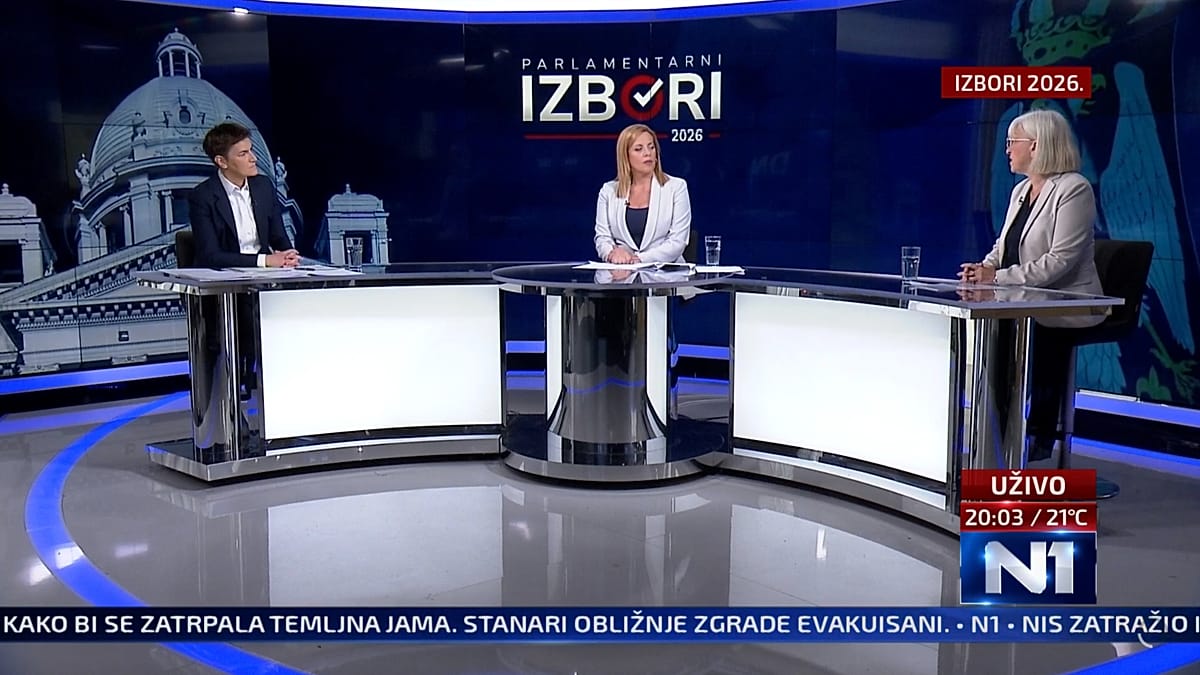
For the first time in nearly a decade, a Serbian media hosted a televised election debate with opposing politicians which drew significant public attention ahead of the 25 October parliamentary vote, in Serbia’s highly polarised media and tense society landscape. Equally for the first time, a top official from the ruling Serbian Progressive Party appeared on N1 television in a live election debate.
Ana Brnabic, Speaker of the outgoing parliament and a former prime minister, as well as top figure in Serbian President Aleksandar Vucic’s political camp, faced the top candidate of the opposition Student List – Students win political platform and Dean of the Arts University in Belgrade, Mirjana Nikolic.
The two contenders agreed to appear together live, but not without hesitations, and engaged in a fiery one-on-one debate, confronting their views on education, the chosen theme of the debate, before descending into the wider Serbian society turmoil and political conflict.
The N1 televised debate was the most watched programme during its time slot, with a rating of over 48 points, and the most followed television show of the past month.
The N1 host invited them to present their programmes, but the contenders went into trading accusations of violence, mismanagement and intolerance which matched the heated national political discourse as the country is gearing up for early elections called after months of demonstrations and protests which led to violent incidents.
Triggered by the collapse of a concrete canopy at the Novi Sad railway station in November 2024 which killed 16 people, the protests were started by students who blocked state universities for a prolonged period of time before spreading across the country. The protesters blamed the tragedy on corruption and mismanagement. Eventually, the ad-hoc student movement registered their political list for the elections and are now seen by part of the public and by most pollsters as the main challengers to president Vucic’s rule.
The political tension was obvious even before the TV debate started, with Brnabic declaring that Nikolic would not even shake her hand when they met in the studio.
“You are constantly offending me, starting from your refusal to shake my hand. I consider that to be a basic human gesture. Generals are at war with each other and still shake hands,” Brnabic said.
She asked her contender if “is that your decent Serbia?,” to which Nikolic fired back saying “decent Serbia is yet to come.”
The intense buzz around the debate
The debate sparked surprise and stirred significant interest in Serbia as government officials have largely avoided the N1 channel throughout multiple election cycles, claiming negative bias, a qualification N1 rejected.
At the same time, not many expected such a programme to happen at all as real debates by political opponents are rare in Serbia, with the media openly supporting one political camp or the other and thus rarely inviting politicians or activists across the partisan lines. In turn, politicians rarely agree to take part in programmes at channels they deem to be hostile and combative.
Therefore, the debate surprised Serbia and, moreover, that it was hosted by N1 television whose editorial policy has so far been seen as consistently and openly anti-Vucic. Viewers have not seen government or ruling party officials on N1 since at least 2017.
Ana Brnabic, who is in third position on Vucic’s United Serbia electoral list, said she has not been on N1 since 2017, stating that “in previous election campaigns N1 would not even allow us to have paid promo clips (in their programme), that is how objective you were.”
“I wasn’t thrilled about coming now either, remembering how your television tried to dehumanise my friend and my president. You criminalised him. I could hear in your programme that he was the product of a viper’s nest,” Brnabic said.
She then explained why she eventually accepted the N1 debate invitation, saying “I came because Aleksandar Vucic insisted. You changed your owner and the man said let’s give them a chance, let the people see how unbiased you are.”
Brnabic referred to N1 television recently changing its ownership. Alpac Capital, a Portuguese private equity and venture capital investment firm, which also owns Euronews, acquired the ownership of the channel as part of a wider regional media acquisition. Alpac promised the media’s business transformation and no direct influence on the editorial decisions other than the request for a professional, unbiased, objective and fair reporting.
Viewers and politicians alike therefore watched the debate as a test and as one of many to come in the month leading to the elections as the channel said it would organise further thematic debates in the run-up to voting day.
The representative of the opposition in the debate, Mirjana Nikolic, said she was also skeptical about the odds that the debate could happen when “the invitation came through regular channels, straight from the media.”
Nikolic said she wondered whether the debate was indeed an opportunity and “whether it was the right moment to take part in this debate,” explaining that she did not know “whether their (the channel) concept would allow for the other side to come.”
“I was fearful because recently it became unpleasant to talk to someone who comes from the position of power,” Nikolic went further, adding that “Ms. Brnabic has the advantage of having all the information at her disposal. Also, our recent meeting at the parliamentary committee for education was full of shouting, stomping and humiliating opponents, so there’s a danger in that.”
Heated exchanges between the two contenders
After a botched handshake attempt at the start of the debate, the contenders engaged in a series of heated exchanges, multiple accusations and both sides claiming they were offended. They sifted through the incidents of recent months, including the beaten students and the disruptions across Serbia.
Brnabic criticised the students protests, the university blockades and the Students List political platform, while Nikolic argued that voters deserved to hear and the proposals of the other electoral lists for education and the country’s youth.
Ana Brnabic hailed the government’s achievements on education, saying that the education budget has been increased more than threefold since 2012, from 140 billion dinars (over 1 billion Euros) to 425 billion (3.6 billion Euros). She added that the percentage of children going to pre-school increased from 48 to 64% and that four science and technology parks were built alongside investments in digitalisation.
“Teacher’s salary went up from 391 euro in 2012 to 1,030 euro by December 2026. That is 2.6 times higher. University professors earned 77,000 dinars (655 Euros) in 2012 and by the end of this year they will earn 191,000 dinars (1,600 Euros). That is 2.5 times increase. This is what we did for their dignity and their living standard, to thank them for all they did,” said Brnabic.
Nikolic countered that figures are not for television and that they can be misleading as it is uncertain that the teachers, despite the increases, can buy what they could in 2012.
“We want dignity, professionalism and safety. In the complex of ideas we stand for, free education in the absolute frontrunner. We stand for free education, not as a populist phrase “free school books”, but for truly free education in all its aspects,” said Nikolic.
She ended by telling Brnabic that she “failed the exam”.
The debate ignited Serbian social media, with many commenting its novelty, the nature of the debate and its takeaways as well as the performances and the punches by the two contenders, with both camps declaring victory. Some doubted it as an intermittent democratic exercise or its concrete conclusions, while others said that the N1 debate could now signal an improvement in Serbia’s polarised media landscape and its culture of dialogue.
Disclaimer: Euronews is owned by Alpac Capital, the same investment firm mentioned in this article as the new owner of N1 television.