
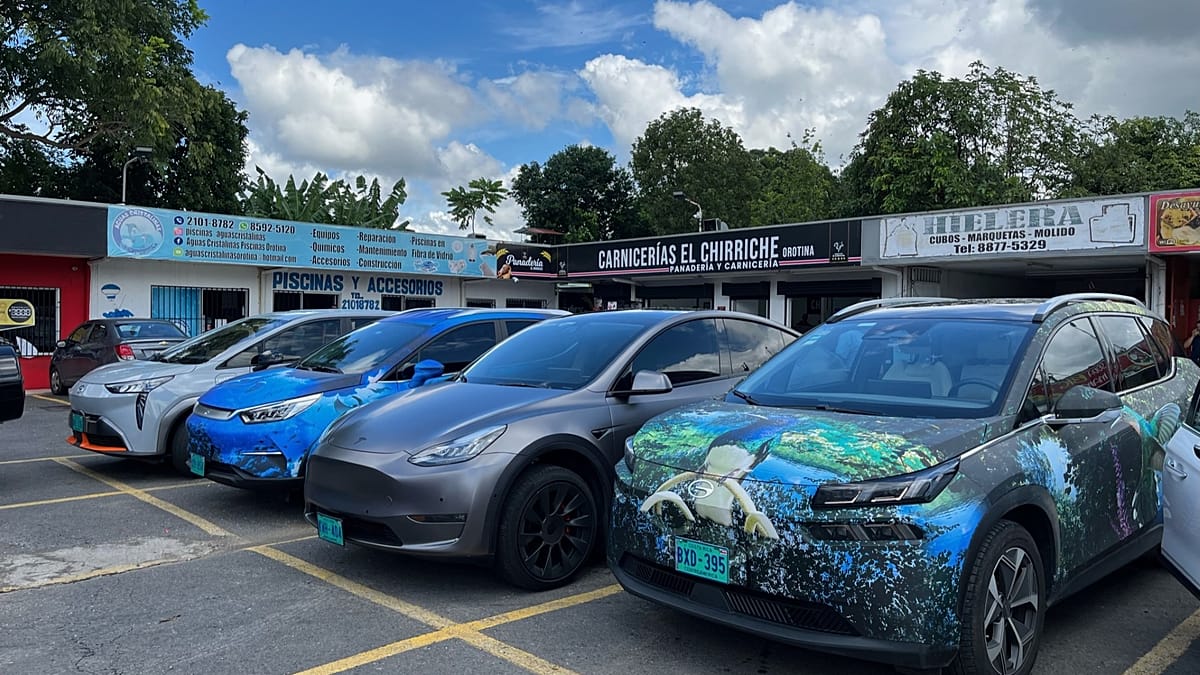
Chinese car brands are taking an increasingly large market share in Norway, even as their electric vehicles are being met with growing scepticism in the country, which leads the world in EV adoption.
According to a new survey by the Norwegian Electric Vehicle Association, conducted from 31 March to 3 May among nearly 15,000 EV owners in Norway, nearly one-third (31%) of Norwegian electric car drivers said they would avoid buying a Chinese brand for political reasons, compared with 23% a year earlier.
“New cars are, in practice, computers on wheels,” the association’s secretary general, Christina Bu, said in a statement.
“As data security and privacy receive more attention, it is only natural that more consumers become concerned about where the cars come from and how the data is handled,” she added.
A few years ago, Norwegian security researchers discovered that a car made by the Chinese maker NIO was transmitting data to China.
Other tests carried out on a bus from China’s Yutong revealed that the manufacturer had access to the vehicle’s control system and could, in theory, stop it or render it unusable remotely.
Sales of Chinese brands such as BYD, NIO and Dongfeng, and brands owned by Chinese companies like Volvo and Polestar, have nonetheless grown significantly in Norway, accounting for about 25% of new EV registrations in the first half of the year.
Back in 2019, they were virtually non-existent.
“This suggests that consumers weigh several factors against one another when they are buying a car,” Bu said.
“For some, factors such as price and technology are decisive, while others are influenced by moral dilemmas and uncertainty about data sharing and security issues,” she said.
Chinese-owned brands gain ground in Norway
In just a few years, Chinese-owned brands have gone from a negligible share of Norway’s new EV market to becoming its second-largest group by origin, according to an earlier report by the association.
The report suggested they could overtake European brands as soon as 2027 if current trends continue. It also said Norway could become one of the first European markets where Chinese EV makers gain a dominant position.
Gaining ground in Norway matters because the country leads the world in EV adoption. Electric cars accounted for 97.8% of new car registrations in the first eight months of 2026, according to the Norwegian Road Federation (OFV).
Norway remains far ahead of the EU, where electric cars accounted for 21.7% of new registrations between January and August, according to the European Automobile Manufacturers’ Association (ACEA).
Chinese brands are gaining ground in the wider EU, too. Registrations across five groups with Chinese brands listed by ACEA rose by about 71% in August from a year earlier. Their combined share of the overall new car market climbed from 6.6% to 10.8%. This means that roughly one in nine new cars registered in the EU came from these groups. The figure includes brands with European roots, such as Volvo Cars, which is owned by the Geely Group.
In the EU, among the fastest-growing manufacturers were Leapmotor (up 211%), Chery (201%), BYD (129%) and Geely Group (24%). Registrations of cars made by US carmaker Tesla grew by 53%.
Tesla resistance falls
Political resistance to Tesla has fallen in Norway, too. According to the survey by the Norwegian Electric Vehicle Association, the share of respondents who said they would avoid Tesla for political reasons dropped to 24% from 43% last year. Musk’s political involvement and support for far-right leaders have drawn opposition to the brand.
“Last year, Elon Musk’s political involvement was highly visible and, unsurprisingly, provoked strong reactions,” Bu said.
“This year, there has been less attention on this, and that may have led to fewer people saying they would not have chosen Tesla,” she added.
Tesla remains Norway’s best-selling new car brand, with a 17.5% share of registrations so far this year, according to OFV data through 24 September.