
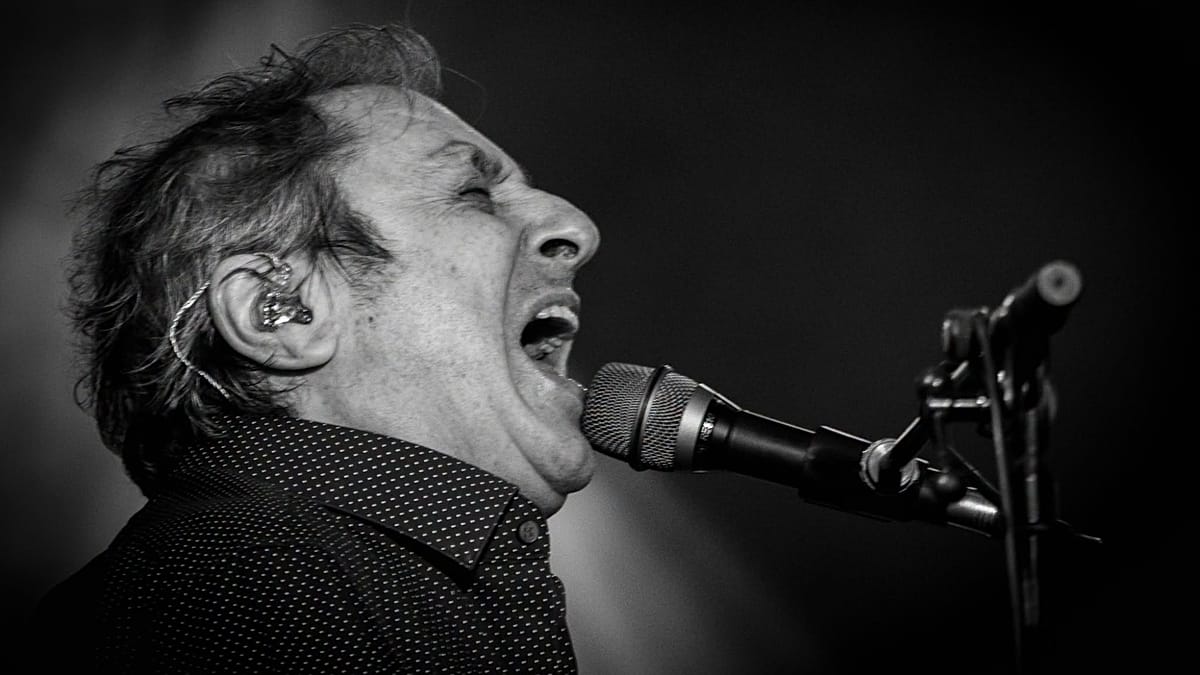
Jorge Palma, one of the most influential singers, songwriters and composers in contemporary Portuguese music, died on Monday at the age of 76 in physical years, even if metaphorically he had lived more than a hundred thousand, as he sang on Encosta-te a mim, a track from the 2007 album Voo Nocturno. The music video, in which Palma appears surrounded by lifelong friends and recent companions, will live on. Palma may have left us, but his songs will forever be part of Portuguese culture and soul.
On Estróina, a track on his most recent album, Vida (2023), he sings: “Whoever my undertaker may be, make sure I am properly dressed.” There could be no finer attire than the many farewell words already dedicated to him, alongside the many he himself wrote.
And, as he went on singing, “and since life is meant to be lived live and in full colour, let us raise a glass to pleasure, with no false modesty.” That is exactly what we will do. Euronews spoke to several people close to the singer, to Portuguese culture and to his work, all unconditional admirers of his legacy, to understand what remains after his passing and which songs they will never forget.
Herman José – Actor and comedian
For Herman José, who crossed paths with Jorge Palma many times and in many different settings, his death “leaves a silence that will be hard to fill”.
One of his most cherished memories with the singer goes back to 1974. “I was one of his musicians, alongside the great Pedro Osório. It is one of those memories that time does not erase and that today returns with particular strength. We were all much younger, in a Portugal that itself was embarking on a new life, and even then Jorge’s extraordinary musical personality was already there – restless, free, unpredictable, fascinating,” he recalls.
The comedian says Jorge Palma was an “utterly unique musician”, one of those who “never needed to resemble anyone else to be recognised from the very first chord, the first word, the first inflection of that voice”.
From all the work Jorge Palma leaves behind, Herman José chooses Deixa-me Rir (from O Lado Errado da Noite, 1985), “perhaps because in it I find so much of Jorge: the intelligence, the irony, the mistrust of certainties, a certain melancholy hidden behind the smile. And that rare ability to say serious things without ever losing his irreverence,” he concludes.
António Zambujo – Singer and songwriter
For the singer from Beja, choosing just one Jorge Palma song is “unfair” because “his body of work is immensely rich”. Even so, he accepted Euronews’ challenge and picked the song O Meu amor Existe, from the voice-and-piano album Só, released in 1991.
“I consider this record the best in the history of Portuguese music, and whatever I might say about Jorge Palma would never be enough, given the dimension I believe he has,” he said.
Gabriel Gomes – Musician and composer
“I have lost a friend, a hero,” Gabriel Gomes, accordionist and former member of Madredeus and Sétima Legião, tells us to begin with. He quickly adds: “But I gained so much from his presence in my life.”
Earlier this year he shared the stage with Jorge Palma and, at the Artes à Vila festival in the Batalha Monastery, presented his first solo project.
“The emptiness hurts, but his memory and his work will eventually fill it. It was quick, as he deserved,” he sums up.
Gabriel Gomes chose the song Passos em Volta, from the album Bairro do Amor, which they played together on stage so many times and in which, just as in the lyrics, Jorge Palma “opened the window and flew away”.
Tiago Cação – artistic agent
With a long career in the music, live entertainment and artist management industries, he confided that he had never wanted to meet Jorge Palma.
“I never wanted to meet Jorge. I never wanted to get close to him. I always wanted to keep Jorge in an intangible place, alongside the great poets and great musicians I have always admired. On Friday, my father (much younger than Jorge), whom I thought knew nothing about music, said: ‘I would not like to die without seeing a Jorge Palma concert. Because with artists like Jorge, we always think they do not die. And they do not’,” he shared.
For Tiago, the song he will never forget is Sonhadores inatos. “I identify with the simple idea of never stopping dreaming, despite the inevitabilities that come with being alive.”
Fernando Vendrell – Film director
The filmmaker admits that today he can only think of Frágil (Bairro do Amor, 1989). “Tonight I feel so fragile,” he paraphrases.
Director of films such as “Aparição” and “Sombras Brancas”, Fernando Vendrell remembers Jorge Palma as “an extraordinary writer of songs”.
“In my view, they are among the most perfect songs ever written in Portugal. His gaze and his writing were agile, his melodies graceful and unique. They brought with them a world we belonged to or wanted to be part of,” he says.
Ana Margarida de Carvalho – Journalist and writer
When she heard the news of the singer’s death, the song that came to her mind was Na Terra dos Sonhos, for its melody and because it was written by a “sceptical optimist”.
Ana Margarida de Carvalho says she knows all the albums, songs, acoustic versions and live recordings, where his “virtuosity on piano, acoustic guitar or electric guitar” always stood out: “He had enormous versatility, a powerful voice that stood the test of time,” she recalls, referring to the many concerts she attended. Jorge Palma’s voice also became part of her everyday life. “He is always on my car playlist…” she says.
Among the many songs by Jorge Palma, the journalist also highlights Portugal, Portugal, which she considers “an anthem”, and Estrela do Mar, whose chords “sound like waves, or the string quartet, in which he pays tribute to Durrell’s Alexandria Quartet”.
However, she told Euronews she was choosing Eu Fui um Lobo Malvado (Acto Contínuo, 1982). “With lyrics that are naïve, perhaps, but which in my view make it a song that turns back on itself and becomes the most beautiful declaration of welcome, a song about friendship and reconciliation, ultimately – and I know it by heart, and so do my children.”
“I have not yet wielded a weapon that did not ricochet / and the scar always outlives even the neatest bandage / but whenever you want you are welcome in my castle / which perhaps because it is old and wrinkled / does not need painting,” she quotes.
Luiz Carvalho – Photographer
The author of the cover photo for this article (kindly made available for publication) recalls his first encounter with the singer: “I have known you since that afternoon in 1980 in Paris when I photographed you singing in the Saint-Michel metro station. Afterwards we went for a drink, I think Graça Lamy was there too. The damned negative exists but I just cannot find it. I love your work and, above all, your attitude to life: free, non-conformist, polite, a musician with classical roots, at times too wild for the body to be able to keep up. I would have loved to make a documentary about you, something alive, handheld camera, direct sound… You will always be in my heart and in my ears, for as long as I still have road ahead of me.”
The song he has chosen is O Lado Errado da Noite, “a striking melody, very much in tune with part of his own journey”.
Finally… the choices of the authors of this piece
Ana Filipa Palma: A Gente Vai Continuar is not only one of his greatest songs, it is also one of the most listened to today and, above all, a promise that his voice will remain “for as long as there are winds and sea”.
The tribute to Palma at the latest edition of the Play awards ended with the whole audience singing A Gente Vai Continuar.
Ricardo Figueira: I choose Bairro do Amor because it is comforting to believe there is a place drawn in coloured pencil by people who have suffered for not having anyone, a country with no prisons and no hospitals, where the sun seems bigger and there are waves of tenderness in every look. Even if that place exists only in songs.